

The Final Push Before the Market Goes Quiet

Last week was anything but dull. Butter reminded everyone that this correction still has plenty of room to run, taking another €300/mt out of the market in just a few days. The pace of the decline is accelerating again. Cheese, after its mini-rally in recent weeks, looks to be topping off. Buyers have stepped back, sellers are still lining up, and we wouldn’t be surprised to see prices ease in the coming weeks. And powders? Demand feels bearish, sellers act bullish, and prices move sideways. If that sounds contradictory — welcome to the current reality.
The last two weeks of November are typically among the final active trading windows of the year. After that, the market usually goes into its classic seasonal slowdown as companies shift from cheese to cheers, from butter to beers, and from powders to parties. But before that slowdown kicks in, we still expect a short burst of activity — a final push before the December hibernation begins.
November is shaping up to be another negative month for the dairy industry. Co-ops are cutting milk prices aggressively, yet commodity valorisation still looks noticeably lower. We expect another heavy correction in December milk prices. The pressure is coming mainly from declining values in cream, butter, and WMP; cheese has found some short-term upward momentum, and powders remain stuck in their sideways range. While some people want to read optimism into recent commodity prints, we’re not joining the bull camp. Milk intake continues to outperform every forecast, commodity production is hitting record highs, and global demand isn’t exactly firing on all cylinders.
The broader economic outlook isn’t doing the dairy market any favours either. We’re seeing more people out of work, fewer open positions across companies, and rising delinquencies on credit-card and auto-loan payments. These aren’t obscure macro signals — they’re the kind of familiar warning lights we’ve all seen before. The sort that usually show up a few quarters before consumers tighten their belts and discretionary demand softens. In other words: nothing to panic about today, but definitely not the backdrop you want when supply is running this hot.. And on that supply side, we are seeing record after record. A few numbers from last week underline the point:
- Netherlands: Strongest October ever, +7.7% vs last year
- Germany: Weekly YoY milk +6.9%, butter production +27%, SMP production +43%
- Denmark: September milk solids +7.5%
- France & UK: Weekly milk +6% and +7.5% YoY respectively
On the demand side, the EU seems to have finally picked up some export interest in butter and cheese. The official data will lag, but anecdotally, there are genuine volumes moving offshore. The problem, however, is simple: it’s nowhere near enough to offset the additional supply coming through.
And while we may be clawing back a bit of export market share, it’s coming at a cost. Lower EU prices are now putting pressure on NZ and US products, and we fully expect both to undercut EU values aggressively in the months ahead. The recent bump in EU cheese exports has supported prices here, but US cheese values, for example, have gone into a nosedive. How New Zealand responds should become clearer in this week’s GDT.
A Bearish GDT?
This week’s GDT is shaping up to be anything but bullish. On butter, we expect the sharpest correction. SGX futures are pointing to an 8–10% drop — and while SGX hasn’t always been the most reliable predictor, NZ butter still looks significantly overpriced relative to global values. Solarec’s butter will not be immune either; we expect a similar 8–10% adjustment. The last tender cleared above €5,000/mt, but for Tuesday we see €4,500–€4,600 as the ceiling. Anything above that would be a win for the market.
Cheese should deliver a steadier outcome. Cheddar continues to surprise every tender, but mozzarella looks more predictable and should land somewhere between €2,950 and €3,050 — a solid improvement versus the last event and roughly a +3–4% print.
In powders, WMP is the weak link again. Depending on how the butter result influences sentiment, we’re looking for another 3–4% decline. SMP remains the only relatively balanced product on the board. Our expectation: anywhere between –1% and +1%, essentially unchanged.
Spot Liquids
This coming week may be the last stretch of stable spot prices for liquids. Once demand for fresh products drops off — as it does every year — we expect the usual seasonal slide to kick in. Cream has already eased to €5,600–€5,700, and we’d expect those levels to hold for now, even though the overall fat market is surprisingly bearish for this point in the season. Raw milk and SMC should trade broadly in line with last week, at least for this week and possibly the next, before the market transitions into its December slowdown.
Butter: Trading Towards €4,000
It’s an unpopular view among producers, but based on the past week’s dynamics, €4,000 looks less like a bearish fantasy and more like an inevitable waypoint. Butter prices have slipped hard, and it’s only a matter of time before we see confirmed trades at — or possibly below — that level. Our lowest trade so far prints Q1 at €4,450, but we’re hearing current-year prices as low as €4,300 FCA Ireland, Spain, Italy, and Portugal. Demand for Q1 is drying up fast, while year-end supply keeps building.
As we’ve highlighted in previous updates, buyers need a reason to take 2025 stocks into their position. No one needs to buy close by, so the incentive has to come via a meaningful discount versus Q1 values. With NL/DE/BE butter trading around €4,500 and Polish Sweet Cream at €4,450, we expect those prices to drift dangerously close to €4,000. Add the fact that cream for week 52 and week 1 is already being discussed near €4,500, and fresh-butter production costs land somewhere around €3,900–€4,000 — not exactly supportive of higher spot values.
Further down the curve, prices are also softening. We brokered Q2 NL/DE/BE butter at €4,675, and Q3 offers are now showing around €4,900. Sellers are clearly becoming more reluctant to sell into Q2 and beyond, with many expecting the weakest point of next year to fall in Q1 2026. We tend to agree only if milk volumes decline sharply over the coming months. But as the US is demonstrating, weak commodity valorisation combined with lower milk prices does not automatically translate into lower milk intake. That adjustment may take 3–6 months longer than most traders expect.
If milk keeps coming, next year’s weakest stretch won’t be early — it’ll be when stocks peak, likely around June/July.
How low this market eventually trades is still unknown. Some saw a floor at €6,000. Then €5,000. Now €4,000. Psychological support may show up again around €4,000, but if financial pressure persists, we’d expect the market to test levels below that as well.
But for now, we begin this week with significantly higher markets than € 4000. We expect to start with
- NL/DE/BE offer for 6 loads November/December at € 4600, bid at € 4200
- Irish lactic offer for 6 loads fca Ireland for November/December at € 4425, bid at € 4250
- NL/DE/BE offer for 6 loads at Q1 at € 4500, bid at € 4400
- Irish lactic offer for 6 loads in Q1 at € 4500, bid at € 4300
- Polish SC offer for 6 loads in Q1 at € 4450, bid at € 4400
- NL/DE/BE offer for 6 loads in Q2 at € 4675, bid at € 4625
- N/DE/BE offer for 6 loads in Q3 at € 4900, bid at € 4800
Cheese: More Offers Now That Prices Are Up
The cheese market is still carrying a mildly bullish tone, but the crowd supporting it is getting thinner. Fewer buyers are willing to dance to the bullish music, while more sellers are stepping onto the floor looking for partners. It’s too early to call a shift back to outright bearishness, but the upside looks capped. Cheese hasn’t been immune to the weaker butter complex, and after butter’s recent correction, it feels increasingly likely that we’ve seen the top of the squeeze.
Export demand has helped take some pressure off the spot market in recent weeks. Higher export sales have reduced the immediate squeeze on domestic availability and offered producers an outlet they were missing earlier in the autumn. But the key question is whether this renewed buying interest can last. With US cheese prices now coming under heavier pressure, the Americans may become more aggressive again in export channels — competition we have not missed. Add to that a weaker USD, which makes EU cheese relatively more expensive abroad, and the sustainability of current export flows becomes far less certain.
As long as spot supply remains tight, we still don’t expect producers to aggressively sell Q1. Traders eyeing the spread between butter and cheese valorisation may look to lock in forward cover while the window remains open. We booked a Q1 Gouda sale at €3,080 last week, and more selling interest continues to pop up around similar levels — but the export backdrop will determine how long that appetite survives.
We expect to find an offer for
- 3 loads of Mozzarella for December at € 3025
- 9 loads of Mozzarella for Q1 at € 3000
- 4 loads of Gouda for December at € 3100
- 9 loads of Gouda for Q1 at € 3080
- 6 loads of Edam for Q1 at € 3050
Powders: GDT, USD or SMC to Set the Tone
In powders, we expect the first two days of the week to be quiet again. It normally takes until Tuesday afternoon or even Wednesday for the market to accept that a flat GDT doesn’t change much. For SMP, especially, the bigger drivers remain the USD trend and the price of SMC. Last week the USD weakened slightly while SMC nudged higher, and the result was a sideways market — uninspiring, but stable.
Talking to producers, most still expect a bit of demand to show up. They’ve already taken the biggest hit on older stock, and they’re not planning to discount unproduced powder just for the sake of activity. Traders are in a similar position: they’ve cleaned up what needed cleaning, and selling more at lower levels only makes sense if cheaper forward product becomes available. There’s little incentive to sell aggressively into a market that’s holding its ground reasonably well and sitting only a few percent above what many believe is the floor.
A weaker USD or a drop in SMC would give sellers the argument they need to move volume, and buyers know it. Buyers are patiently waiting on the sidelines, confident that time is on their side. The market almost feels pre-programmed: everyone knows what should happen, but nobody feels pressured to be the first one to make it happen. No rush in a market that’s signalling patience — today’s opportunities will probably still be there tomorrow. No need to take the risk of being wrong when simply being on time counts as being right.
Could this week’s GDT set the tone? Maybe. WMP is expected to soften, but we don’t anticipate big surprises in SMP — though surprises, by definition, only become surprises when nobody expects them. So let’s see what this week brings.
We expect to start the week with:
Offers
- 500mt, Q4, West EU High Protein SMP (unstandardised), min. 37% as is, 25kgs, fresh, €2150 DAP NL
- 300mt, Q1, FR/DE origin, SMP MH, 25kgs, fresh, incl standard docs + labels, €2100 fca FR/DE
- 300mt, Q2, FR/DE origin, SMP MH, 25kgs, fresh, incl standard docs + labels, €2180 fca FR/DE
- 300mt, Q1, German codex SMP MH, 25kgs, fresh, incl export docs, €2125 ex plant
- 300mt, Q1 West EU codex SMP MH, 25kgs, fresh, incl export docs, €2100 fca nl/be/de/fr
- 300mt, Q2, SMP MH, fresh, 25kgs, West EU, incl standard export docs, €2190 ex
- 300mt, H1, SMP MH, max 04 months at delivery, DE/BE origin (premium brands), 25kgs/bb in sellers option, €2150 DAP NL
- 200mt, Q4, DMK SMP MH, fresh, 25kgs with standard export docs, €2150 fca DE
- 200mt, Q4, Limelco SMP MH, fresh, 25kgs with standard export docs, €2125 fca BE
- 200mt, Jan ETD, West EU SMP MH, 25kgs, fresh, with standard docs, €2110 ex
- 150mt, Q4, Lakeland (N-IE) SMP MH, incl standard export docs, €2100 ex UK
- 100mt, Jan ETD, SMP LH, Euroserum, fresh, 25kgs incl standard export docs + labels, €2125 ex fr
- 100mt, Q4, West EU SMP LH (nl/be/de/fr), fresh, in BB, €2100 fca NL
Bids:
- 400mt Nov/Dec/Jan, SMP MH, Solarec, incl standard export docs + labels, 25kgs, fresh, €2120 ex plant
- 300mt, Q1, any German SMP MH (codex), fresh, 25kgs with standard docs + labels, €2075 ex plant
- 300mt, Q1, West EU SMP LH (codex, fresh, 25kgs, with standard docs + Labels, €2020 ex plant
- 300mt, Q4, West EU High protein SMP (unstandardised) min. 36% as is, 25kgs, €2070 DAP NL
- 300mt Q4, BMP, fresh, DMK/Muller/Arla/Euroserum, incl export docs + labels, 25kgs fresh, €2150 ex plant
- 150mt, H1, DMK/Frischli/Solarec/Rucker/Uelzena SMP MH, 25kgs, max 04 months old at ETA, €2125 DAP NL
- 100mt, Q4/Jan ETD, Algeria SMP MH, 25kgs, incl gmp halal/export docs/labels/pallets, €2125 ex nl/be
- 100mt, Q4/Jan, Solarec BMP, 25kgs, fresh, €2200 ex plant
- 50mt, Nov ETD, Limelco SMP MH, 25kgs, fresh, incl standard docs, €2070 ex BE
- 50mt, Q4/Jan ETD, Algeria SMP LH, 25kgs incl gmp halal/export docs/labels/pallets, €2125 ex nl/be
Final Note
The next two weeks will likely give us the last real pulse of activity before the market slips into its December slowdown. Butter is still searching for a floor, cheese is running out of room, and powders are drifting in whatever direction the USD and SMC pull them. Supply remains heavy, demand is selective at best, and most participants are focused more on timing than conviction.
In short: the market isn’t searching for direction — it’s waiting. Waiting for someone else to blink, for milk volumes to ease, for exports to stay alive, or for a macro signal to break the stalemate. Until then, we trade what’s in front of us, not the stories we’d prefer.
Let’s see what this week brings.
More from the desk
Our Long View Before Our Long Break 
Our Long View Before Our Long Break
Last week the market found a bit of stability. After lower trades on cheese, the cheese market traded slowly up, although a real rally remains absent. Butter prices did dip a bit further, although at the start of this week we see some strength on the back end of the curve. And on powder, our bullish feeling just doesn't go away — and now we can find some confirmation in the market as well.
Dairy Carry Has a Shelf Life 
Dairy Carry Has a Shelf Life
Last week was bearish across the board — every product we broker leaned the wrong way. Powders lost more momentum, cheese slipped well below €3,000 for some products, and butter continues to impress with just how much keeps showing up. Supply, supply, supply.
Summer Shopping or Summer Sale? 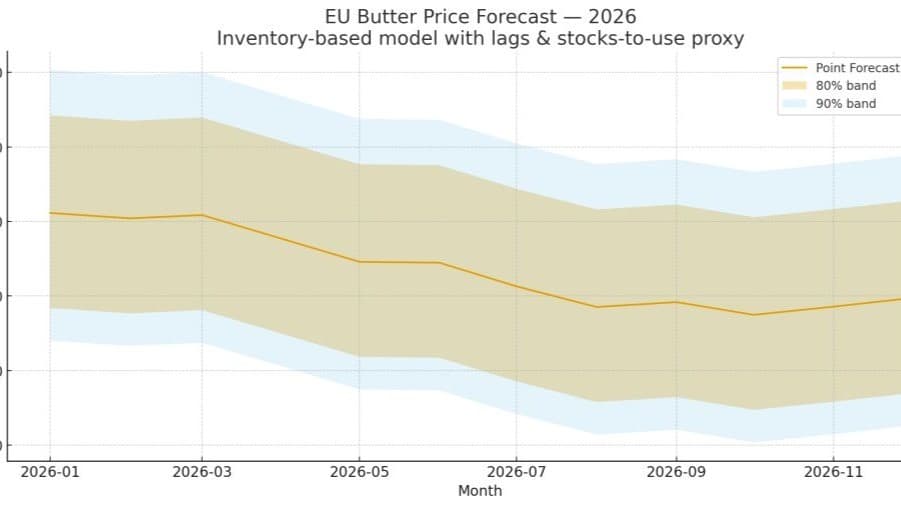
Summer Shopping or Summer Sale?
Last week was again a bit of a bearish week for the entire dairy industry. With cream prices under pressure and milk intake still strong, we keep seeing a market that has more supply than demand. Butter prices took another step lower, cheese prices cracked, and the powder market gave back a bit of its gains again.
The weekly report
Get it before it is anywhere else
Every market report, straight to your inbox the moment it is written. Butter, cheese, powder, liquids — pick what you actually trade.
Roughly weekly · Free · Unsubscribe any time