Dairy Carry Has a Shelf Life

Last week was bearish across the board — every product we broker leaned the wrong way. Powders lost more momentum, cheese slipped well below €3,000 for some products, and butter continues to impress with just how much keeps showing up. Supply, supply, supply. The picture underneath is simple enough: the market is overwhelmingly oversupplied on most products, with year-on-year production up a lot pretty much everywhere. And when there's more of something than anyone needs today, the market does what it always does — it pays people to hold. Right now dairy is paying its traders and producers a nice carry to hold stock and push it forward.
So far, so textbook contango market pricing. Financing isn't the problem at these rates. Storage might cost you a little, although finding capacity is harder than the storage cost themselves. But the real danger in dairy isn't on the invoice that comes with the carry trade — it's the product itself. Because while you sit there collecting your carry, your stock is quietly getting older. Fresh becomes frozen, frozen becomes old frozen, and somewhere down the line it stops being the thing you agreed to deliver.
This week we look at how a normal contango market is supposed to behave, why it pays you to hold — and why dairy plays by slightly different rules and what the forward premium is telling us about the current age of the product. In most markets, time is just a cost you finance. In ours, time is also eating your product.
How the textbook values a carry
Start with the clean version, the one that doesn't perish. Gold, crude oil — the stuff every commodity course uses as its example, precisely because a barrel today is identical to a barrel in six months. Nothing ages, nothing spoils, nothing falls out of spec while it waits.
In a market like that, the forward curve answers one question: what does it cost to carry this thing through time? Three things, really — financing (the money tied up in the stock), storage (the tank, the warehouse, the vault), and insurance. Add them up and you get the cost of carry. When the forward price sits above the spot price by roughly that amount, the market is in contango, and it's doing something quite reasonable: it's offering to pay whoever's willing to own the stock today and deliver it later. Buy spot, sell the forward, pocket the difference, cover your costs in between. If the curve pays more than it costs you to carry, that's free money, and traders pile in until it isn't anymore. That's contango working as designed — a market with plenty around, paying people to hold the surplus until it's needed.
And the other way round
Now flip it. Sometimes the forward price sits below spot — the curve slopes down, not up. That's backwardation, and it's the market sending the opposite signal: don't hold this, I want it now. When something's tight — short supply, hungry demand, an empty warehouse somewhere — buyers will pay a premium to get their hands on the physical product today rather than wait. In a backwardated market, carrying stock isn't rewarded, it's penalized. Every month you sit on it, the curve says you've lost a little. The market isn't paying you to store the surplus, because there is no surplus — it's paying you to give it up.
So: contango says plenty, please hold. Backwardation says scarce, please sell. One pays patience, the other punishes it.
Which brings us to butter
Rewind to Q4 2024. That was textbook backwardation, and a textbook example of it. Spot butter traded above €8,000, while the forward curve sat around €7,000 — a thousand euros lower out front. The market couldn't have been clearer: I don't want your December stock, I want your butter now, and I'll pay €8,000 today rather than €7,000 to wait. Carrying inventory in that market was the wrong trade twice over — the curve already penalized you for holding, every forward month priced below the day in front of you. Whoever anticipated the rally and sold during that heavaly backwardated market did well. Traders could sell their stock, and buy it back cheaper on the curve. Whoever sat on stock hoping €8,000 had more room got punished by the curve and the calendar at the same time.
Then watch what happened across 2025. As the year wore on, that backwardation slowly bled away. Prices came down — toward €4,000 by year-end — and somewhere along the way the curve quietly flipped. The downward slope flattened, then turned up. By the end of the year the forward was paying roughly a €500 premium over spot. Same product, same freezers, opposite signal. The market had gone from give me your butter now to please, hold it for me — and it was putting €500 on the table to whoever would.
And that's the regime we're trading in today. The market is back to paying a carry, but now it's offering more thant that €700 to sit on stock and deliver it forward. Looks like free money — finance is cheap, storage is manageable, and the curve is handing you a premium just for waiting.
Except this is butter. And in butter, "just for waiting" is exactly where the trouble starts. Slowly the curve is charging you for more than just finance, storage and insurance. Because the one thing the curve is did not price is the thing quietly happening to your stock the whole time you hold it. Age!
So where does that leave us today?
Spot butter for June and July is trading around €3,500. The cost of carrying it — finance, storage, insurance, the works — runs roughly €40 per MT per month. Give or take, that's the real bill for sitting on a MT of butter and pushing it forward.
Now look at what the curve is actually paying. The premiums further out aren't €40 a month — they're almost €250 per quarter, sometimes more. Do the arithmetic and the gap jumps out: real carry costs you something like €120 a quarter, the curve hands you between € 200 and €250. The market is paying roughly double what it costs to hold the stock.
In a non-perishable world that's an arbitrage, and it shouldn't last — traders would pile in, buy spot, sell forward, and squeeze that premium back down to the cost of carry. But it isn't closing (it feels it is widening even), and the reason is the whole point of this article. That extra premium isn't mispricing. It's the market quietly paying for something the textbook carry doesn't include: the need to refresh stock along the ride. Three-month-old butter simply has more outlets than thirteen-month-old butter. The premium beyond the cost of carry is the price of staying young.
Why it hasn't bitten — yet
Until now, age hasn't really been the problem. Remember where we came from: December 2024 gave us the lowest butter stocks on record, thats only 18 months ago, and the building only really started around this time last year. So the stock that exists simply hasn't aged enough to cause trouble. The clock has been running, but not for long enough for anyone to feel it.
That's the trap, though — it looks fine in the rear-view mirror precisely because it's a forward problem. Look at the forecast for butter stocks rather than today's snapshot, and you can see it coming. The stock that's comfortable at three and four months today is the stock that's nine and twelve months old in Q4. The aging hasn't stopped; we just haven't reached the part of the curve where it hurts.
And you can already see the first signs
It's already showing up in the bids and offers. Traders are starting to pay premiums for fresh butter, while the offers landing on the table are for product nine to twelve months old. That tells you exactly where the squeeze is forming — everybody wants young, the market is long on old.
Today, traders face an awkward decision about their own stock. A lot of them are collecting fresh goods from producers right now. The cheapest way to fulfil a contract is obvious: take that fresh truck straight from the producer to the customer, done, no detour. But that doesn't solve the age profile sitting in the freezer. So what we're now seeing instead is traders routing fresh goods into the very warehouse where they're defrosting older butter to ship out — refreshing the stack, managing the average age of the book, rather than just delivering the short way round. It works, but every one of those extra movements costs money, and that cost has to be charged somewhere down the supply chain. We hear end users are delaying contracts and are willing to pay the cost of carry. But for traders, the question becomes if that's enough to cover their real cost. In that same delay, buyers should be willing to pay for the entire cost.
Which is why the curve has to keep paying more
Follow that logic forward, and the shape of the curve makes sense. The more problematic age becomes, the bigger the premium further out has to be — not because storage got more expensive, but because keeping that stock deliverable got more expensive. The premium isn't paying for the freezer. It's paying for the trucks, the defrosting, the reshuffling, the whole effort of keeping an aging book young enough to sell.
And here's the line worth leaving people with. Plenty of traders are looking at their freezer and assuming the age problem is theirs alone — a quirk of their own book. It isn't. If the forecast is right, half the market is holding the same ageing stock at the same time. The trader who treats it as a private problem may well find themselves doing both halves of the squeeze at once come Q4: fighting everyone else for fresh goods, while struggling to move the old stock nobody wants — paying up on one side and discounting on the other. The carry looked free. The bill just arrives later, and in a currency the curve never quoted: age.
Market snapshot
A quick run through the board of our market books.
Butter
Cheese
Powder
A final note
So that's the week. Bearish across the board, stocks building, and a curve that's paying you to hold — which, on the face of it, sounds like the easy part of the cycle. Finance is cheap, storage is manageable, and the market is handing out a premium just for waiting.
But the whole point of this week's piece is that the premium isn't free money — it's the market pricing in a problem that hasn't fully arrived yet. The carry looks generous today because the stock is still young. Come Q4, when that same stock is twelve and thirteen months old, the question stops being "what does the curve pay me to hold?" and becomes "who still wants what I'm holding?"
So as you read your own book over the coming weeks, the question worth asking isn't just
For now, the curve pays. Just remember it never quoted the one cost that matters most in our market: time.
GFD, Good trading 🤝
More from the desk
Our Long View Before Our Long Break 
Our Long View Before Our Long Break
Last week the market found a bit of stability. After lower trades on cheese, the cheese market traded slowly up, although a real rally remains absent. Butter prices did dip a bit further, although at the start of this week we see some strength on the back end of the curve. And on powder, our bullish feeling just doesn't go away — and now we can find some confirmation in the market as well.
Summer Shopping or Summer Sale? 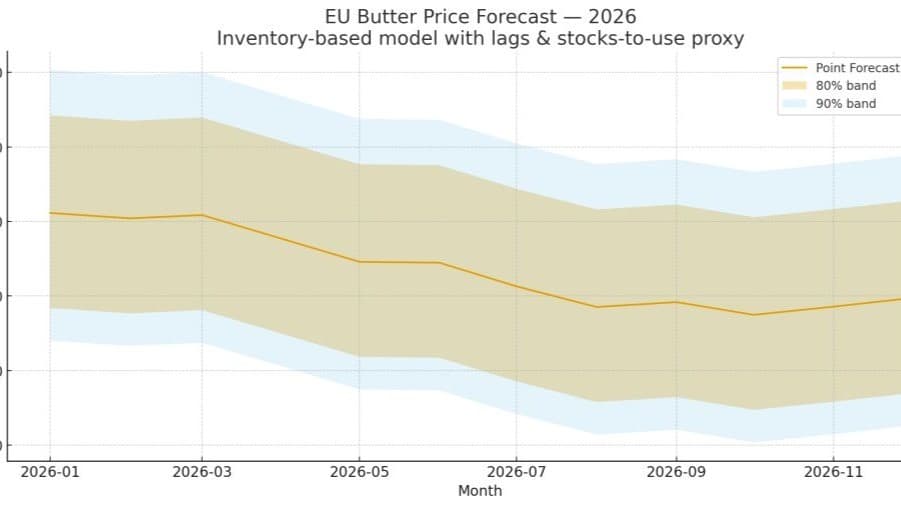
Summer Shopping or Summer Sale?
Last week was again a bit of a bearish week for the entire dairy industry. With cream prices under pressure and milk intake still strong, we keep seeing a market that has more supply than demand. Butter prices took another step lower, cheese prices cracked, and the powder market gave back a bit of its gains again.
The Agro Gravity Effect 
The Agro Gravity Effect
Last week was a strange week from our side. With relatively low activity and a lot of customers on the move due to Eucolait, activity came as quickly as it went away again. Tuesday's GDT put the market on hold, but when the results came out, a bit of downward trading occurred. The same went for Eucolait.
The weekly report
Get it before it is anywhere else
Every market report, straight to your inbox the moment it is written. Butter, cheese, powder, liquids — pick what you actually trade.
Roughly weekly · Free · Unsubscribe any time