The Agro Gravity Effect

Last week was a strange week from our side. With relatively low activity and a lot of customers on the move due to Eucolait, activity came as quickly as it went away again. Tuesday's GDT put the market on hold, but when the results came out, a bit of downward trading occurred. The same went for Eucolait. Activity died once traders arrived, all waiting for the bearish confirmation from Monika's speech at the Eucolait. But as soon as the market took its step lower, activity slowed down again.
This week starts no different. With one trade on powders the market seems to be eyeing slightly higher again, while the butter market took yet another notable step down. What to expect from this week? More of the same, we fear.
We talk a lot about dairy, and let's not pretend we know anything about any other agro commodity out there. But speaking to one of our partners today, he did point out to us that dairy is not trading in isolation from the other major agro commodities.
The Agro Gravity Effect
For much of the past two years, dairy markets have traded largely on their own fundamentals. Milk availability, fat balances, export demand and inventory levels determined direction. Today, however, dairy finds itself increasingly pulled into a broader agricultural commodity cycle.
Across the agricultural complex, momentum has clearly softened. Corn prices have fallen roughly 12% over the past month, soybeans are down around 8%, wheat has lost more than 7%, while coffee and cocoa have corrected even more aggressively, especially when you look at these commodities YoY. The broader message from commodity markets is straightforward: inflation fears are fading and buyers are becoming less willing to chase prices higher.
Historically, dairy rarely remains completely isolated from these shifts. Lower grain and oilseed prices eventually translate into lower feed costs, improving farm margins and encouraging production growth. While feed is only one component of milk production costs, it remains one of the most influential variables in determining expansion decisions. At first glance, this should be bearish. Cheaper feed generally means more milk.
Sure, the reality is more nuanced. Longterm global milk supply growth remains remarkably restrained despite improving margins. European milk production continues to face structural constraints from environmental regulations, labor shortages and ongoing animal health challenges.
For dairy processors and buyers, this changes psychology at the same time it changes physical supply. When corn, soybeans and other agricultural commodities trend lower, buyers naturally assume dairy will eventually follow. Purchasing urgency declines. Coverage becomes shorter. Bids become more cautious. The result is often a weaker market sentiment, and this time, along with additional milk across all major production regions.
In many ways, the current dairy market resembles the early stages of previous commodity normalization cycles. The explosive inflationary phase that followed Covid, the energy crisis and the war in Ukraine has largely passed. The FAO Food Price Index remains almost 3% above year-earlier levels but still sits more than 18% below the 2022 peak, illustrating how global agricultural markets have transitioned from scarcity-driven pricing toward a more balanced environment.
That does not necessarily mean dairy prices must fall more sharply from current levels. The strong demand for dairy proteins is a supportive factor in our analysis. And the confidence buyers have with their last-minute buying strategy still poses a price rally risk we think. But butter stocks are becoming unmanageable, cheese inventories are still growing and milk growth remains strong by historical standards. Dairy can still trade on its own fundamentals, but it now faces an extra headwind: commodity gravity.
When the broader agricultural complex moves lower, dairy buyers become increasingly convinced that time is on their side. Whether that belief ultimately proves correct will depend on one critical question: how does the production side respond to the hesitant buying side.
For now, feed markets are pointing toward more milk. Our brokerage markets are confirming weakness in the main dairy commodities, excluding those with high protein concentrations.
That gap between fat and protein demand may become one of the most important stories of the second half of 2026.
Butter: Old, Older, Oldest
It seems sellers have started to play a new game, called who has the oldest butter out there. It might feel like I'm telling a joke here... but it's based on true facts. The later we get into this year, the more butter from 2025 we keep getting offered. And every time we see these old parcels offered directly from some producers, we can't help but wonder what stopped them from selling these loads at € 7000, € 6000, € 5000 and € 4000, and why, now we are trading near € 3500, it feels it's a good time to start selling it. As one trader told us, giving away presents usually happens around Christmas — this seems too early.
All joking aside, these older parcels are heavily pushing on this market sentiment. With trades today for Q3 at € 3650 for butter delivered to France and € 3500 delivered for June, we are hitting new low prices every day. Of course, all these trades have a story behind them, but regular NL/DE/BE butter also traded for June at € 3575 and for July at € 3650.
And again today we got into a back and forth with a producer, who kept telling me they would rather sell at € 4000 in Q4 in a few months, than sell today forward at that level. I warned them that the price by then could just as easaly trade near € 3300-3500 levels.But as he put it again, "Wouter, I cannot speculate on future market prices". But our counter argument stays the same: by not selling, he is speculating for prices not to fall below € 4000 in Q4.
All those sellers who did not sell the full 2026 curve above € 6500 when they got the chance in September last year, speculated. And in October, when they declined those same bids at € 6000, they speculated again. All on behalf of the farmers, taking on all the risk. Sure, in hindsight it's easy to say what they should have done, but they have had their warnings. From analysts, from traders, even from one very noisy broker. Advising to sell forward at € 4000 for Q4 and Q1 of this and next year might seem risky. But looking at all the data, we would still advise sellers to do so. Even if milk volumes turn lower, on butter stocks we have a big overhang, and the eventual upside lies in Q2/Q3 2027 onwards.
Our forward curve looks like this:
July: € 3600 bid / € 3650 offer
Q3: € 3650 bid / € 3725 offer
Q4: € 3900 bid / € 4000 offer
Q1: € 4150 bid / € 4250 offer
The rest? Hard to make a market
On the powders and cheese market, no real update from our side today. The cheese market continues to see more sellers, but prices haven't been trading as spectacularly as the butter or SMP market has. The balance seems better, although if we had to put a sticker on the cheese market, it would be a bearish one. (but not a big sticker)
On the powder market we put a big question mark. And we would grab that question mark from the heads of most of our partners. The market is torn between a lot of milk and a lot of uncovered demand... or at least, that's what we think we see. Buyers are reluctant, waiting, seeing high milk production, relatively heavy offers for quick collection... But as one partner put it, as soon as the excess milk dries up, the drying towers will come to a halt, the US still won't have much to offer, and with NZ still out of season... where to find a lot for spot SMP?
The market holds more upside than downside from our point of view, but as certain as we are about selling butter, we would not be as certain to advise stockpiling for EU buyers. It's just a very tricky market to trade. Choosing the long side might keep you sitting on stock for a long time... shorting this market might get you margin in the short term, but as soon as this market turns bullish (and it will), the losses on your last shorts might be heavier than the gains on your shorts. A very tricky market to trade...
And that's where we'll leave it this week. A market that keeps stepping down, buyers convinced time is on their side, and sellers still hoping the present-giving can wait until Christmas. Our view hasn't changed: sell the butter you can while you can, keep a cool head on powders, and don't mistake standing still for not having a position — by waiting, you're trading too.
We'll be back next week. Same noisy broker, hopefully a slightly less bearish chart.
GFD, Good trading 🤝
More from the desk
Our Long View Before Our Long Break 
Our Long View Before Our Long Break
Last week the market found a bit of stability. After lower trades on cheese, the cheese market traded slowly up, although a real rally remains absent. Butter prices did dip a bit further, although at the start of this week we see some strength on the back end of the curve. And on powder, our bullish feeling just doesn't go away — and now we can find some confirmation in the market as well.
Dairy Carry Has a Shelf Life 
Dairy Carry Has a Shelf Life
Last week was bearish across the board — every product we broker leaned the wrong way. Powders lost more momentum, cheese slipped well below €3,000 for some products, and butter continues to impress with just how much keeps showing up. Supply, supply, supply.
Summer Shopping or Summer Sale? 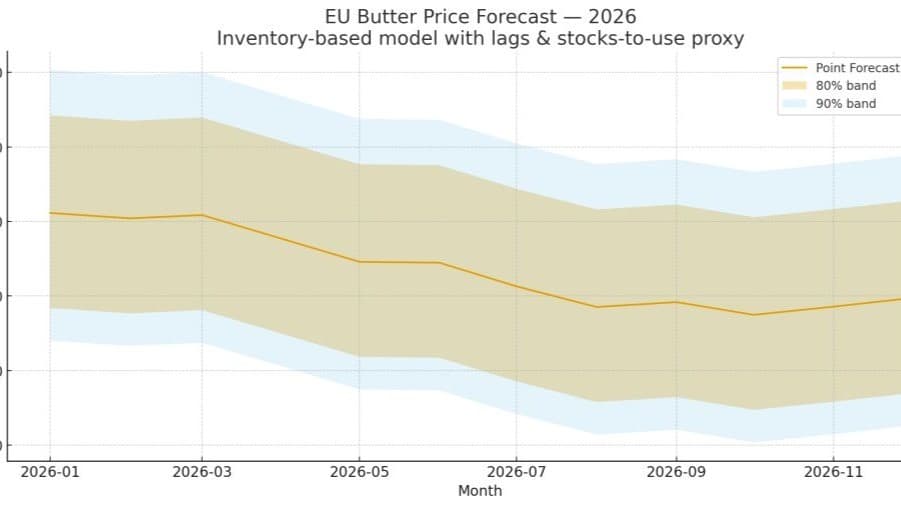
Summer Shopping or Summer Sale?
Last week was again a bit of a bearish week for the entire dairy industry. With cream prices under pressure and milk intake still strong, we keep seeing a market that has more supply than demand. Butter prices took another step lower, cheese prices cracked, and the powder market gave back a bit of its gains again.
The weekly report
Get it before it is anywhere else
Every market report, straight to your inbox the moment it is written. Butter, cheese, powder, liquids — pick what you actually trade.
Roughly weekly · Free · Unsubscribe any time