
The market that feels calmer the further you stand back

Last week was a strange one from our side. Fats opened slowly, but by Friday's close it felt as if someone had thrown open the warehouse doors and decided selling was the only logical thing left to do. And where the bearish trend on butter feels logical, we now find the same bearish sentiment creeping into powders. Less predicted from our side, perhaps — but speaking to traders, the fear of a correction may well be the cause of the correction. Cheese, meanwhile, is a split picture: more Gouda on offer at lower prices, while the mozzarella market stays tight and trades slightly up. Overall the market feels nervous. But zoom out, and prices are not actually moving that much. And the further you zoom out, the calmer this market looks.
The supply side of the market remains very strong. French milk is the only "weaker" performing source — though even there, you could argue that after the strong YoY growth of the first months of the year, we would not have been surprised by a more dramatic drop. But the real numbers are coming from the rest of Europe — or should we say the world. Every major producer is showing strong milk output, and the latest Dutch headline collections came in at 3.8% (4.3% on solids). Germany continues to report +5% YoY growth.
On the other side of the world the picture is no different: New Zealand is reporting over 6% milk intake growth, Australia is up +4%, and the US is still running a 2.5% increase — almost 3.4% on milk solids.
Spot milk price data, however, suggests volumes are now over the peak, with most liquids trading higher. Raw milk prices are back up around 20ct, cream is nearing €4,300, and SMC is trading around €1,600–€1,700. And still — convert SMC to SMP and you are left with a healthy margin; convert milk into whatever commodity you like and you make money; convert cream to butter and you roughly land on the spot price for butter.
Spot milk commodities are starting to valorize closer to commodity levels — a healthy signal the market is sending us — but they remain far below what the coops are paying farmers. The cream market had felt supported by reasonable butter demand, but with cream now creeping over butter prices (and butter falling), we would expect cream levels to drop back again. Butter producers are not going to produce more butter without selling it; conviction for higher prices simply isn't strong enough. And without butter producers buying cream, and no exceptional demand for fresh cream, the market is simply oversupplied as 3-4% milk growth is not absorbed by the spot market.
So when we look at the supply side of this market — the liquids — the spot market is still telling us the same thing: we are milking too much. And only lower commodity prices will convince producers to pay farmers less, so they will, eventually, produce less.
Butter: Bearish By Data
The butter market — we just can't get bullish on it. Twelve-month-old butter (and older) is now being pushed around by traders and suppliers, while finding a freezer for fresh butter is getting more and more problematic. We continue to receive feedback that end users keep delaying contracts, and that warehouses are full and not accepting new clients.
More and more end users with deep pockets have started to join the traders in the cash-and-carry game. Money doesn't seem to be the problem — warehousing capacity is. Over the last three trading days we have seen prices come down by over €100/mt again, and we struggle to find buyers for 2026. Demand for 2027 remains healthy, but the unhealthy balance between buyers and sellers for 2026 can only mean one thing in our opinion: lower butter prices.
The only statistic that isn't bearish for EU butter is the EU butter price. With spot prices around €3,800, the entire market seems to realize the bottom is closer than the top. Today's physical curve has June at €3,800, Q3 almost flat versus June, the Q4 spread at €4,150 bid / €4,200 offer, and Q1 at €4,300 bid / €4,400 offer.
We discussed a study with one of our partners — that today's €3,800 levels, adjusted for inflation, are close to the 2020 prices below €3,000 and that downside therefor is very limited. He quickly replied that I should share that statistic with a potato farmer (who is selling his harvest for free). If an agricommodity market is oversupplied, there is simply no fixed bottom that prices can't drop below.
But as mentioned many times, shorting this market below today's spot prices feels dangerous. Selling the carry — the premium versus the spot market — is still a very profitable trade for most, pulling 2027 demand well into 2026. The perfect setup for a long bear market: maybe without much downside, but with equally little upside.
SMP: Doubting the Upside, Fearing the Downside
The powder market still looks supported nearby, although conviction further out remains less strong. The U.S. short squeeze in NFDM appears largely behind us — CME corrected sharply, and U.S. milk production continues to increase. At the same time, nearby U.S. remains fundamentally tight, which keeps support under the front-end.
Current CME vs EEX spreads still leave Europe highly competitive nearby: June at roughly €830/MT, July at around €485/MT, and August narrowing to about €170/MT. So while the advantage narrows into Q3, Europe remains competitively priced for nearby export business. One thing to keep in mind: recent CME front-end moves traded on relatively thin volume, so physical confirmation remains key.
This week most Middle East and Islamic markets are largely absent due to the holiday period, creating some temporary pressure at the front while the trade sits on nearby product and producers remain comfortable. However, if export demand resumes after the holiday and Algeria (ONIL) returns to the market shortly, we still see good rebound potential for June/July.
Our overall view remains constructive nearby: support is there, although August onwards currently looks more balanced as Oceania gradually returns into season.
We share the following Offers and continue to look for bids
Codex Offers
Unstandardised SMP / High Protein Offers
Final Note
To close — the market as a whole still feels like two stories running side by side. On fats, our outlook remains bearish: the warehouses are full, the carry is being sold, and nothing in the supply picture argues for a turn. On proteins we are more hopeful — support nearby is real, and if export demand returns after the holiday there is genuine rebound potential into June/July.
On cheese we hold very few firm views, and we would rather report on it only with strong, backed-up analysis once we have it. For now, the facts: we traded two trucks spot at €3,625 this week, loading for mozzarella. We continue to hear more availability on Gouda and cheddar, while only the mozzarella market feels tighter and more supported.
So — a nervous market, but not a dramatic one. Bearish on fats, hopeful on proteins, and waiting for cheese to give us something solid to say. Zoom out, and the picture is calmer than the week felt.
More from the desk
Our Long View Before Our Long Break 
Our Long View Before Our Long Break
Last week the market found a bit of stability. After lower trades on cheese, the cheese market traded slowly up, although a real rally remains absent. Butter prices did dip a bit further, although at the start of this week we see some strength on the back end of the curve. And on powder, our bullish feeling just doesn't go away — and now we can find some confirmation in the market as well.
Dairy Carry Has a Shelf Life 
Dairy Carry Has a Shelf Life
Last week was bearish across the board — every product we broker leaned the wrong way. Powders lost more momentum, cheese slipped well below €3,000 for some products, and butter continues to impress with just how much keeps showing up. Supply, supply, supply.
Summer Shopping or Summer Sale? 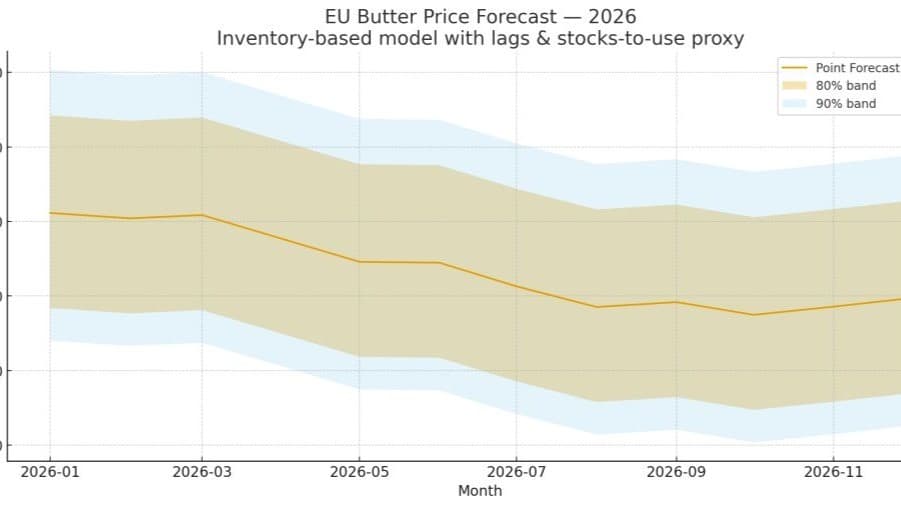
Summer Shopping or Summer Sale?
Last week was again a bit of a bearish week for the entire dairy industry. With cream prices under pressure and milk intake still strong, we keep seeing a market that has more supply than demand. Butter prices took another step lower, cheese prices cracked, and the powder market gave back a bit of its gains again.
The weekly report
Get it before it is anywhere else
Every market report, straight to your inbox the moment it is written. Butter, cheese, powder, liquids — pick what you actually trade.
Roughly weekly · Free · Unsubscribe any time