Our Long View Before Our Long Break

Last week the market found a bit of stability. After lower trades on cheese, the cheese market traded slowly up, although a real rally remains absent. Butter prices did dip a bit further, although at the start of this week we see some strength on the back end of the curve. And on powder, our bullish feeling just doesn't go away — and now we can find some confirmation in the market as well. ONIL seems to have struck at the exact low point of this market, with all markets now trending higher. But with the usual quieter market ahead of us in July and August, we are uncertain across all products whether we'll see real change in the curve over the next weeks. Partly for that reason, and also because we just like spending time with the family, this will be our final update before summer. We'll be back brokering and informing the market on dairy commodities 8 weeks from now. In this update we'll look back a bit, but mostly forward — at what we expect to happen over the coming weeks.
But first, let's look back at the past 3 months. The last quarter has just about finished — with only one more day of trading remaining, Q2 2026 is our strongest second quarter yet, up more than 100% on last year, though volume did decline a bit versus Q1. With over 33,000 MT of product changing hands via our books, we remain thankful and proud of the trust we're getting from the industry and our partners. The majority traded over butter (21,000 MT), with the rest of the volume over SMP (over 10,000 MT) and the remaining 2,000 MT on SWP/FCMP/BMP, Gouda, Mozzarella and Edam.
And where some might feel the market has traded with high volatility, the data shows something else (or at least more nuanced). Spot butter early April traded at € 3,950, and last week at € 3,600. That's a € 350 change over a period of 13 weeks — not that dramatic. On SMP we started with spot trades for codex between € 2,575 and € 2,650, roughly where we'd see the last trades we brokered. For cheese we have too few trades to really see a trend, but looking back through our conversations, cheese would be the weakest commodity, although liquidity for spot remains thin. If we would have to summerize, we would say that on fat the market showed a bit of weakness, on protein a bit of support — but in general Q2 should be looked back on as a fairly stable quarter.
Why has fat been trading lower?
Milk collection has been strong across the EU, with France and the UK nearing or dipping just below last year's strong trend, but Germany, Belgium and the Netherlands still strong YoY. The same trend can be seen in North and South America — so there is plenty of milk worldwide. Butter production in Germany this year so far has been up 10% YoY, leaping over the first 6 months of 2025 that also showed a 5% average increase in production YoY. Other countries show smaller increases, but across the EU produciton seems up 8% v.s. last year.
The bigger impact on fat versus protein should, in our opinion, be sought in the strong food trend across Western countries, where more consumers are turning to GLP-1 medicine — increasing their demand for protein, but reducing their cravings for fat. We have seen this trend tripple whey protein prices over the last 2 years, but its having its toll on butter it seems. This is no longer a story that should be ignored or dismissed. In the US, the share of adults taking a GLP-1 for weight loss roughly doubled to 12.4% in late 2025, up from 5.8% in early 2024, and Morgan Stanley expects the global market to more than double to $190 billion by 2035 — so the trend is accelerating, not fading. What matters for us is the direction of the diet shift. Receipt-level studies show GLP-1 users buy fewer calories, less sugar and less saturated fat, while protein purchases actually tick up. A US survey found a large share of users eating less beef, pork, milk and processed food, and a Cornell study put the average grocery-spend reduction at 5.3% within six months, rising past 8% for higher-income households — exactly the wealthier, Western consumer that drives premium fat demand.
Modest per person, but at this adoption rate it adds up, and it pulls demand in opposite directions for our two main commodities: away from fat, toward protein.
Stocks for all commodities seem to be increasing, although the stocks on butter (especially in the EU) seem far more problematic than the SMP stocks. A good international pull on powders can empty EU warehouses for SMP much quicker than it can empty the butter freezers.
Milk volumes into and beyond summer
We expect the trend of increases milkvolumes across Europe to continue. That means German milk intake across the summer is expected to remain elevated over 2025. The last data we've seen points to collections still up 7% versus last year, and although a lot of partners had expected milk to dry up in the second half of this year, we now see most of them rolling that expectation towards Q4 — and some even into next year.
We would expect milk collection to slowly lose a bit of momentum on the growth towards the end of the summer, but similar to collections worldwide, the decline of milk intake goes much more gradually. We saw milk intakes pick up slower 18 months ago than many forecasted — it seems the decline also takes a lot longer. 18 months ago we found out you could not simply put cows in a higher gear when milk prices were strong. And putting them in a lower gear simply isnt that simple either.
And as long as milk collections aren't dipping 1–2%, commodity production should remain elevated versus last year — and with that, the increased pressure on the market.
Butter forecast
Our forecast for the butter market remains grim. As said, we expect butter production to remain elevated as long as milk production stays elevated. So over the next two months the market will have to make more butter without finding much extra outlet in and we fear also outside of the EU. The US market remains more competitive and their forward curve sits well below the EU price curve. As said, to really clear stock, the EU needs to go below US pricing.
Looking at the US, we see their stocks are much lower — all while their production is up to the highest point in history. The discrepancy seems to sit in high exports absorbing the higher production. That's bad news for EU butter, we feel, because in order to keep prices from falling further at home, the US needs to remain competitive on the export markets. If those exports slow down, pressure can build fast.
Can butter really fall much lower than the current spot market in the EU? We don't really think so. There might still be another 200–300 to go down when the market quiets through the summer, and for some origins we might even head towards € 3,000 — but the current spot price at € 3,600–€ 3,700 is likely to roll forward into Q4. We expect the market to trade roughly there when we come back from our break, leaving September prices maybe around € 3,500 and the forward months a bit higher. And as Q1 usually trades flat versus Q4, we would expect Q1 trades roughly in line with, or slightly above, those levels as well — somewhere towards € 3,650–€ 3,700. One of the bigger things to watch is the EEX quotation. Average quotations are still sitting roughly € 300 above the physical market. Via the VPI and the PanEU EEX quotation we can see they view the market more in line with the prices we broker. If the EEX quotation falls in line with the physical trades and the other quotations, we'd expect that to pull away one of the fundamentals under the strong forward curve. Let's see if the French are going to quote again, and if the Germans will report the trades we've been seeing between € 3,600 and € 3,700.
Let's see where we find the butter market when we return to it end of August.
Powder (SMP) forecast
Our powder forecast is also an internal debate between Linda and myself. I've been bullish on SMP all the way down from € 3,000+ to € 2,500 levels, all while Linda saw peak production pushing on spot prices. But as peak production fades and we hear buyers are very short covered, we now see the trend picking up again. Linda has been calling the book right; we have to give her credit on that. And we can't really convince her yet on becoming a fellow bull on powders yet.
Yes, stocks are higher; yes, production is up, a lot. But even with increased production and higher stocks, EU prices have been trending higher if you zoom out. The dip can be explained by peak production — but also a bit by psychology. We've said it before: in butter, the fear of high prices is keeping buyers extremely engaged, putting a strong bottom under the market. In powder it's the mirror image — the fear of prices dropping back is keeping sellers engaged and buyers reluctant. Give it a good few buyers going back into panic-buying mode, combined with strong protein demand in general and eventually milk volumes that slow down, and we keep forecasting SMP prices to rally.
We'd say SMP is more likely to trade towards € 2,800–2,900 once the summer holidays are over than to sit at today's levels. That said, we say this with less conviction than our butter call. But market psychology makes us think the worldwide SMP market is a touch oversold — and we're seeing traders and producers rethink their last trades.
Cheese forecast
So we need to forecast cheese… and our forecast is… we just don't know. We're weak on fat and bullish on protein — and cheese sits a bit in between, a combination of both.
Looking at the strong production numbers we see across the EU, the increased stock forecast, and the fact that we hear demand has been declining and under pressure, makes us weaker. But at the same time, EU producers have been getting easier access to export markets when they drop their prices — using exports to balance the EU market. We'd expect sentiment to turn more bearish through a slow summer, and the fundamental data we see points to lower prices. But cheese has been trading on its own sentiment, ignoring fundamental patterns for months already.
Our best forecast would be Gouda between € 2,900 and € 3,100, Mozzarella 15–20 ct higher, and Cheddar around € 3,300 levels.
A final note before the break
That's our look back and our look forward. We're grateful for the support through Q2 — it's exactly that trust that lets us close the books, switch off the screens, and enjoy the quiet first week of Q3 with our family.
We're stepping away from the market, but we're not disappearing. For anything contract-related — confirmations, logistics, the things that don't wait for a market view — we're still here and happy to assist. It's only the market commentary and brokering that take the summer off.
One last word on the forecasts above. Treat every one of them as a best guess on today's data, nothing more. In dairy, data travels slow — by the time the numbers confirm a trend, the market has often already moved. That's the nature of the game we're in, and it's exactly why we put our necks out with a view rather than waiting for certainty that never quite arrives. Everything we write is meant to inform and advise our partners, and should be read in that spirit — a compass, not a guarantee.
So that's it from us for eight weeks. We'll be back end of August, screens on, ready to broker — and curious to see how much of this we got right. Until then: enjoy the summer.
GFD, Good trading 🤝
More from the desk
Dairy Carry Has a Shelf Life 
Dairy Carry Has a Shelf Life
Last week was bearish across the board — every product we broker leaned the wrong way. Powders lost more momentum, cheese slipped well below €3,000 for some products, and butter continues to impress with just how much keeps showing up. Supply, supply, supply.
Summer Shopping or Summer Sale? 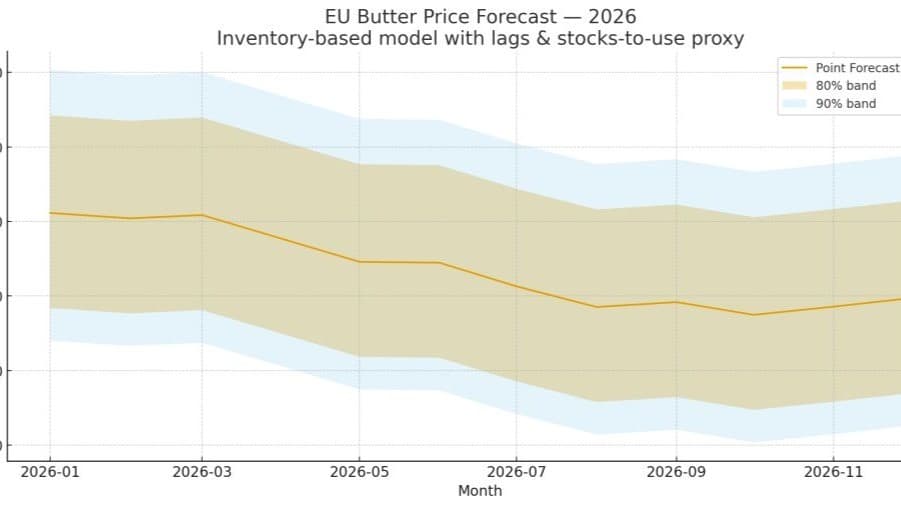
Summer Shopping or Summer Sale?
Last week was again a bit of a bearish week for the entire dairy industry. With cream prices under pressure and milk intake still strong, we keep seeing a market that has more supply than demand. Butter prices took another step lower, cheese prices cracked, and the powder market gave back a bit of its gains again.
The Agro Gravity Effect 
The Agro Gravity Effect
Last week was a strange week from our side. With relatively low activity and a lot of customers on the move due to Eucolait, activity came as quickly as it went away again. Tuesday's GDT put the market on hold, but when the results came out, a bit of downward trading occurred. The same went for Eucolait.
The weekly report
Get it before it is anywhere else
Every market report, straight to your inbox the moment it is written. Butter, cheese, powder, liquids — pick what you actually trade.
Roughly weekly · Free · Unsubscribe any time