
Global Dairy Dip Deepens

The global dairy market continues to present a firmly bearish landscape: more milk, slower demand, rising stocks and declining prices. Each week adds another layer of negative data, and the dip simply deepens. The question is what will halt this decline. Either demand must strengthen or supply must ease, yet neither shows any sign of shifting. Today’s Global Dairy Trade (GDT) auction only reinforces what the market already sensed—prices are slipping further, with this week’s auction merely another step down the ladder and more steps likely ahead.
Some of our partners prefer not to hear more talk of falling prices and continue to hope for a quick reversal. But the reality is more sobering. This downturn is not only deepening; it is likely to last far longer than many would like to admit.
The GDT headline index at -3% landed squarely within our expectations. Butter dropped 7.6%, closely matching our forecast of -8%, marking a sharp correction. We anticipated Solarec butter prices would finish between €4,500 and €4,600; only December slightly outperformed that range by €20. New Zealand values also fell significantly, finally aligning with the global trend in fats, while AMF eased another 5%.
Mozzarella clearly underperformed versus our projections. We had expected prices around €2,950, but with December–January settling below €2,800, our view proved too optimistic. Cheddar also softened by 2.7%, adding another confirmation to the cooling cheese market.
WMP eased 1.9%—a bearish move, though milder than expected. Trades outside GDT have been notably weaker, and we expect next week’s Pulse event to continue the downward trajectory. SMP landed squarely within our forecast range of -1% to +1%. The 0.6% decline is modest, but it reinforces the overarching bearish momentum.
All commodities delivered bearish outcomes, and in each case we doubt the market has found its floor. Evidence continues to accumulate that international demand is slowing, while milk production keeps outperforming even the rosiest expectations. The broader econmic outlook just give more bearish confirmation with lower stock prices, declining prices for gold and Bitcoin. With stocks building rapidly, our bearish outlook not only deepens but lengthens. The more product accumulated at low prices, the longer the market will need to work through those volumes before any meaningful recovery can begin.
Liquids: Losing Premium
Spot markets, typically tight and bullish in November, are following the same downward trend. Prices continue to slip, with the first cream indications this week already starting lower. Cream at €5,500 is widely available, and some report deals below €5,400 for next week. Christmas cream continues to weaken, with offers around €4,450 and rumours of trades near €4,300. Even at €4,450, fresh butter production pencils in well below €4,000—roughly €3,850 by our calculation. Raw milk and SMC show little momentum for now, and no trader we spoke with expects any near-term uplift.
Butter: Lower Prices After Each Trade
The butter market shed another €75 per metric ton in the first two trading days of this week. Prices for NL/DE/BE Q2 slipped to €4,600—down from Friday’s €4,675 low—and now sit €400 below last week’s opening trade. The lowest confirmed business was Polish lactic butter for January at €4,340, although we expect December levels to fall below that in the coming days. The best buyer-side indications for December are around €4,200, with offers sitting just above €4,300.
With Wednesday bringing another round of quotations, attention naturally shifts to this much-debated topic that continues to occupy our partners. The French have reported “no quote” more often this year than in the previous five years combined. As Europe’s largest butter producer, they should have no difficulty finding sufficient trades—something we can confirm based on the activity we’ve seen. Should they decide to quote this week, a level well below €4,700 appears justified given where their current offers sit (we see their offers between € 4400 and € 4600).
Germany, which has been quoting with a significant lag since the summer, finally showed some movement last week. Several major producers sold thousands of tonnes between €4,500 and €4,600 for Q1, with spot trades even below those values. Against that backdrop, a German quotation above €4,800 would be surprising (but keep in mind, they still quoted € 5300 last week). The Dutch—typically the closest aligned with real-time market conditions—are likely to print somewhere between €4,650 and €4,700. If these levels are confirmed, the EEX index could fall by roughly €400–€500, which would likely pressure the forward curve for next year and add another layer of sales pressure to the market.
The US is back on its bearish track with CME prices dropping again after finding a bit of a lift. But speaking to our US partners, it seems US fat demand is weaker than many hope. Christmas demand seems weaker than normal, and the question is how deep the Q1 dip will drag prices. Someone told us today, even your most bearish partners aren't bearish enough about the US market. We expect US exports to drag the rest of the world market for fat further down, not stopping at today's lows.
Meanwhile back in Europe, cream prices are expected to remain above €5,000 for this week and next. But once December begins, the €5,000 resistance may give way quickly—taking the €4,000 floor for butter with it.
We expect to start tomorrow with
- NL/DE/BE offer for 6 loads November/December at € 4440, bid at € 4200
- Irish lactic offer for 6 loads fca Ireland for November/December at € 4350, bid at € 4100
- NL/DE/BE offer for 6 loads at Q1 at € 4450, bid at € 4400
- Irish lactic offer for 6 loads in Q1 at € 4400, bid at € 4300
- Polish SC offer for 6 loads in Q1 at € 4450, bid at € 4300
- NL/DE/BE offer for 6 loads in Q2 at € 4625, bid at € 4500
- N/DE/BE offer for 6 loads in Q3 at € 4825, bid at € 4650
Cheese: Short-Term Shorts, Long-Term Longs
The cheese market still feels relatively tight. Anyone needing product for next week—or the week after—may struggle to secure what they’re looking for. Yet those hoping to sell from December onward may find the opposite problem: far fewer buyers than the volumes they are willing to offer. With ongoing questions around demand, renewed competition in export markets, and clear signs of weaker buying interest—as reflected in the latest GDT—we see no foundations for a bullish stance. If butter moves below €4,000, cheese simply cannot sustain levels above €3,000, a logic that appears increasingly clear even to producers.
The overall tone is tense, with neither aggressive bids nor aggressive offers on display. We expect the market to open roughly where it closed in recent days, with the following levels in focus.
We expect to find an offer for
- 3 loads of Mozzarella for December at € 3025
- 9 loads of Mozzarella for Q1 at € 3000
- 4 loads of Gouda for December at € 3100
- 9 loads of Gouda for Q1 at € 3080
- 6 loads of Edam for Q1 at € 3050
More from the desk
Our Long View Before Our Long Break 
Our Long View Before Our Long Break
Last week the market found a bit of stability. After lower trades on cheese, the cheese market traded slowly up, although a real rally remains absent. Butter prices did dip a bit further, although at the start of this week we see some strength on the back end of the curve. And on powder, our bullish feeling just doesn't go away — and now we can find some confirmation in the market as well.
Dairy Carry Has a Shelf Life 
Dairy Carry Has a Shelf Life
Last week was bearish across the board — every product we broker leaned the wrong way. Powders lost more momentum, cheese slipped well below €3,000 for some products, and butter continues to impress with just how much keeps showing up. Supply, supply, supply.
Summer Shopping or Summer Sale? 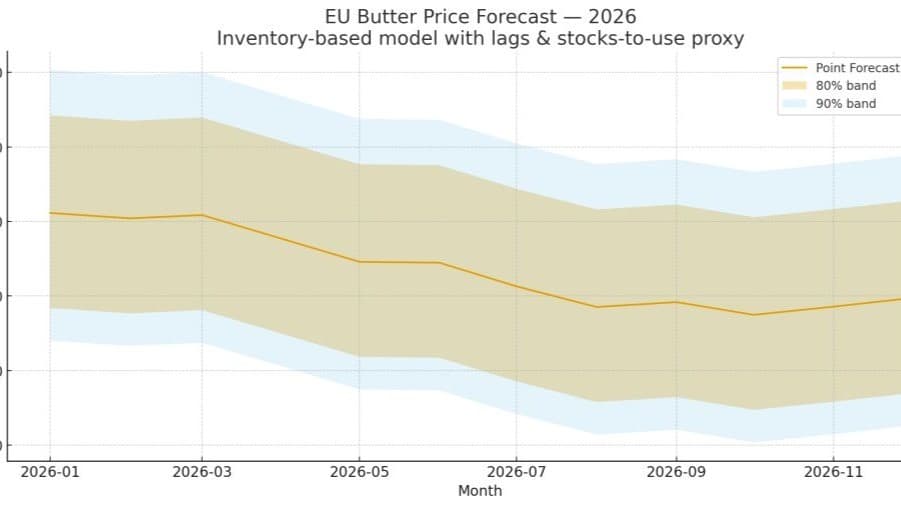
Summer Shopping or Summer Sale?
Last week was again a bit of a bearish week for the entire dairy industry. With cream prices under pressure and milk intake still strong, we keep seeing a market that has more supply than demand. Butter prices took another step lower, cheese prices cracked, and the powder market gave back a bit of its gains again.
The weekly report
Get it before it is anywhere else
Every market report, straight to your inbox the moment it is written. Butter, cheese, powder, liquids — pick what you actually trade.
Roughly weekly · Free · Unsubscribe any time