
Quotation Frustration & Commodity Corrections

Yesterday the market delivered another heavy correction. The bearish outcome of the GDT appears to have stirred additional sellers into action, adding fresh offers across butter, cheese and powders, and pushing prices lower on all commodities. As on previous days, we received a stream of frustrated calls regarding quotations from France and Germany, and it seems likely that the relevant committees are once again dealing with overflowing inboxes. At the same time, global sentiment continues to cool, and pressure is now evident across all major dairy-producing regions.
Butter prices took another clear step down, cheese is beginning to follow the same downward trajectory, and SMP bids continue to drift lower. The most dramatic movement, however, comes from the liquids market. Increased milk availability is pushing raw milk prices back below €0.30, while cream for next week is trading in a range between €5,200 and €5,400 FCA. The so-called “Christmas cream” for weeks 51–2 is showing even sharper weakness, with trades reported as low as €4,400 DAP Poland and €4,100 FCA in Western Europe. Despite many traders indicating they are already well covered for the Christmas period, more supply continues to surface. If additional offers appear in the coming weeks, it would not be surprising to see Christmas cream values slip below €4,000.
Recent milk intake data provides no sign of a slowdown in the current flush. The late-calving effect will eventually fade, reducing some of the year-on-year increases, but for now the EU continues to produce exceptionally high volumes. Even once milk output begins to ease, the market will still be stepping over a weak first half of 2025. Based on current trends, we expect year-on-year growth in milk production to remain steady throughout the first half of 2026, keeping supply pressure firmly in place well into the second quarter.
Quotations Frustrations
Frustration around the quotations continues to grow, and frankly, we understand why. Looking at the VPI—the new instrument intended to serve as the basis for future quotation settlements—we currently see a €560 gap between the VPI level and where EEX is settling. Compared with the German quotation, the gap widens to €750. Under these conditions, it will be very difficult to convince buyers to renew quotation-linked contracts. We wonder what the strategy is behind the clearly failing quotations. In the long run, we continue to think this is a disadvantage of the German and French producers who base a large part of their yearly volumes on these indices.
The French quotations, while not as high as the German ones, still increased this week—despite a period dominated by heavy corrections on butter and cream selling and an exceptionally bearish GDT. Once again, only the Dutch quotation moved down meaningfully, landing at a level we would still call high, but at least explainable within the market context.
Some may ask why we continue to highlight these unusual settlement levels. The reason is simple: these quotations form the reference for major financial instruments across the industry, settling thousands of tonnes per month. When butter is trading across platforms, on the GDT and in our own market significantly below the levels used for contract settlement, the outcome is not only frustrating — it is extremely costly for a large part of the supply chain.
Our hope is that either the EEX initiative or the Vesper initiative will soon be adopted as the new industry standard, bringing transparency and accuracy back into the system. The dairy sector urgently needs a professional, credible financial instrument that the industry can rely on — one that reduces these recurring spikes in frustration and restores confidence in quotation-linked trading.
Butter: Diving Deeper
Butter prices continue to move lower as more producers add stock into an already saturated market. Cheaper cream is setting the stage for heavy Christmas production at levels well below €4,000. The cream we brokered yesterday indicates workable values between €3,800 and €3,900 for collections in the first weeks of January. On the back of these lower cream levels, we traded Polish lactic butter down to €4,300 for Q1 and €4,350 for NL/DE/BE origins. The Q2 curve slipped to around €4,500, while Q3 offers are appearing near €4,750 — though buyers show little interest in paying those premiums.
Current-year product is now trading below €4,300, and with fresh offers continuing to pile up, there are hardly any bids available to absorb the volume. Irish butter for this year's collection is attracting interest only below €4,000, while buyers of German butter are aiming to secure positions between €4,200 and €4,250.
We are keeping a close eye on the US market, which still serves as a useful indicator of what may come next. Although the EU is unlikely to fall to US price levels, it is difficult to foresee a meaningful upward correction in Europe while the US continues to trade lower. CME prices keep sliding, putting US 80% butter below €3,000 and 82% just above that threshold. With US butter increasingly reaching EU export destinations, the European market will need to secure higher-value buyers elsewhere to compensate for the volumes now being displaced by more competitive US offers.
Cheese: Back on the slide
The cheese market has rejoined butter in its downward trajectory. Although the reaction is less severe than in butter, the tone across cheese remains undeniably weak. We traded volumes of Gouda below €3,000, with levels between €2,900 and €2,920. Sellers appear increasingly comfortable adding volume, and we are now seeing offers for Mozzarella and Edam following the same direction. While the EU has managed to shift some product into alternative outlets, we expect supply to outpace demand in Q1, which is likely to strip a meaningful portion off EU cheese values.
Looking again at the US market, there is little to suggest a near-term reversal. Both Mozzarella and Cheddar continue to soften, and with US values slipping further, the EU will be forced to compete more aggressively. As Cheddar and Mozzarella lose altitude, we expect Gouda and Edam production to continue running ahead of what is typically a relatively subdued Q1 demand profile.
Powders: Sideways on thin ice
Temperatures are dropping quickly, and the first night frosts have been recorded here in the Netherlands. Thin layers of ice are appearing in the early mornings — and the powder market seems to be sliding sideways on a similar thin sheet of ice. The market hasn’t broken yet, but it feels as though it could take a step lower at any moment. We traded some December/January volumes at €2,110 for fresh Belgian product for export.
For Q1, we are seeing fresh exportable goods from Germany and France offered at around €2,075, with Q2 indications near €2,125. We are also receiving offers at similar levels DAP NL for older stocks for Q1. So far, buyers are in no rush, while sellers appear increasingly willing to listen to bids and entertain lower ideas.
Once again, CME prices are weighing on sentiment, and global supply looks more than sufficient to keep pace with demand. The market has not broken, but it feels far too heavy to move upward, and it may take only a small catalyst for powders to take a decisive step lower.
Final Note
With sentiment deteriorating across butter, cheese, powders and liquids, the market is entering a phase where small triggers can have outsized effects. Supply across the EU remains strong, global competition is intensifying, and buyers are increasingly reluctant to step in until clearer signals emerge. Until fundamentals show genuine tightening — whether through milk intake, cream values, or export competition — the path of least resistance remains downward. Staying close to the market, maintaining flexibility, and managing exposure proactively will be essential as we move into the final weeks of the year and prepare for a challenging Q1.
More from the desk
Our Long View Before Our Long Break 
Our Long View Before Our Long Break
Last week the market found a bit of stability. After lower trades on cheese, the cheese market traded slowly up, although a real rally remains absent. Butter prices did dip a bit further, although at the start of this week we see some strength on the back end of the curve. And on powder, our bullish feeling just doesn't go away — and now we can find some confirmation in the market as well.
Dairy Carry Has a Shelf Life 
Dairy Carry Has a Shelf Life
Last week was bearish across the board — every product we broker leaned the wrong way. Powders lost more momentum, cheese slipped well below €3,000 for some products, and butter continues to impress with just how much keeps showing up. Supply, supply, supply.
Summer Shopping or Summer Sale? 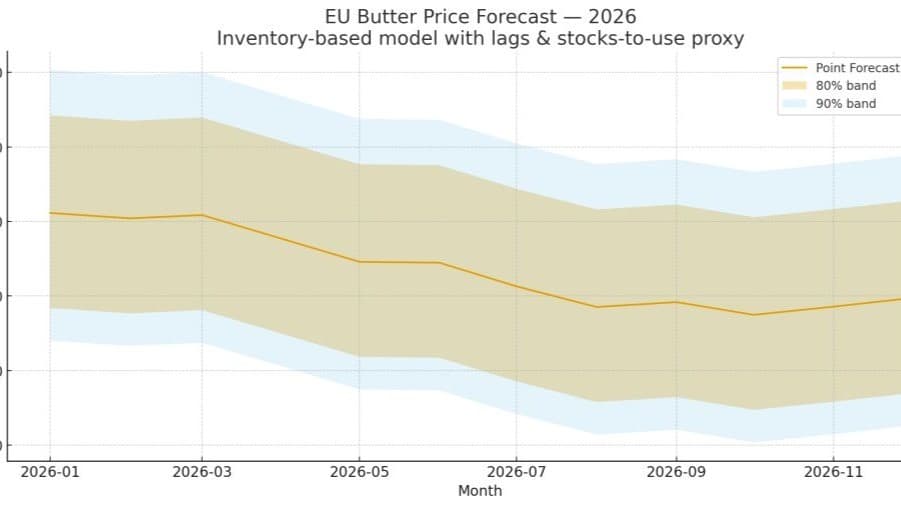
Summer Shopping or Summer Sale?
Last week was again a bit of a bearish week for the entire dairy industry. With cream prices under pressure and milk intake still strong, we keep seeing a market that has more supply than demand. Butter prices took another step lower, cheese prices cracked, and the powder market gave back a bit of its gains again.
The weekly report
Get it before it is anywhere else
Every market report, straight to your inbox the moment it is written. Butter, cheese, powder, liquids — pick what you actually trade.
Roughly weekly · Free · Unsubscribe any time