

Surplus Situation: Supply Stacks Up

Another hectic start to the week with over 1,000 mt of commodity trades concluded. This time not only butter but also powders and cheese joined the flow of business. Supply appears abundant across every commodity we broker, and with milk volumes flowing with ease, more product is on the way. Demand is far from impressive, yet the market seems weighed down primarily by significant supply surpluses. From every corner of Europe, milk, SMC, and cream are proving difficult to sell in what is normally the trough of seasonal milk deliveries. Once this dip has passed and milk intake surges again, pressure on commodities is likely to intensify further. The ongoing correction feels anything but complete, with sellers under real strain to find solutions for swelling stocks.
The liquid market is extremely heavy, and in some respects alarmingly so. Cream in particular is under severe pressure. Traders report purchases between €6,600 and €6,800 FCA Western Europe for this and next week’s loadings, while end users have been paying between €6,900 and €7,000 DAP. Looking back to 2022, the comparison is sobering: cream traded above €8,000 in September of that year, only dipping below €7,000 by mid-December. If this week’s early indications solidify into broader price settlements, the speed of correction in commodities may escalate further over the coming days and weeks.
The producers’ dilemma is clear. Selling forward at lower levels accelerates the downward mood—something they are desperate to avoid. Yet holding back only to watch the market fall almost hourly feels just as futile. Buyers are revising bids after every transaction, regardless of whether they executed it themselves. One buyer reminded us that exactly one year ago, the tables were turned—buyers were chasing a butter market that climbed by the hour, equally impossible to keep pace with.
Producers point out that the rapid decline in commodity prices will impact the farmgate milk price faster than many in the market anticipate. Once farmers begin to see profits erode, the surge in milk output could come to an end just as quickly as it began. While most producers expect this to materialise within the next two to three months, our assessment suggests the adjustment may take closer to six to nine months to fully unfold.
Deciding in Dublin
Many partners and key market participants are heading to Dublin in the coming days. The StoneX Dairy Market Outlook & Risk Management Conference could not be better timed. This month’s extreme volatility again highlights the importance of disciplined risk management. Even the most bearish players may have been surprised by the speed at which this market has collapsed. It is not just cream and butter that are falling fast—Mozzarella futures for Q1 next year are trending below €3,400, with similar pressure visible on Gouda futures.
For some sellers, Dublin offers a chance to gauge sentiment face-to-face. Events such as StoneX or major exhibitions have shifted market tone before, and the appetite to test the room is understandable. Yet if the mood we hear daily on the phone is mirrored in Dublin, the bearish undertone could easily deepen further.
Butter: Breaking Lower
The butter market is breaking down at a pace that outstrips even our most pessimistic forecasts. Weak demand combined with offers from every conceivable seller is exerting unprecedented downward pressure. French sellers in particular appear burdened with significant frozen stock, offering around €5,800 ex-works France, still not enough to trigger meaningful demand. Our earlier expectation was that prices might dip below €6,000 by year-end. At the current trajectory, sub-€5,000 levels could be a reality before we reach December. Support must come from either third-country demand or major supply disruptions. Without either, it is hard to see where this market could find a floor.
Yesterday saw prices slide across all periods and platforms. We are now approximately €300/mt lower than Friday—a decline of that magnitude in just two business days. Via our own books, the Vesper Marketplace, the NUI Marketplace, fellow brokers, and EEX futures, we recorded significantly lower trades at the following levels:
September: €5,800 DAP/FCA NL for Irish lactic butter
Q4: NL/DE/BE at €5,725 and €5,800, Irish butter at €5,800 FCA NL
Q1: NL/DE/BE between €5,700 and €5,800
Q2: NL/DE/BE at €5,700
End users are now focused on securing volumes for Q2 onward at levels below the last trades. Many have already covered substantial forward positions and are more comfortable waiting before locking in additional supply. Buyers generally feel they overpaid on contracts agreed in recent months and are now eager to average down their purchase prices. In our view, this is not a demand crisis but a supply-driven imbalance.
Those looking to the US for some relief might be looking in the wrong direction. CME prices keep trading lower and the CME spot call seems about to break the $ 2,- per pound.
Cheese: Ageing and Growing Stocks
Cheese feels every bit as bearish as butter. The price moves may appear smaller in absolute terms, but the impact on milk valorisation is no less dramatic. Gouda traded between €4,200 and €4,400 in the first half of the year but now sits below €3,600 on spot, with futures even lower. Best bids barely scrape €3,400, marking a near €1,000 correction. In terms of milk valorisation, that is equivalent to a €2,000 swing in butter.
Mozzarella followed a similar path, ranging around €4,300 earlier in the year and now trading at €3,450 FCA and below €3,400 on Q1 futures. Cheese is proving just as destructive to milk value as butter, if not more so.
The larger issue for cheese is rapidly ageing inventory. Recent weeks have seen offtake drop sharply—or production surge just as steeply—and outlets are limited. Stocks of 8–9 weeks old cheese are now circulating in the market. Buyers are in no rush, citing sufficient stock, sluggish downstream demand, and a preference for patience. For once, waiting seems to favour them rather than penalise them.
Powders: More Sales at Lower Levels
Bullish sentiment is virtually absent in powders, though partners differ in how they interpret the market. Some argue demand will reappear once prices fall below €2,250 FCA equivalent. We lean closer to €2,200 as the real trigger. But similar to butter and cheese, this is not just a demand problem. Supply remains the dominant force weighing on prices, not only in Europe but globally.
Once Europe moves beyond the seasonal milk dip, more SMC is expected to enter the market, driving tower output higher. EU stocks are already estimated at 15% above last year’s levels. With surplus milk flowing increasingly toward butter and SMP, stocks will almost certainly rise further.
Final Note
Markets are not driven by reason but by balance, and when balance is lost, logic often follows. In such moments, survival belongs not to the strongest, nor the fastest, but to those most prepared to withstand the storm. Every market participant has been given good reason in the last 12 months to listen and learn in Dublin. For us, it has become more than clear that risk management is the only way out of such a dangerous market without getting hurt.
For those willing to discuss the market with us in Dublin, hit us up, but please, don't hit us too hard.
More from the desk
Our Long View Before Our Long Break 
Our Long View Before Our Long Break
Last week the market found a bit of stability. After lower trades on cheese, the cheese market traded slowly up, although a real rally remains absent. Butter prices did dip a bit further, although at the start of this week we see some strength on the back end of the curve. And on powder, our bullish feeling just doesn't go away — and now we can find some confirmation in the market as well.
Dairy Carry Has a Shelf Life 
Dairy Carry Has a Shelf Life
Last week was bearish across the board — every product we broker leaned the wrong way. Powders lost more momentum, cheese slipped well below €3,000 for some products, and butter continues to impress with just how much keeps showing up. Supply, supply, supply.
Summer Shopping or Summer Sale? 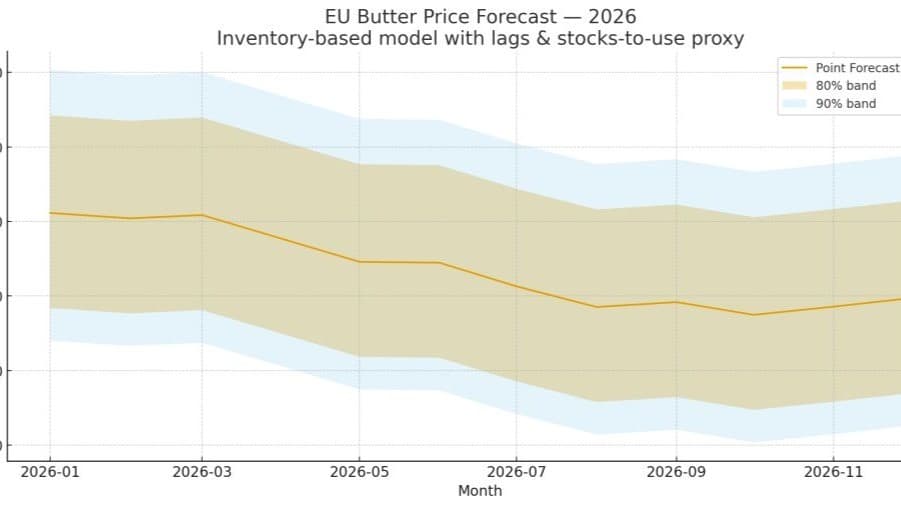
Summer Shopping or Summer Sale?
Last week was again a bit of a bearish week for the entire dairy industry. With cream prices under pressure and milk intake still strong, we keep seeing a market that has more supply than demand. Butter prices took another step lower, cheese prices cracked, and the powder market gave back a bit of its gains again.
The weekly report
Get it before it is anywhere else
Every market report, straight to your inbox the moment it is written. Butter, cheese, powder, liquids — pick what you actually trade.
Roughly weekly · Free · Unsubscribe any time