Why So Bearish?(!)

Last week the dairy market extended its downward slide, with weaker prices across nearly all product categories. Spot milk slipped below €0.45, SMC dropped well under €2,000, and cream moved towards an average of €6,400. Traders and end users we spoke with compared the situation on the spot market to the quiet holiday weeks at the end of each year, describing a market awash in liquid supply with little to no additional demand.
Unsurprisingly, low liquid values continue to pull commodity prices down. Butter fell into the €5,450–€5,550 range, with Q4 contracts now occasionally trading below Q1 levels. On cheese, Edam and Gouda traded around €3,400 while mozzarella futures dipped even lower. Cheddar curd edged beneath €4,000 as well, with UK product hit hardest—reported as low as €3,850 FCA. Powders offered little in the way of relief. SMP futures kept trending down, and producer offers have started to surface below €2,200.
All of this played out against the backdrop of the StoneX Dairy Risk Management Conference, where a large group of the dairy community came together to discuss how to manage exactly these kinds of price swings. The mood there was uniformly bearish—whether from end users, traders, or producers. The open question is whether we are nearing the market floor or if further corrections lie ahead. Our own view leans toward more downside potential. In conversations with producers and traders, one question kept coming back: “Why so bearish?!” In the following, we will walk you through our reasoning.
As we have said many times before, the current price correction can be traced back to the rapid shift in the supply and demand balance. While we had expected this correction to start earlier in the year, high prices were prolonged by a lack of reliable visibility in the data. Now that the data clearly reflects the underlying changes, the bearish fundament now translates into sentiment as well. For the coming period, the trend is undeniable, as sentiment is starting to converge to what fundamentals were already giving.
Conversations at the StoneX conference made it clear that many participants still maintain a cautious stance. Uncertainty remains around milk production, import flows, and demand. While we understand the optimism from some who hope for a rebound, it often feels like many are unwilling to confront the possibility of further downside. What struck us most was that these conversations took place at a market outlook event centered on risk management, yet some still seemed reluctant to actively anticipate and mitigate the risk of a faster decline than their forecasts allow.
With our conversations in Dublin fresh in mind, we want to explain to you what we told our counterparts during our lively debates, why we believe the supply and demand balance is set to tip much faster than many expect.
Supply: Conservative Forecasts Setting Up a Supply Surprise
While the demand side of this market remains questionable, it is the supply side that, in our view, drives commodities lower. Consumption patterns may shift, but overall demand tends to grow steadily each year. It would be a real surprise to see EU consumers suddenly cut back significantly. Supply, on the other hand, has historically had a far greater and faster impact on the supply-demand balance and the price fluctuation. Supply, unlike demand, is also much easier to impact, although there is always a lead time. It took the EU a bit longer than expected to crank up the volumes; it will take longer than many expect for that volume to drop back down again.
Imports: About to Surprise
Recent presentations have made one thing clear: imports are sharply higher compared with last year—and even compared with the years before. Cheese imports are up over 30% year-to-date, following a 30% increase already in 2024. Two consecutive years of heavy inflows are now visibly weighing on the cheese market. Most of these volume increases are coming from Oceania, with cheese imports alone adding more than 12,000 mt compared to last year.
On the fat side, the picture is even starker. Butter and AMF imports have already reached almost 27,000 mt by June—just 5,000 mt short of the full record year of 2022. With six months still to go, a new record seems certain. US and NZ export data show another 10,000 mt shipped to the EU in June and July that have not yet appeared in the EU import numbers. That volume alone would lift this year’s total to 37,000 mt.
From our own brokerage activity and conversations with traders and end users, we know even more is coming. Imports from NZ and the US are expected to remain profitable well into 2026 as a lot of forward contracts are already in place and hedged against higher EU sales. Add the possibility of Ukrainian butter entering in Q4, and a conservative estimate for EU fat imports in 2025 would be 45,000–50,000 mt.
SMP imports have risen modestly, but WMP continues to show stronger gains—again mainly from NZ. Chocolate manufacturers tell us they have worked hard to approve NZ origins for WMP and AMF, and they will continue to increase their reliance on these imports.
Across the board, imports are higher than last year. Export data from supplying countries shows no slowdown ahead, and many trading partners expect elevated imports to persist into 2026. The import surplus is, therefore, a constant bearish weight on the market. And the record size of the imports makes us think it's going to impact the EU supply balance in a way not many can foresee. Imports are this year's surprise, although for some, not a welcome one.
Production: Conservative Milk and Commodity Output
The more data we see on milk production, the more conservative current forecasts we see across most data platforms appear. And if milk production forecasts are conservative, commodity production forecasts are underestimated even more. Looking EU-wide rather than country by country, milk collections in the first six months of this year contracted only slightly. On milk collection data there are different sources to find, and depending on the data source you prefer, EU milk production in the first 6 months of 2025 is somewhere between –0.5% and +0.5% versus last year.
But even if we take the most optimistic milk intake, with that modest milk change, the EU produced 3.5% more butter compared to last year (just under 40,000 mt), 1.5% more cheese (around 80,000 mt), and a little over 1% more SMP (10,000 mt). The implication is that virtually all the extra milk is being diverted into commodities. We expect the increase of butter and smp production to grow harder than that of cheese, as both commodities are easier to store and their value compared to cheese. In some countries, it seems that for every percentage point of milk intake increase, commodity production increases between 3-4%.
The latest German production data for week 39 underlined this trend: 4% more milk led to 19% more butter, 33% more SMP, and 6.5% more cheese versus the same week a year earlier. Of course, one week of German data cannot be extrapolated to the entire EU, but the pattern is strong; in the previous weeks, we have seen similar numbers, although not to those extremes yet. France, Ireland, and Poland are likely to follow a similar—if less extreme—trajectory. And the more milk the EU is going to see, the stronger commodity production will rise.
Even under conservative scenarios, forecasts of 1% more milk in H2 2025 translate into sizeable commodity growth. Copying the H1 trend would add roughly 10,000 mt of SMP, 40,000 mt of butter, and 80,000 mt of cheese. We know that EU milk production is lower in H2, but with expansion continuing, we feel these numbers are not unrealistic and may even be conservative. Stocks are therefore likely to build at an increased pace—and with the EU already the most expensive origin on the world market, the question is: where will the surplus go?
Some partners dismiss the idea that EU commodity production could break records this year and that taking this stance is highly speculative. But we would ask in return: where else should the extra milk go? This year, the EU consumers seem less enthusiastic to keep buying more products, and on the export side, there is plenty of competition. Ignoring the possibility of commodity production overflowing the market in H2 is risky, and those risks need to be managed. We have seen in the last 8 years, both in 2017 and 2022, that once production is up and running, it takes several months after milk prices drop for this production to come to a halt.
Demand: Troubles Outside the EU
Every time in the past when the EU faced oversupply, exports were the release valve. In 2022, we had a USD/EUR rate of 0,96, giving the EU an excellent position on the export markets. This time, the global backdrop is not favourable. The US, with a weak dollar, is aggressively taking market share in SMP, cheese, and butter. Typical "dumping" areas have already been supplied by the US, and even with record export numbers, the US continues to trade lower, in search of more outlets. EU sellers report they simply cannot compete with US prices.
We see strong US competition on all products. On SMP, Southeast Asia buyers last week favoured the US product over the EU, although price differences aren't that big yet. On butter, that difference is bigger. CME butter prices fell to $1.86/lb on Friday, the lowest in five years, translating to roughly €3,500 per mt. Even if you would pay premiums to produce unsalted lactic butter, US butter prices should remain under €4,000. Some producers will say they will only produce 82% lactic butter at a higher premium, but if salted butter keeps trending lower, they will switch quickly. CME cheddar prices are also at this year's lowest prices, now around €3,000 per mt. Quality comparisons aside, such price gaps are difficult to bridge.
The US, for us, looks incredibly weak. More worrying for the EU, we see great similarities. A fast-increasing milk supply combined with higher milk solids and stagnating internal demand. It seems the US is where the EU might be in a few months. Five-year lows are being reached without buyers stepping in; it seems nobody is willing or needs to catch the falling knife. In the EU we have seen a lot of buyers buying the way down, but they are now stepping out. One of our partners said it well. "I am done trying to catch a falling knife, but if it lies still on the ground, I am ready to pick it up." If the US remains as weak as it is today, EU producers know what they need to avoid.
NZ products were also cheaper than EU equivalents, although the last two weeks EU prices took a major step down. NZ Butter on the last GDT even traded higher than Friday's EEX levels. So this week’s GDT will be key to seeing if NZ follows the heavy EU and US corrections. If so, EU prices will need to adjust further to stay competitive. SGX futures seem to have moved to the same level as EEX prices, suggesting this week's GDT will be weak for fats again. But the drop might not be as big as EU butter production. Since the last GDT EEX prices have dropped roughly 15%. SGX futures have not corrected that much, so how weak this week's GDT will be remains to be seen.
The global problem is simple: elevated milk prices worldwide have incentivised farmers everywhere to expand production. But nobody can turn up or off a cow quickly; that takes time. The fact that worldwide these high farmgate milk prices seem to be materialising into strong milk expansion all at once can only be described as a perfect storm. And to make it worse, supply is rising, but demand growth is far from guaranteed.
Back in the EU, exports show a generally negative picture: fats are down 5% (roughly 6000mt), cheese down just under 1% (roughly 5000mt), SMP up 7% (a little over 30.000mt), WMP down 20% (over 23.000mt). Cream exports—a meaningful flow—are also down over 10% (13.000mt). Individually, the numbers per catagory look small, but combined, they add up to significant milk-equivalent volumes, especially for commodities containing fat (47.000mt)
Internal Demand: Stable at Best
If the world won’t absorb the EU surplus, could domestic demand fill the gap? Supermarket promotions have kept retail consumption steady, but price resistance is creeping in. So far, cheese retail seems in line with last years, but on butter, we hear more and more declines in retail sales. Butter, cheese, and dairy products are more expensive than in years past, and consumers are starting to get picky. But its not just dairy products themselves, products using dairy as an ingredient are affected as well. Chocolate bars, for instance, have nearly doubled in retail price over the past five years. And although we love chocolates, it seems even chocolate is showing elasticity.
Foodservice is an even bigger question mark. Those supplying the food service notice that buyer are much more reluctant to cover forward as their forecast remains uncertain. Consumers are tightening discretionary spending, and while past years showed a steady upward line, that line is flattening—arguably even falling.
For those frustrated about milk collection data that comes in late in the EU, consumption data is much slower. We have to work with small portions of data and hearsay anecdotes. We have heard many partners in Dublin suggesting that demand is down as well. We would say that at best, internal demand looks stable.
Cheese Demand vs. Butter and SMP
If there is a bullish angle, it lies in cheese. Butter and SMP buyers are already forward-covered well into 2026, but cheese buyers have remained, more than their butter and skimmed pears, on the sidelines. Once German retail contracts conclude, we expect renewed cheese demand. In such a well-stocked market, this will not be a game-changer, but it could provide a short-term bullish bump that many on the sales side look forward to. If there is no cheese bump ahead... prepare for a hole in the road.
So, Why So Bearish?
As said, many producers asked us in Dublin, Why are you so bearish? Let us be clear, we are a supporter of EU dairy, but our role is not to paint the picture brighter than it is. We are here to inform, advise and connect our partners, both on the buyers' and sellers' side. But looking at our bearish forecast, the logic is straightforward. Imports in our view, are highly underestimated, and volumes will surprise further. Milk production is climbing, and commodity output will expand faster than milk supply growth suggests. For data enthusiasts, we advise you to look at June's milk data and commodity production data. There, the milk expansion influence on commodity production is visible best. And on the demand side, exports are challenged by aggressive competition, particularly from the US. And to finalise the summary, domestic demand is slowing.
The numbers speak for themselves: on fats alone, we see EU butter stocks rising by 120,000 mt this year (75–80,000 mt more production plus 45,000 mt imports). We even think this forecast is conservative, as we do not add the export losses and internal demand losses. On cheese, the increase is closer to 180,000 mt (160,000 mt from production plus 25,000 mt imports). Meanwhile, cheese exports are also slowing down, leaving the number of expected supply increases still on the conservative side.
That leaves the EU needing to place more than 300,000 mt of extra product. Produced at high cost, these volumes will come under financial pressure. At high financing costs, producers will face a two-sided battle. They need to pay their farmers high milk prices while their sales of commodities leave them with less liquidity. Stock that they are not willing to sell, they need to finance with high financing and storage costs. By year-end, we expect finance controllers will want stocks off the balance sheet, priced against the forward curve that is expected to be in backwardation. That, in turn, will keep exerting downward price pressure.
What would make us bullish?
So what would make us bullish again? A few key shifts would need to happen. First, production must slow down. Yet those who follow farm margins know it will likely take months—and commodity prices lower than today’s—before farmgate milk prices drop beneath the cost of production. And once they do, it usually takes months for these lower farmgate milk prices to translate into weaker milk production, just as it took month before high prices translated into more milk. Another bullish trigger would be if EU prices fall below world market levels, or if other origins start trading above us. The latter seems unlikely, but if prices correct another 20% we start being competitive and the world market can give the EU some relief. But look at the US, even with record export numbers, commodity prices keep falling. Weather swings can always disrupt production cycles. And of course, there is the chance of a black swan event: animal disease, geopolitical conflict, or a major supply chain disruption.
But absent any of these, the odds of a bullish turn in the near term look slim.
GDT: Bearish Forecast
Let's also look towards the coming week. We expect this week’s GDT to deliver another bearish result. Futures for butter are trading lower, converging towards EEX levels. The key question is whether NZ prices will have to move below European values. Our expectation based on SGX futures is that AMF will correct more gradually, while NZ butter prices fall 4–5%. But if the GDT follows the same correction as EEX and CME butter prices did since the last event, we can be looking at a correction greater than 15%. For EU butter, this GDT could prove especially negative. Solarec butter still traded at an average of €6,400 at the last event, but we expect the fresh GDT result to settle closer to €5,600–€5,700—an 11–13% drop (and that would almost have to be considered bullish)
SMP prices are also likely to step down. Buyers can now source significantly cheaper product in both the EU and US. While some demand for NZ origins will remain, we forecast a modest SMP correction of 1–2%. WMP, however, looks more exposed: we expect another bearish outcome here, with prices dropping 2–4%.
Mozzarella is also expected to soften further. EU mozzarella traded at €3,600 during the last tender, but this week’s GDT could see it close at or even below €3,400—down more than 5%.
Final Note
What lies ahead is not a market pausing to find balance but one still in motion, sliding faster than many are prepared to acknowledge. Imports are not easing, production is not slowing, and competitors abroad are cutting deeper into EU’s traditional outlets. Financing costs and stock overhangs are not abstract risks—they are realities that will show up on balance sheets before year-end.
Until supply tightens or a true shock resets the landscape, this market will keep writing lower numbers. The question isn’t if we go down further—it’s who is set up best to handle the consequences and risks when we do.
More from the desk
Our Long View Before Our Long Break 
Our Long View Before Our Long Break
Last week the market found a bit of stability. After lower trades on cheese, the cheese market traded slowly up, although a real rally remains absent. Butter prices did dip a bit further, although at the start of this week we see some strength on the back end of the curve. And on powder, our bullish feeling just doesn't go away — and now we can find some confirmation in the market as well.
Dairy Carry Has a Shelf Life 
Dairy Carry Has a Shelf Life
Last week was bearish across the board — every product we broker leaned the wrong way. Powders lost more momentum, cheese slipped well below €3,000 for some products, and butter continues to impress with just how much keeps showing up. Supply, supply, supply.
Summer Shopping or Summer Sale? 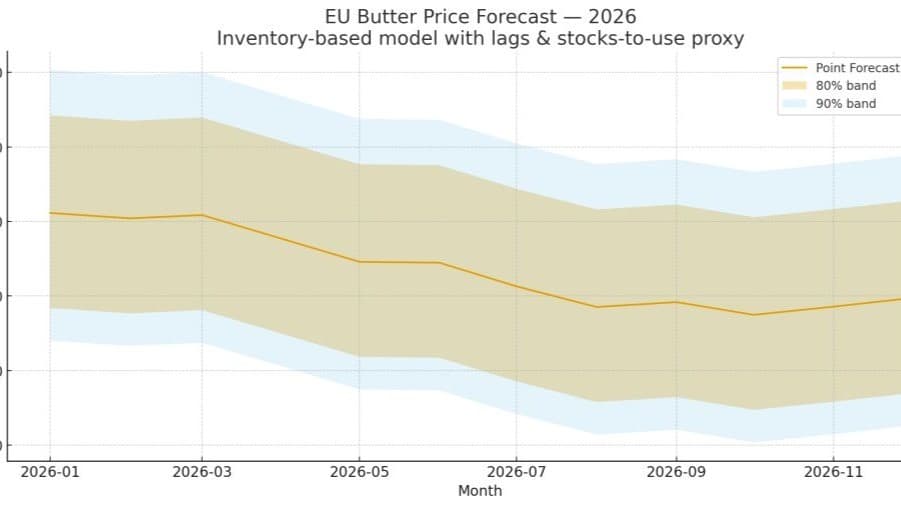
Summer Shopping or Summer Sale?
Last week was again a bit of a bearish week for the entire dairy industry. With cream prices under pressure and milk intake still strong, we keep seeing a market that has more supply than demand. Butter prices took another step lower, cheese prices cracked, and the powder market gave back a bit of its gains again.
The weekly report
Get it before it is anywhere else
Every market report, straight to your inbox the moment it is written. Butter, cheese, powder, liquids — pick what you actually trade.
Roughly weekly · Free · Unsubscribe any time