
Dairy in Freefall: Supply Surges, Demand Falters

Last week once again confirmed the bearish sentiment dominating dairy markets. Futures across all commodities continue to test lower levels, and at present, the market appears unable to establish a convincing floor. Tuesday’s GDT auction did little to inject optimism, and weakness in the spot liquid market is evident. Butter futures are pressing against the €6,000 threshold, yet in the physical market, producers are already accepting prices below this psychological level. Deals on the Vesper Market Place confirmed the first Q1 trades executed beneath €6,000. In cheese, prices have stepped down significantly, and following Tuesday’s GDT auction, the SMP market is now probing this year’s lows. The central question our partners ask us: Is there support ahead, or how deep will this correction run? Let us take a closer look at the data to determine if a floor is within reach.
Commodity prices remain volatile as the delicate balance between supply and demand shifts. Let's take a look at all indicators that determine the balance: milk collections, demand (both internal and on exports), commodity production numbers and stocks.
Milk Collections: Strong Year-on-Year Growth
In recent years, milk collections contracted due to a range of factors: elevated production costs paired with relatively modest farmgate prices, one of the longest droughts on record, mounting political pressure on the industry, and the sudden impact of bluetongue disease last year.
Since September last year, however, many of these limiting factors appear to have started easing. Following a wet autumn, Europe entered a dry spring, yet weather conditions in most regions proved favorable for grass growth. During our summer break in the Netherlands, we endured daily cycles of rain showers, sunshine, and relatively mild temperatures—ideal conditions that also supported robust crop yields. The result has been abundant, affordable feed compared with last year. Farmers now receive between €0.50 and €0.56 per litre for their milk, while cost structures vary from €0.35 to €0.42 depending on the operation. Profit margins have rarely looked this attractive, incentivising farmers to maximise output. Even in 2022, when farmgate prices touched €0.60, profitability was less pronounced given high energy, fertilizer, and feed expenses.
Bluetongue has remained contained this year thanks to improved vaccination programs. There was a brief scare when foot-and-mouth disease emerged in Germany, yet Europe seems to have narrowly avoided disruption. Lumpy skin disease remains unresolved, but it does not yet pose a significant threat to milk production, it seems.
These favourable dynamics are beginning to show in the collection data. The UK has consistently reported +5-6% throughout the year, while other regions initially lagged. The turning point, however, has become visible since June. France in the recent week has reported 4–5% year-on-year growth during the summer, surpassing 2023 and 2022 levels. Germany, after trailing last year until July, now shows a 3.7% year-on-year increase in their latest weekly numbers, again exceeding not just 2024 but also the two years prior.
In addition to higher volumes, the elevated milk price has encouraged farmers to improve milk quality, with solids per litre rising across multiple countries. July’s Irish data is illustrative: volumes grew 3.6%, yet solids increased 6.6%. Even in the Netherlands, where political pressures have weighed on herd sizes, recent figures reveal year-on-year increases in mlk collection.
While August data remains scarce, and September reports are not yet available, conversations with liquid traders and cooperatives confirm strong output. Notably, September cream prices fell below butter values—an anomaly we cannot recall in all our years in the trade. Historically, cream should command a premium of several hundred to over one thousand euros per metric ton above butter equivalent over the next weeks. The fact that cream is now trading below is a warning signal that milk volumes are pressing hard. We can see the same for spot raw milk prices, trading well below contract prices. It is reasonable to conclude that August and September collections will be very strong.
Looking ahead, there is little reason to believe milk volumes will show a decline again. A partner once reminded us: “the trend is your friend.” As long as conditions remain favourable, the current trajectory of 2–4% year-on-year growth appears likely to continue. Only a meaningful reduction in farmgate prices—potentially below €0.43–€0.45 per litre—will curb farmer enthusiasm. Yet with cooperatives competing aggressively to retain farmers, such a correction in milk pay-outs seems unlikely in the short term. Feed costs are secure for months ahead, further reinforcing strong production.
Globally, the same dynamics apply. Margins are solid, milk solids are robust, and expansion looks likely across most major producing regions. Milk collections, therefore, remain a bearish driver for commodity prices in the months ahead—whether four, six, or nine months is uncertain. But if prices hold above €0.43 until April, Europe may well face strong collections through the first half of next year. Rising volumes in the US, South America, and New Zealand only compound the bearish outlook.
Demand: Fragile Without Export Support
In recent years, weak milk collections were met by robust demand, both domestically and abroad. EU consumption was supported by favorable economic conditions: low interest rates, COVID-related subsidies, and later government measures to cushion the impact of cost increases caused by the war in Ukraine. Simultaneously, global buyers continued sourcing actively from the EU.
During 2022 and 2023, the EU benefited from a competitive euro-dollar rate below parity, positioning Europe as a highly attractive supplier. At that time, US butter prices aligned with EU levels, cementing Europe’s role as preferred supplier to the Middle East and North Africa. New Zealand remained the exception, pricing its butter well below EU equivalents. Over time, global prices converged downward to the lowest available world market levels, with NZ imports of AMF and butter helping rebalance the EU market.
In recent months, however, Internal EU demand appears to have stalled. Foodservice struggles, retail sales show cracks, and inflationary pressures are eroding discretionary spending. Industrial repackers, producers in the chocolate industry and bakeries are delaying or even selling back contracted volumes. Consumers, constrained by higher costs of living and restricted credit, are reconsidering purchasing habits.
More troubling for Europe is the shift in trade flows. Imports of butter and AMF are rising, particularly from the US for butter and AMF from NZ. CME butter values translate to sub-€4,000 equivalent in Europe, even if the bulk is 80% salted. Increasing volumes of unsalted lactic and sweet cream butter are also arriving at EU ports. Though import data lags, US and NZ export figures suggest 2022 levels will soon be surpassed.
Exports, meanwhile, are weakening. The first months of the year already showed slower trade, and with the euro strengthening, further declines are inevitable. It is not just bulk commodities—value-added products such as cream, cookies, and frozen pizzas are also reporting declining shipments.
The net effect is clear: delayed domestic demand, rising imports, weaker exports, and an EU economy increasingly burdened with defense expenditures rather than consumer stimulus. This side of the balance sheet is undeniably bearish.
Commodity Production: Milk Growth Exponentially Expands Output
Milk collections may be up only a few percentiles, but commodity output is expanding disproportionately. This is because incremental volumes tend to flow into the lowest-valorized segments—commodities.
France and Germany provide good examples. In H1 2025, France reported milk down 0.6% year-to-date, and Germany down 2.5%. Yet butter production in France increased 2.5%, and Germany’s by 4.5%. France’s cheese production edged up 0.5% despite lower milk, while Germany’s SMP output surged nearly 5%. Looking at butter production increase v.s. milk production numbers we see similar trends in several countries
| Country | Milk Output Change | Butter Output Change |
| Poland | 0.2% | 3,4% |
| Ireland | 6,0% | 4,7% |
| Italy | 3,5% | 8,5% |
| Denmark | 0,5% | 3,0% |
| US | 1,0% | 4.8% |
| NZ | 1.4% | 8,0% |
Recent German data illustrates this effect even more starkly: a 3.7% increase in milk intake generated 15% more butter, 45% more SMP, and 3.1% more cheese. This confirms that commodity output expands much faster than raw milk intake.
Given this trend, the second half of the year is likely to see even greater increases. Butter and SMP, both relatively easy to store, will probably see the largest gains, while cheese output also rises. The result is more bearish supply pressure on already fragile markets.
Stocks: Expensive to Hold, Hard to Place
More milk and more commodities are converging with slowing demand and rising imports. Unsurprisingly, stocks are rising. Butter stocks in May already exceeded last year’s levels and are on track to reach historical averages by year-end in our analysis. Cheese inventories are building as well, evident in extended ageing profiles for Gouda and in strong availability of cheddar, cheddar curd, Emmental, and Maasdam. SMP inventories are also rising, with the average age increasing in recent months.
Some argue stocks are not as heavy as in 2022, when commodities corrected more than 40%, therefore expecing this years correction to be less severe. We agree with the analyses that stocks are smaller, yet financing costs today are significantly higher. Storing butter priced at €6,000 now costs partners roughly €20–25 additional financing cost per metric ton per month extra compared to 2022 as a comparison, while handling costs also continue to climb. SMP storage costs have been less affected, but even for powders, the increased burden is still meaningful.
The question becomes: who will have to carry these stocks, especially with the fiscal year-end coming up aheadd for most active partners? End users face margin pressure, producers must reconcile high farmgate prices with weak commodity valorisation, that leaves traders as the only logical candidates. Well equipped to finance and manage risk, they will intervene—but only if market structure justifies it. With forward curves for most commodities still in backwardation, a shift to contango is necessary to make cash-and-carry strategies viable. That would require either a sharp fall in Q4 prices or a rally in 2026 values. But with milk production expected to expend, forward buyers see no reason to pay a premium v.s. Today's prices, especially at these price levels.
Until the 2025 months give a healthy discount on the forward prices for 2026, the stock situation adds another bearish weight to the market. While maybe not as extreme as 2022, the environment is far from constructive.
Market Balance: Buyers Take Control
For much of the past two years, forward contracting was characterised by imbalance: buyers needed coverage, but producers were unwilling to sell forward, particularly with backwardation prevailing. Without any indication, the price might correct in the months forward, producers felt at ease selling months for months, and it has been the best strategy for many months. This mismatch kept markets inflated above what fair value might suggest.
Now, the dynamic is reversing. Buyers have secured forward coverage deep into 2025 and even Q1+Q2 2026. Producers, meanwhile, are chasing bids as offtake weakens on spot. The balance has shifted decisively: buyers are now in control. This, too, adds to bearish momentum.
Outlook: Where is the Bottom?
The question remains: are we at the bottom? The simple answer is no. How much further prices can fall is harder to predict. Fundamentals and sentiment are aligned in a bearish direction, and sentiment is often as decisive as data in this market. When we summerize this market we cant find any bullish argument that suggests a floor is in sight.
Production is outpacing demand, and as long as we are trading well above historic support levels, we doubt buyers will start building stocks, traders to start building long positions and even producers to keep stock. In last year's bull run we saw finance and risk managers taking over the seat of the purchasing managers. This year, they might take a seat in the sales meetings. Managing stock and risk will be the key to success for most.
Looking at butter, history provides perspective. Over the past decade, two major corrections from record highs occurred—in 2017/18 and again in 2022/23. In both cases, sharp declines began in September and stabilised in Q1, finding support around €4,200 - € 4400 levels. There is no reason 2025–26 cannot follow the same trajectory although we do think speculators might feel confortable starting to build some stock just below € 5000,-
Exports are unlikely to recover unless EU butter discounts meaningfully against NZ. If NZ holds between €5,600–5,800, some support may emerge near €5,500. But we have seen NZ prices decline in line with EU prices, keeping a discount v.s. the EU prices. In the last price rally down we also noticed that EU and US butter prices dropped together towards the, at that moment, lowest seller in the market, NZ. So logic tells us to win back meaningful export demand against US competition, EU butter may need to fall below €5,000. Without stronger exports or a halt in production, stabilisation is unlikely in the near term.
The most probable scenario in our view, therefore, is a quick drop to €5,500 in the coming weeks, with potential further declines toward the low €5,000s once we near the end of 2025 and sellers need to clear their stocks and clean up their balance sheets. In Western Europe we expect ot find support at that € 5000,- and potentially sub-€5,000 in Eastern Europe. This view will not be popular with producers, but we think it is grounded in current fundamentals.
Cheese markets appear equally heavy. Last year, cheese benefited from butter’s rally, but proved less tight, softening sooner than butter prices did and more quickly. If butter prices fall below €5,500, expect processors to divert more milk into cheese, further weighing on the market. Stabilisation may occur by year-end, but likely around €3,000–3,300 for Gouda, Edam, and Mozzarella, and €3,600–3,800 for cheddar.
As for powders, the SMP market has offered little cause for optimism in recent years, and there is no reason to expect immunity from broader bearish sentiment now. Some partners foresee SMP trading around €2,000 for the next 6–9 months—a dull outlook, but realistic given the fundamentals.
More from the desk
Our Long View Before Our Long Break 
Our Long View Before Our Long Break
Last week the market found a bit of stability. After lower trades on cheese, the cheese market traded slowly up, although a real rally remains absent. Butter prices did dip a bit further, although at the start of this week we see some strength on the back end of the curve. And on powder, our bullish feeling just doesn't go away — and now we can find some confirmation in the market as well.
Dairy Carry Has a Shelf Life 
Dairy Carry Has a Shelf Life
Last week was bearish across the board — every product we broker leaned the wrong way. Powders lost more momentum, cheese slipped well below €3,000 for some products, and butter continues to impress with just how much keeps showing up. Supply, supply, supply.
Summer Shopping or Summer Sale? 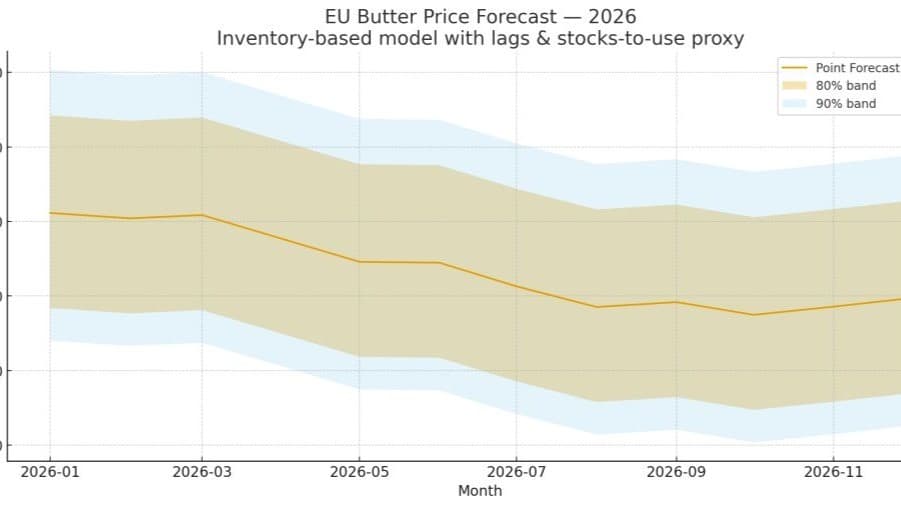
Summer Shopping or Summer Sale?
Last week was again a bit of a bearish week for the entire dairy industry. With cream prices under pressure and milk intake still strong, we keep seeing a market that has more supply than demand. Butter prices took another step lower, cheese prices cracked, and the powder market gave back a bit of its gains again.
The weekly report
Get it before it is anywhere else
Every market report, straight to your inbox the moment it is written. Butter, cheese, powder, liquids — pick what you actually trade.
Roughly weekly · Free · Unsubscribe any time