

Butter Bleeds, Powder Peak, Cheese Sleeps

The first two trading days of this week have again been very active. With more than 1,500 metric tons of product changing hands via our books in powders and butter, the 2026 season can now officially be considered open for business. Butter prices continue to slide lower, moving toward the lowest levels we have traded in the past four years. According to our books, we have to go back to August 2021 to find lower price levels. SMP prices, on the other hand, remain remarkably firm (compared to where it has traded), while the cheese market has been largely silent from our side.
But we start the update with a major milestone for us: this week we traded our first 44 metric tons of butter via the GFD Marketplace. While many users still need to be onboarded and activated, the first trade was completed after a seller confirmed a bid placed by one of our buyers on the platform. We expect activity to build gradually over the coming weeks and invite all partners with trading interest to register and experience the marketplace for themselves.
Back to the market. There is little genuinely new to report. Early indications suggest that the spot market for liquids is unlikely to strengthen in the coming days. Increased milk availability and higher cream supply continue to push prices lower. Cream is reportedly being offered at a discount versus last week (we hear prices between € 3200 and € 3300 fca western EU), although sellers note that buyers remain reluctant to bid, fearing that their bids may be fully filled. We expect to have a more complete picture of liquids by the end of today.
Butter Bleeds
Lower cream prices continue to stimulate butter production, and we expect butter prices to take another hit today after already trading lower over the past two sessions. January NL/DE/BE butter traded down to €3,875, with renewed bids now coming in below that level.
The forward curve for NL/DE/BE butter currently shows offers around:
- €3,950 for February/March
- €4,050 for Q2
- €4,250 for Q3
- €4,450 for Q4
We see bids roughly €50 below these levels.
Additional pressure this week is expected from Eastern European offers. Yesterday, partners reported Polish butter being offered between €3,800 and €3,850, depending on quality, age, and location. Buyer interest is expected to start at least €100 below these levels. If such prices are confirmed, we would expect downward pressure to extend across the full NL/DE/BE curve as well.
Further downside may come from the quotations. We have stated this before, but this week it increasingly feels that the committees will have little choice but to align more closely with market reality. After average quotations last week settled at €4,408, we would expect a correction of at least €200. Based on factory indications from last week, a more realistic quotation would be closer to €4,100, but we know how slow the official quotations tend to move with the market.
A quotation settlement closer to market levels should also encourage additional selling interest on EEX. The current basis between physical trades and EEX futures has been close to €300 — an unhealthy gap that should narrow once quotations adjust accordingly.
Looking at the GFD Marketplace, we currently see several active bids and offers on the platform. Partners interested in interacting with any of these can either contact us directly or sign up for a trading account to engage directly through the marketplace.

Cheese: A Sleeping Market That Should Wake Up
The cheese market remains dormant. It appears that we are not alone in struggling to generate activity. Conversations with traders across the market point to the same situation: there is no urgency on the buying side and no urgency on the selling side. And without urgency, there is no trading activity.
Producers remain largely on the sidelines, although offers are slowly starting to appear. At the same time, the gap between buyer bids and seller offers remains too wide to facilitate meaningful trade. For now, both sides of the market feel comfortable enough to call the other side’s bluff.
In discussions with one of our long-term partners, we concluded that predicting the next move in the cheese market is particularly difficult. While fundamentals do point toward a more bearish direction, it would take only two large buyers to lift prices by €100–200 per metric ton. Conversely, renewed selling pressure from producers in a bearish environment could just as easily push prices back toward previous trading levels, implying cheese prices in the €2,800–2,900 range.
Compared to butter, where such price moves can occur within a typical trading week, this level of volatility represents a far more significant and consequential decision for cheese market participants. Those who are looking towards the US to predict the next move will be on the more bearish side. After dipping together with the EU in early December, cheese prices also found their way back up in mid-December. But since the start of the year, the market appeared to trade down again, hitting new lows on the CME yesterday.
On our marketplace place we did see a bid all day for Mozzarella for January at € 2950 for two loads; that bid is still active on it, ready to get confirmed.

Powders: Peak (Before the Pivot)
The powder market is clearly approaching a peak. Prices have again reached fresh recent highs, and activity via our desks has been strong over 1500mt traded in the first 2 weeks of this year. This suggests that some market participants have been carrying less stock than both they—and we—initially expected. The market is currently well supported, with several large tenders in progress, most notably ONIL and Soummam.
Internally, we find ourselves somewhat divided in our market view, and we believe that is a healthy situation. A one-sided perspective is risky, and we value being challenged. While neither of us would describe ourselves as outright bullish, Linda sees a demand side that remains healthy alongside a notably reluctant sales side. From my perspective, being less directly connected to day-to-day buyer and seller behavior and focusing more on the data, fundamentals suggest the market is closer to a downward pivot than to another meaningful step higher.
Low SMC prices, high production, higher stock levels compared to last year, and a strong dependence on tender-related sentiment could quickly shift the market lower if tenders are filled with non-EU product. Based on conversations in the market, this scenario does not seem unlikely. Cheaper product from Iran, Belarus, and Russia may be offered, and increased freight costs from the EU into Algeria could further incentivise buyers to source outside the EU.
Fundamentally, we therefore see the market as stable at best around current price levels (approximately €2,100). From a sentiment perspective, however, prices may still edge higher in the near term. The key question remains whether today’s price levels represent a midpoint toward further upside, or a pivotal point before a reversal.
Looking at activity on the marketplace, we currently see limited willingness from partners to actively show interest, with only relatively small bids visible at this stage.

Final Note
Across commodities, the common theme remains caution. Activity is present, but conviction is limited. Butter continues to absorb the weight of rising stocks, powders are testing their upper range with sentiment doing more of the work than fundamentals, and cheese remains in a waiting game where a single move from either side could quickly reset the market.
In this environment, timing and execution matter more than direction alone. Price levels may look attractive or unattractive depending on perspective, but liquidity, flexibility, and access to counterparties are becoming increasingly important.
With the GFD Marketplace now live, we see it as a practical tool to support that process—not as a replacement for brokerage, but as an extension of it. Transparent market access, targeted exposure, and direct broker support will be key as the market continues to adjust.
As always, we remain available to discuss positions, structure trades, and help navigate what is shaping up to be a volatile start to the year.
More from the desk
Our Long View Before Our Long Break 
Our Long View Before Our Long Break
Last week the market found a bit of stability. After lower trades on cheese, the cheese market traded slowly up, although a real rally remains absent. Butter prices did dip a bit further, although at the start of this week we see some strength on the back end of the curve. And on powder, our bullish feeling just doesn't go away — and now we can find some confirmation in the market as well.
Dairy Carry Has a Shelf Life 
Dairy Carry Has a Shelf Life
Last week was bearish across the board — every product we broker leaned the wrong way. Powders lost more momentum, cheese slipped well below €3,000 for some products, and butter continues to impress with just how much keeps showing up. Supply, supply, supply.
Summer Shopping or Summer Sale? 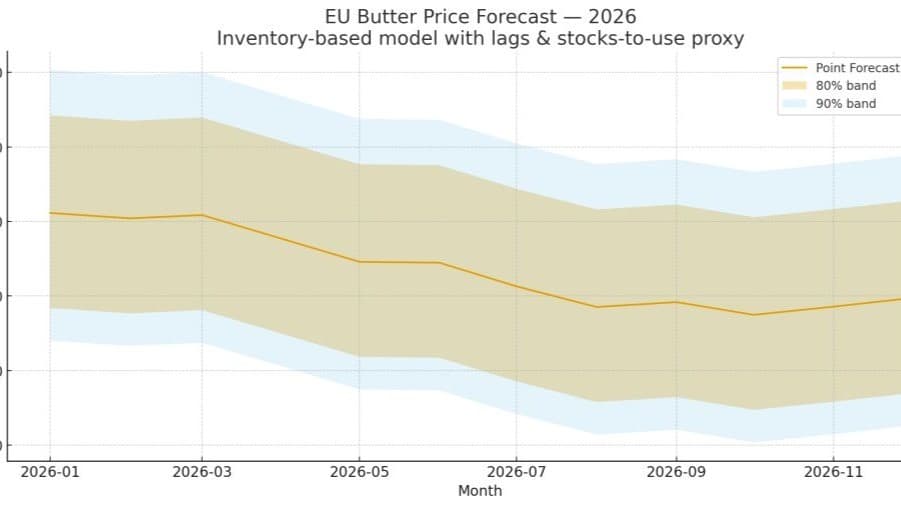
Summer Shopping or Summer Sale?
Last week was again a bit of a bearish week for the entire dairy industry. With cream prices under pressure and milk intake still strong, we keep seeing a market that has more supply than demand. Butter prices took another step lower, cheese prices cracked, and the powder market gave back a bit of its gains again.
The weekly report
Get it before it is anywhere else
Every market report, straight to your inbox the moment it is written. Butter, cheese, powder, liquids — pick what you actually trade.
Roughly weekly · Free · Unsubscribe any time