Market(Place) Update

Last week marked the start of 2026, a year that promises to push the EU dairy market back toward the lower end of its historical trading range for most commodities. Despite a surprisingly bullish GDT result, the week ended on a bearish note. Overwhelmingly negative data in the previous weeks finally got sellers back to the market on Friday. This loosened the sales side of the market. Activity focused mainly on butter, where we saw prices decline by €100–150 per metric ton.
This week, a number of EU trading partners will gather in Brussels for the annual Eucolait meeting. Linda will be attending and will be available to discuss market developments with interested parties.
Speaking with our closest partners during the week, it became clear that few genuinely believed in a bullish start to the new year. The bullish sentiment was even questioned by most producers who would love to see the market increase. At the same time, there was reluctance to trigger a broad-based selling wave. That said, individual commodities continue to show differing dynamics. While our overall outlook remains bearish across the board, the starting point from which prices may soften varies by commodity.
Cheese: Clean Market, but Production Increasing
The cheese market currently feels relatively clean. In particular, Gouda, Edam, and Mozzarella are being delivered to customers as remarkable young cheese. Gouda deliveries are reportedly aged between three and four weeks; in an oversupplied market, we would normally expect significantly older product. Availability of nearby Mozzarella is also tight, supporting the narrative that exports remain strong.
At the same time, the internal EU market is not showing much last-minute uncovered demand for the running month. Speaking of a price rally, therefore, seems premature. At price levels above €3,000 for Mozzarella, Edam, and Gouda, exports have reportedly slowed, while U.S. Mozzarella has once again become competitive.
We are not specialists in Cheddar, but feedback from partners active in that market suggests higher stock levels. According to these sources, Cheddar exports have absorbed less EU stock than Gouda and Mozzarella.
Overall, internal EU demand for cheese appears stable, exports are slowing again, and stocks remain relatively tight. However, recent data indicates that cheese production in Western Germany has been running 8–10% higher in recent weeks. If this trend is representative of Western Europe more broadly, availability of Gouda, Edam, and Mozzarella should improve. As noted in previous updates, with milk volumes close to seasonal peak levels, cheese plants are expected to operate at maximum capacity. This could add significant volume to the EU market, putting pressure back on the cheese market.
Cheese summary:
- Demand: Stable within the EU, challenging on exports; buyers remain relatively short covered
- Supply: Low starting stocks, but production running at maximum capacity; sellers expected to bring more volume to market
- Outlook: Weaker in line with overall bearish sentiment, though supply and demand remain relatively balanced
Powders: Exports Providing a Floor
Powders show somewhat different supply-and-demand dynamics. Internal EU demand for powders has been stable at best for an extended period, with no clear signs of improvement. Export demand, however, remains the key driver. At prices close to €2,000, EU powder is currently the cheapest on the global market. Despite high utilisation rates at EU drying towers, stocks do not appear to be building more rapidly.
With ongoing rumours around Algerian tenders, the relatively bullish sentiment surrounding EU powders may persist for a while longer. From a European perspective, demand is currently adequate, even to balance out higher production it seems.
On the supply side, conditions remain strong. With Skimmed Milk Concentrate priced well below €1,000 per metric ton—and in some cases even below €500—any available processing capacity is being used to valorize SMC. Stocks are reported to be up around 45% year-on-year, and global milk production, along with SMP output, continues to increase.
Not all market participants are convinced that the current upward price momentum can be sustained. We share some of this hesitation. Given ample milk supply, it is difficult to adopt a bullish stance; however, being outright bearish near historical lows also feels unjustified.
Powders summary:
- Demand: Stable within the EU; increased export demand as EU prices are the lowest globally
- Supply: EU stocks up approximately 45%; production increasing due to cheap SMC
- Outlook: Stable for now, but stock pressure may weigh on prices
Butter: Higher Production, Higher Stocks, Lower Prices
From our perspective, the butter market is more straightforward. Stocks are at a five-year high, and with production and imports expected to increase in the coming months, inventories are forecast to reach an all-time high—around 20% (50kmt) above 2021 levels and up 100kmt compared to last year. Nearby demand is largely covered, and buyers are increasingly comfortable waiting for lower price levels.
Globally, butter production is reaching new highs, while on export markets the EU faces intense competition from the United States. U.S. prices remain well below EU levels, and U.S. butter continues to find its way into the European market, adding to already ample stocks. Cream prices have not strengthened in recent weeks and we cant find many partners who expect prices to pick up fast. So with continued pressure on liquids, fresh butter production is feasible at levels between €3,000 and €3,500 per metric ton.
At some point, producers are likely to be forced into selling older stocks in order to refresh warehouse inventories, warehouses that are already reporting to be full. While traders appear short, we believe most are already covered for their Q1 sales. Price pressure from current levels is therefore expected to build gradually rather than abruptly. Instead of sharp declines of €500–1,000 seen in past episodes, we anticipate a more measured downward move.
We expect the lowest price levels to be reached around June, when stock pressure peaks. With a target near €3,000, this implies a gradual decline of roughly €150 per month. Any expectation of a swift rebound once the bottom is reached should be tempered by historical experience: price recoveries driven by stock pressure tend to be slow initially, only accelerating several months after the low is in place. Based on current stock forecasts, a meaningful return to significantly higher prices would be more likely in the summer of 2027.
Butter summary:
- Demand: Stable at best within the EU; weaker on exports due to competition
- Supply: Production at record levels; stocks expected to reach an all-time high
- Outlook: Clearly bearish in the long term
Market Place Update: Slowly Going Live
One year ago, we decided to start building our own marketplace. Our initial ambition was to go live by summer. That enthusiasm, however, quickly met reality: building a trading platform brings far more complexity than anticipated. After summer, we reset our target to October, but once again bugs, system issues, and technical limitations pushed that deadline further out.
So, is the Get Fair Dairy platform ready? Yes.
Is it everything we originally envisioned? Absolutely not.
The longer we work on the marketplace, the clearer it becomes that what we believe the market needs is not a finished destination, but a journey. User flexibility and interface friendliness often require constant compromise. Every added function can improve flexibility for one user, while making the interface more complex for another. As a result, we expect to tweak, adjust, and change many elements of the platform over the coming months.
We are fully aware that every market participant has different needs and preferences. That said, we believe the current setup offers the highest level of flexibility for the largest group of buyers and sellers, while keeping the platform practical and intuitive.
Despite these compromises, we have now reached an important first milestone: a fully tested, stable, and "easy"-to-use marketplace that is ready for practical use by partners who are already familiar with working with Get Fair Dairy as a broker.
The marketplace currently offers:
- Access to all closed contracts executed via a Get Fair Dairy broker over the past four years
- The ability to send bids and offers to the full GFD partner network
- The ability to send bids and offers to selected, targeted groups within the GFD network, for minimal exposure
- The option to create templates for frequently used bids and offers
Over the coming months, we plan to expand the platform with:
- Insights into anonymised market trades from the past four years
- Integrated GFD market updates
- EU quotations for all major dairy commodities
- Market indicators as interpreted by the GFD team
All partners who have closed a deal with Get Fair Dairy in the past four years are visible within the marketplace. This does not mean that all of them are currently active with a live trading account. For partners who would like access to the live environment, we kindly ask you to send a request to wouter@getfairdairy.nl. We will then schedule an introduction meeting together with our colleague Twan Schwanen to walk you through the platform in detail and set you up for a first deal.
Finally, it is important to stress that broker assistance will remain a key element in getting this marketplace up and running. The platform is designed to support and enhance trading—not to replace the advisory and execution role of the broker. Active guidance, market context, and direct support from the GFD team will be essential in helping partners make effective use of the marketplace as it continues to evolve.
This is a first step — not the final one — and we look forward to building further together with our partners.
The marketplace is live at https://marketplace.getfairdairy.nl/
More from the desk
Our Long View Before Our Long Break 
Our Long View Before Our Long Break
Last week the market found a bit of stability. After lower trades on cheese, the cheese market traded slowly up, although a real rally remains absent. Butter prices did dip a bit further, although at the start of this week we see some strength on the back end of the curve. And on powder, our bullish feeling just doesn't go away — and now we can find some confirmation in the market as well.
Dairy Carry Has a Shelf Life 
Dairy Carry Has a Shelf Life
Last week was bearish across the board — every product we broker leaned the wrong way. Powders lost more momentum, cheese slipped well below €3,000 for some products, and butter continues to impress with just how much keeps showing up. Supply, supply, supply.
Summer Shopping or Summer Sale? 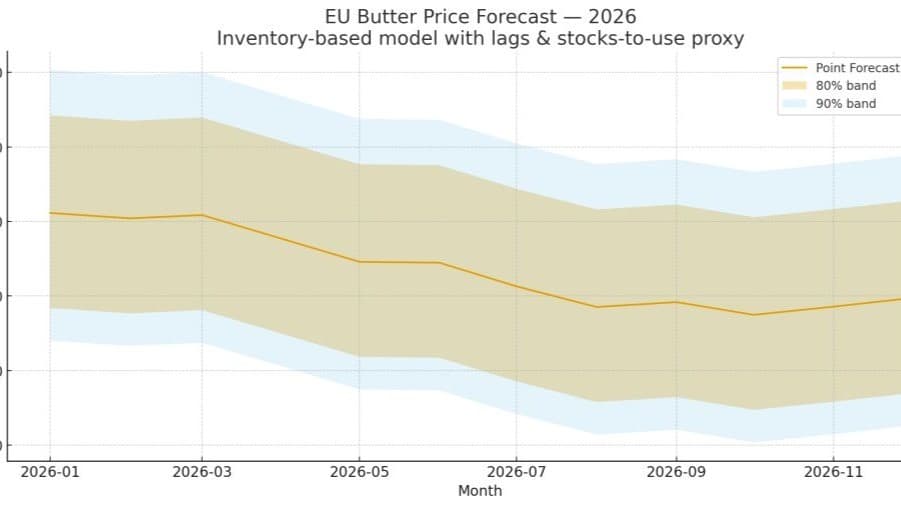
Summer Shopping or Summer Sale?
Last week was again a bit of a bearish week for the entire dairy industry. With cream prices under pressure and milk intake still strong, we keep seeing a market that has more supply than demand. Butter prices took another step lower, cheese prices cracked, and the powder market gave back a bit of its gains again.
The weekly report
Get it before it is anywhere else
Every market report, straight to your inbox the moment it is written. Butter, cheese, powder, liquids — pick what you actually trade.
Roughly weekly · Free · Unsubscribe any time