Bears will be Bears, And Bullies will be Bullies

Last week was an extremely busy one from our point of view. With over 6,000 mt of product changing ownership via our books, it marked the busiest week in our existence. Most of the volume was traded in butter, although the powder market took a larger-than-usual share of overall activity. We were asked how long we intend to maintain our bearish outlook. In our view, the answer is straightforward: the bears are likely to remain in control of the dairy market for quite some time. Structural supply pressure is unlikely to change over the next few months. That said, with a big bully in the US injecting ever more uncertainty into global markets, the importance of staying agile is underlined once again. Volatility driven by politics, trade war rhetoric, and policy risk is something the market will have to learn to live with. Let's just say that in the dairy market, the bears will remain bearish—and in the US, the bully will continue to bully.
Last time we wrote something critical about the US president, we received significant pushback from some of our US readers. The argument was clear: business and politics should be kept separate—a view we usually agree with. However, the current political climate in the US is increasingly impacting global markets, and not because of ideological differences. It is driven by a reckless president, willing to bully the rest of the world into his direction. Flexing power and threatening allies. This is not a strategy; it is classic schoolyard behaviour, pushing others around to show dominance.
We already touched on this in a previous update, but the reality remains: the only way to deal with a bully is to push back. From a personal standpoint, we hope the EU will stand firm and defy the threats of Mr. Trump. Yes, that may escalate tensions into a trade war. Yes, that could be bad for (our) business and strain overseas relations and contracts. But we would be proud EU citizens if the EU accepts those short-term painful consequences in exchange for long-term stability, credibility, and independence.
That where we leave it with our personal opinion about Mr. Trump. But we do have to take a look on if and how this will impact the situation for the EU dairy market.
Tariff Impact: More an FX Issue Than a Trade One
When news broke on Saturday about a 10% tariff increase on selected EU countries, we received several messages asking whether this should be seen as bullish or bearish for the dairy market. Our first reaction: bearish, but with important nuances. For butter and cheese, the US remains a key export destination for the EU, while SMP is far less exposed in terms of directs outlet. However, history matters. Last year the EU faced far more severe tariff threats, and even with duties in place, butter exports to the US continued to grow in 2025. Cheese exports did slow somewhat, but it remains unclear whether this was tariff-related or driven by higher domestic US cheese production.
The challenge with tariff threats that change every few weeks is that markets struggle to price them properly. In discussions with EU exporters over the past year, the prevailing view has been consistent: tariffs are paid by the importer, and as long as orders continue to come in, there is little reason to adjust sales projections.
The bigger potential impact may actually come from the other direction. Last year, substantial volumes of US fat were imported into the EU They are one of the key reasons stocks in the EU rose to the level it did. If the EU decides to retaliate with tariffs on US dairy products, this could disrupt planned imports in the coming months. We know significant volumes are already on the water or about to go on, but higher tariffs could break the economic rationale for importing US fat into an already well-supplied EU fat market.
In that scenario, the net effect could be mixed:
That said, any volume impact is likely to be limited in absolute terms.
Where the real risk lies is not trade flows, but FX and macro spillover. Market reaction from the last year so far suggests that the impact on the USD and interest rate expectations could be more significant than the tariffs themselves. A weaker USD would be particularly negative for the EU competitiveness on export. We expect the biggest impact on SMP, given the EU’s heavy reliance on export competitiveness. With SMP prices already softening toward the end of last week, adverse FX moves could reinforce downside pressure rather than offset it.
For now, we expect markets remain in wait-and-see mode, but if tariffs escalate into broader financial uncertainty, FX may end up doing more damage than duties ever could.
GDT: Another Bullish Surprise or a Correction?
This week’s GDT will provide the first indication of whether global dairy markets are reacting at all to the rising tensions between the EU and the US. Looking at NZX futures, we see signs of a mild correction following the bullish GDT outcome two weeks ago. WMP, butter and AMF futures are pointing slightly lower. SMP futures look marginally stronger at first glance, although EU market sentiment weakened toward the end of last week. Overall, we expect most products to show an average, slightly weaker correction.
From an EU perspective, butter will be the key focus. EU butter prices from Solarec, which during the previous tender averaged around €4,150, have moved ahead of global benchmarks. A GDT butter result above €4,000 would therefore be a firm signal. More realistically, we expect the tender to land between €3,850 and €3,950.
Mozzarella is likely to show some strength. With the previous tender closing around €2,930, we see scope for prices to move closer to €3,000 this round.
For SMP, while NZX futures indicate modest upside, the picture from the EU is less convincing. Recent ONIL tender results look to be slightly disappointing and have weighed on Thursday and Friday market confidence. Combined with softer EU sentiment and ongoing export competition, this raises the risk that SMP could struggle to hold recent gains and potentially settle at a lower level than the previous GDT outcome.
With WMP and butter futures pointing lower, EU butter expected to correct more visibly, and SMP facing renewed downside pressure, while the more constructive commodities only perform marginally better, the overall GDT outcome is likely to be slightly negative.
Butter: Sales Volumes Pressing Prices Lower
Looking at the butter market last week, we saw over 3,000 mt changing hands via our books, of which more than 200 mt was traded via the GFD Marketplace. While this is only a first step, we are encouraged by the engagement so far: 20 companies logged in, six partners placed bids or offers, and three partners confirmed the first trades via the platform.
Prices moved materially lower across the curve. Spot and nearby NL/DE/BE butter traded down by roughly €200, with Q1 changing hands as low as €3,725.
A similar correction was visible on EEX futures, although prices hover roughly € 150-200 higher due to the disconnect between physcial traded prices and official quotations. Following the French EEX settlement, which fell sharply from €4,800+ to around €4,310, the premium of EEX futures versus physical butter narrowed a bit. With physical quotations expected to move lower again this week—still lagging the market—we expect EEX futures to follow and potentially drag the market down further.
From a supply perspective, pressure continues to build. Butter plants are running at full capacity, as plants in Eastern Europe struggle to absorb additional cream, even at prices around €3,200. With fresh butter production achievable at cream levels nearing €3,000, production costs below €3,000 look increasingly realistic in the coming weeks.
We remain confident that cheaper Eastern European butter will continue to weigh on Western EU prices, reinforcing the current bearish momentum. We start the day with the following bids and offers on the GFD Marketplace. For those interested in offline bids and offers, feel free to contact us.
Cheese: Silently Building Stock
The cheese market remains something of a black box. Activity is limited, with both buyers and sellers acting calmly and showing little urgency to engage. And this seems to be not only the case for us, but also most of our trading partners. On paper, however, momentum should be building on both sides. Both sellers and buyers have avoided the market longer than normal, creating urgency on both sides we think.
Data-driven partners remain firmly bearish. Higher production figures combined with weaker export numbers suggest that stocks should be accumulating. From a purely statistical perspective, the market should be under pressure. Yet feedback from partners active in physical flows tells a different story. Product on offer remains relatively young, end users appear short-covered, and producers continue to act relaxed. In practice, availability in the nearby market remains limited.
While we prefer to steer by data, we cannot ignore what we see in the market. At this stage, we are unable to source meaningful short-term volumes to broker. As long as our partners show more buying interest than selling interest, it is difficult to adopt a bearish stance on cheese.
Tuesday’s GDT tender may provide further direction. We expect more buyer interest and potentially a stronger mozzarella result. Whether this triggers a short-term squeeze, as some partners anticipate, remains to be seen. For now, our bias remains constructive, at least until sellers start actively approaching the market.
There is currently no cheese market visible on the GFD Marketplace. Once activity emerges, we will report on it. If you want to be among the first to bid or offer cheese via GFD, feel free to get in touch.
Our best indications for the product are:
Powder: Momentum Leaving the Market
Since the start of the year, the powder market had built moderate bullish momentum, lifting prices €150–€200 above pre-Christmas lows. Relatively solid export demand, a stronger USD, and higher price levels in New Zealand and the US positioned the EU as the most competitive origin. Add a series of tenders, and the market found temporary support.
That momentum, however, now appears to be fading.
Recent tender results—based on the information available so far—came in below expectations. May/June deliveries reportedly cleared around $2,700–2,740, well below the $2,850 levels initially discussed. The EU’s share of these volumes is not yet fully visible, but we will report once more clarity emerges.
At the same time, cheap SMC continues to weigh heavily on the market. Although SMC prices have firmed slightly, we still see material offered between €550 and €700 ex works, with some partners claiming fresh production costs well below €1,400.
If momentum continues to fade before SMC prices can close the gap with SMP, the risk is that SMP prices will once again follow SMC lower, potentially pulling values back toward pre-Christmas levels. Export demand remains reasonable, but global milk production continues to run above year-ago levels, limiting the market’s ability to absorb downside pressure.
For now, the powder market appears to be losing direction, with downside risks increasingly outweighing upside potential.
Final Thought
Markets do not need certainty to function, but they do require consistency. In the current environment, fundamentals continue to point lower, while political risk adds another layer of unpredictability rather than support. For now, bearish sentiment remains intact, and volatility is being driven more by headlines than by structural change.
In that setting, positioning, flexibility, and discipline matter more than conviction. Bears will remain bears—and uncertainty will continue to reward caution.
More from the desk
Our Long View Before Our Long Break 
Our Long View Before Our Long Break
Last week the market found a bit of stability. After lower trades on cheese, the cheese market traded slowly up, although a real rally remains absent. Butter prices did dip a bit further, although at the start of this week we see some strength on the back end of the curve. And on powder, our bullish feeling just doesn't go away — and now we can find some confirmation in the market as well.
Dairy Carry Has a Shelf Life 
Dairy Carry Has a Shelf Life
Last week was bearish across the board — every product we broker leaned the wrong way. Powders lost more momentum, cheese slipped well below €3,000 for some products, and butter continues to impress with just how much keeps showing up. Supply, supply, supply.
Summer Shopping or Summer Sale? 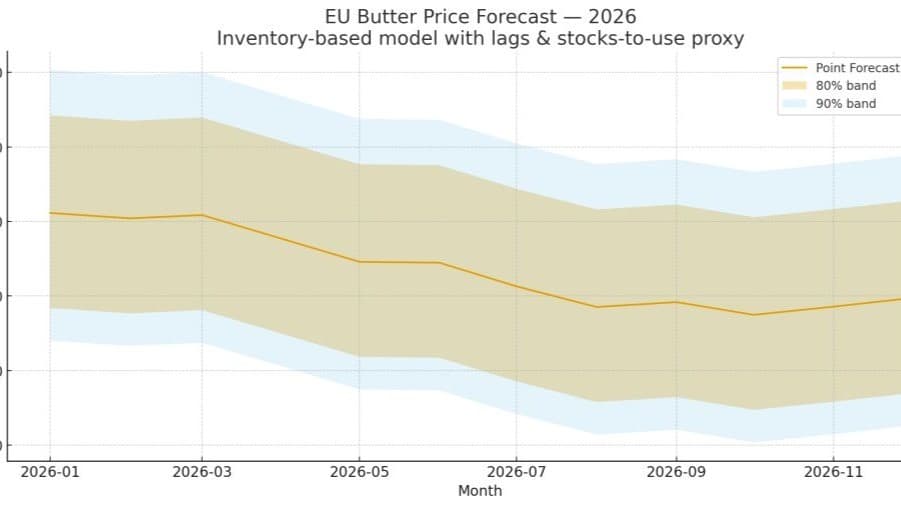
Summer Shopping or Summer Sale?
Last week was again a bit of a bearish week for the entire dairy industry. With cream prices under pressure and milk intake still strong, we keep seeing a market that has more supply than demand. Butter prices took another step lower, cheese prices cracked, and the powder market gave back a bit of its gains again.
The weekly report
Get it before it is anywhere else
Every market report, straight to your inbox the moment it is written. Butter, cheese, powder, liquids — pick what you actually trade.
Roughly weekly · Free · Unsubscribe any time