Bearish to the Finish Line...

As we approach the end of November, another active week in butter trading has pushed us close to price levels many believed would never return. Polish butter for early next year is changing hands between €4,050 and €4,150, and two partners report purchases even below the €4,000 mark. As expected, cheese prices are easing as well, while the powder market remains unusually quiet. With this November shaping up to be one of the weakest in recent memory for the fat complex, the market appears to be gearing up for a sprint toward year-end — though with ongoing pressure across cream, milk and butter, it increasingly feels like a sprint straight to the bottom.
For those tired of GFD’s persistent bearish tone, consider this some relief: this will be our final GFD update of the year. With travel, family commitments and the need for some mental breathing space, we will return to the market only in January. Our brokering activities will go to a lower level as well, although we will keep servicing our closest partners. During the following months, we intend to finally introduce the long-awaited GFD Market Place, set to go live in January 2026. But for anyone willing to indulge one more round of bearishness, here is our final forecast for EU dairy before we sign off.
We began November with a degree of optimism. Our first update of the month — “Correction Complete?” — acknowledged a bearish long-term outlook but maintained a more constructive short-term view. Historically, November is a supportive month for dairy, but this year it has been one of the weakest periods we have ever traded. At the start of the month, cream was still at €6,100, spot butter near €4,800, and Q1 butter held respectably just under €5,000, with Q2 and Q3 still firmly above that level up to € 5750. Since then, the market has unravelled. Cream values yesterday fell to €4,600–€4,700 for next week, and we hear indications as low as €3,700 for weeks 52 and 1. These declines drag butter production costs back under €4,000, and producers are already offering €4,050 FCA Poland and €4,200 FCA Western EU for the first month of next year. In our view, the entire curve slipping below €4,000 is only a matter of time. The real questions are how long the market stays there and how the rest of the complex responds.
More Milk, More Milk, and even More Milk
The underlying issue remains milk. Collections are extraordinarily high — across Europe and globally. This week’s data only deepens the bearish mood. German intake is running at +7%, the UK and France between +6% and +6.8%, and Dutch collections rose more than 7.5% year-on-year in October. The US reported +5.6% on a solids basis for the same month, and Argentina is more than 10% higher. The liquid spot market reinforces the message. Production pressure remains intense, with raw milk for next week reported between 23ct and 28 cents in Western Europe and Christmas milk falling well below 20 cents. Cream has slipped sharply under €5,000, with most indications between €4,500 and €4,750; UK cream is even testing €4,000 for next week. Supply keeps coming, demand does not, and even SMC — which had shown some recent strength — has slid back to €1,000–€1,200.
Conversations with partners about milk intake offer little encouragement. Many expect the next six months to mirror recent weeks. Bluetongue may ease, but the US and Argentina never had to deal with it. Even within Europe, regions untouched by the disease are showing strong year-on-year increases. The lower milk price has not yet triggered any slowdown in production, and as we step over a weak H1 2025 base, we expect H1 2026 milk to show a further +2% to +5% increase.
Not IF, but How Long below € 4000
For butter, the descent below €4,000 seems inevitable. The last time official quotations broke below that threshold was June 2019, and they remained there until February 2021 — an 18-month stretch. At the time, high stocks (although lower than expected levels for 2026) and aggressive competition from low US and NZ prices trapped EU butter below €4,000 for far longer than expected. Today the market arguably resembles that period: global milk production is running hot, export competition is intense, and EU stock levels are already above the 2019–2020 range. The previous cycle, before 2019, required nearly two and a half years (Q1 2014 to Q3 2016) before prices consistently returned above €4,000.
Some will find our stance excessively bearish, but many of the same people have dismissed growing warning signs for too long. The market is producing too much fat, and only a more proactive commercial approach will relieve the pressure. A short, clean three-month dip is simply not in line with historical cycles. Instead, we continue to see sellers reluctant to commit beyond what is already produced, chasing buyers who have covered well into Q3 2026, and taking each new sale slightly lower than the last.
A shift toward cheese production could ease some pressure on butter, but for now it seems producers want to protect decent returns on cheese. So for now the current butter output forecast remains extremely high. EU production only began significantly outpacing previous years from June onward, with YoY increases of 8% in June, 6% in July, 9% in August, and 13% in September. Anecdotal indications suggest October was similar, while November may exceed those levels given the sharp drop in cream pricing. If elevated production continues another six months at +5% to +15%, even StoneX’s forecast of the highest EU butter stocks in two decades may prove conservative, as their assumptions rely on only 2–5% growth.
History tends to rhyme. After record-low stocks, the EU will spend the next phase digesting record-high stocks, and cycles of heavy inventory always require low prices to clear. This process consistently takes more than a year to materially influence the market. With limited export relief and competing regions producing aggressively, these depressed prices risk becoming more persistent than the industry can comfortably tolerate. Over time this will damage parts of the supply chain, but markets rarely ask permission to be rational.
Our GFD forecast is straightforward. When we return from the December break, we expect the butter market for H1 2026 to be firmly below €4,000. The heavier pressure should unfold by late Q1 and into Q2. In our update Ai AI AI why so bearish from early October we asked AI to forecast butter prices. It's forecast Q1 at € 4100 seems spot on, its forecast Q3 around € 3000 feels very plausible. We estimate the market may need to finance and carry an additional 60,000 to 80,000 tonnes of butter compared with this year, and such volumes only move at meaningful discounts. In the most stressed scenario, the market could briefly probe levels near €3,000 during the summer, before gradually rebuilding toward €4,000 by this time next year.
Cheese: How long can producers protect cheese?
Although cheese prices are not immune to the bearish momentum in butter, they have shown notable resilience. Looking back at our first November update, prices have essentially held steady, and one could even argue they have firmed slightly in the weeks since, only to ease back in recent days. Still, if butter breaks decisively below €4,000 and milk volumes begin to rise again in the coming months due to seasonal patterns, downward pressure on cheese seems unavoidable.
What stands out, however, is the determination among sellers to defend cheese values wherever possible. Either by shifting milk or selling cheap on export markets to protect the EU internal prices. In many cases, those able to protect price levels are doing everything they can to maintain them. Cheese also has the advantage of being far easier to place on the world market at a discount than butter, which limits the need to aggressively undercut domestic pricing. Even so, turning outright bullish on cheese is difficult when the broader fat complex remains as sharply bearish as it is today. Despite this, cheese has historically held up far better than butter during downturns, and we would not be surprised to see Gouda and Mozzarella continue trading between €2,700 and €3,000 during the rest of the year. EU first-quality Gouda faces fewer risks on export markets, and while global Mozzarella prices may soften somewhat, we do not expect a significant break lower. A typical Q1 demand lull combined with negative sentiment may trigger a short-lived dip, but overall demand should help insulate the market from extreme volatility.
Cheddar, on the other hand, is proving more difficult to interpret. The spread between Gouda/Edam and Cheddar could narrow further, even if production costs do not necessarily justify such a move.
Our GFD cheese outlook remains noticeably less bearish than our view on butter. Gouda could slip toward €2,700, and potentially a bit lower if sentiment worsens. For Mozzarella, we see prices trending into a similar range — perhaps slightly lower in Q1 — before healthier demand in Q2 encourages a rebound toward €2,800.
Powder: Sideways towards Intervention
The outlook for powders is increasingly shaped by the same dynamic that is weighing on the rest of the complex: rising milk intake. As seasonal production begins to build, the pressure on powder pricing will inevitably intensify. Stocks will build and are forcasted 50% higher compared to a year ago. Even if demand remains steady in key regions, the sheer volume of milk expected in the coming months will gradually tip the balance, leaving buyers more patient and sellers more willing to move volume at lower levels.
Whole milk powder in particular looks vulnerable. If global fat prices continue to break down — and the signs are all pointing in that direction — WMP will struggle to hold current values. Markets in South America are already showing heavy pressure, with aggressive offers causing international buyers to hesitate. Should this pressure continue, or even accelerate, the downward pull on WMP could deepen well into Q1, especially as Oceania and South America compete for the same export destinations.
Skimmed milk powder has been trading in an unusually tight range, but that band appears to be drifting ever closer to EU intervention territory. We do not expect SMP to actually test intervention levels, but the market will likely continue gravitating in that direction as supply builds and the fat complex weakens. Intervention may not become a realistic floor, yet it will feature more prominently in market discussions as buyers push bids lower and sellers confront increasing stocks.
Whey powder is likely to soften modestly as cheese production ramps up, increasing available whey solids on the market. However, unlike fat and WMP, whey continues to benefit from relatively healthy demand across feed and food channels. This should prevent any sharp correction and keep the downside limited. Prices may ease, but a structural collapse appears unlikely unless demand unexpectedly falters.
In summary, the powder complex faces mounting headwinds as seasonal milk growth meets broad-based bearish sentiment. WMP is at greatest risk if global fat markets continue to unravel, SMP is drifting toward intervention but unlikely to breach it, and whey may weaken only slightly as long as demand remains firm.
Final Year Note
As we wrap up this final update of the year, we want to extend a sincere thank-you to everyone who has read, commented, shared, challenged, encouraged and even disagreed with us over the past months. The discussions, the feedback, the sharp questions and the constructive pushback have all helped shape the quality and direction of GFD’s market views. We are genuinely grateful for the trust placed in us, and for the openness with which so many partners have shared information, insights and perspective. It has made our work better, sharper and far more grounded in the realities of this complex market.
It has been a year dominated by heavy supply, stubbornly bearish sentiment and more volatility than most would have wished for. Yet markets are cyclical by nature, and no trend — not even a deeply bearish one — lasts forever. After rain there is sunshine, and at some point this market will turn again. Until then, we appreciate your continued engagement and partnership.
We look forward to returning with fresh analysis and a clear head in January. Until then, we wish you a restful December and a strong start to the new year.
More from the desk
Our Long View Before Our Long Break 
Our Long View Before Our Long Break
Last week the market found a bit of stability. After lower trades on cheese, the cheese market traded slowly up, although a real rally remains absent. Butter prices did dip a bit further, although at the start of this week we see some strength on the back end of the curve. And on powder, our bullish feeling just doesn't go away — and now we can find some confirmation in the market as well.
Dairy Carry Has a Shelf Life 
Dairy Carry Has a Shelf Life
Last week was bearish across the board — every product we broker leaned the wrong way. Powders lost more momentum, cheese slipped well below €3,000 for some products, and butter continues to impress with just how much keeps showing up. Supply, supply, supply.
Summer Shopping or Summer Sale? 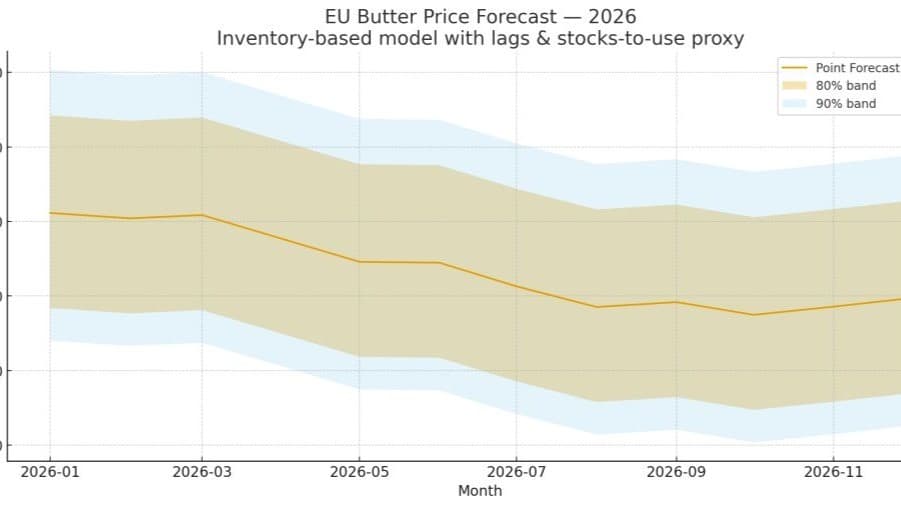
Summer Shopping or Summer Sale?
Last week was again a bit of a bearish week for the entire dairy industry. With cream prices under pressure and milk intake still strong, we keep seeing a market that has more supply than demand. Butter prices took another step lower, cheese prices cracked, and the powder market gave back a bit of its gains again.
The weekly report
Get it before it is anywhere else
Every market report, straight to your inbox the moment it is written. Butter, cheese, powder, liquids — pick what you actually trade.
Roughly weekly · Free · Unsubscribe any time