

Happy New Bears! And A Bullish GDT!

Yes! We are back, and let us start by saying Happy New Year to everyone. As we enter 2026, let’s optimistically assume it will be a normal year for the dairy industry — ideally with fewer tariffs, fewer export blocks, fewer animal diseases, and fewer logistical “surprises” than we’ve grown accustomed to. To all your loved ones, families, and friends, we wish good health above all. And to all companies across the dairy chain, may 2026 be the year of calm markets, clear signals, and wise strategic decisions.
After spending a few weeks in the snowy Alps with our family, we were happy to return to the market—reading, discussing, and debating what 2026 might have in store. It’s probably fair to say that forecasting too far ahead makes little sense. After all, who would have predicted the US removing the Venezuelan leader, Western Europe coming to a standstill because of icy roads, decade-low spot prices for liquids, and a surprisingly bullish GDT kicking off the year after nine consecutive bearish auctions? Still, we wouldn’t be ourselves if we didn’t at least try to put the current market into perspective and offer a view on the weeks ahead. So with that said: welcome back to the GFD market updates.
After following the market from the sidelines, we returned with the sense that surprisingly little had changed over the past month. Prices are still broadly within the range at which we closed our books, and the forward curve on futures doesn’t look materially different from where it was when we stepped away. Lower activity initially pushed prices slightly higher during our absence, but pressure from the spot market—particularly on liquids—has since pulled values back down.
The continued year-on-year increases in milk intake keep surprising the market. Across reports from banks, benchmark agencies, dashboards, and international traders, the conclusion is broadly the same: the current growth in milk supply is increasingly expected to persist well into Q2 of this year.
Liquids: Finding Outlets
Looking more closely at the spot market, one of the reports we follow closely noted that prices around Christmas fell to their lowest levels of the past decade. With spot milk reportedly available for just a few cents, SMC trading around €450/mt and cream dipping below €3,000 FCA, the downside move proved sharper than we had anticipated. Even prices for delivery this week have struggled to recover meaningfully.
Early indications from the cream market suggest offers for next week are coming in around €3,500 ex works, although some end users claim to have already secured volumes DAP at similar levels. For spot milk and SMC, we have yet to see concrete offers materialise. To our surprise, the companies selling cream also have the ability to process the cream into block butter, but they claim to have no extra capacity. Finding that capacity elsewhere seems more difficult than it should be around this time of year.
Speaking with liquids traders, the comparison most often made is to peak production months such as April and May. German milk intake in week 52 reportedly came close to the seasonal peak levels seen in 2025. If seasonal milk volumes continue to rise over the next 14 weeks (as they normally do), the market is likely to face ongoing challenges in finding outlets for spot liquids in the coming weeks. Should this scenario play out, EU commodity production would be expected to run at—or very close to—maximum capacity.
GDT: Surprisingly Bullish
It’s not all bearish data on our screens. Yesterday marked the first GDT auction of the year and, to our surprise, the index jumped by 6.3%. After nine consecutive declines, a technical rebound would have made sense—markets do tend to bounce eventually. But a 6.3% move? We’re still searching for a fully logical explanation.
Looking more closely at the results, AMF and butter stood out, up 7.4% and 3.8% respectively. These outcomes do not neatly align with SXG futures, the generally bearish sentiment on the CME, or recent price developments in the EU. Some markets clearly favor NZ product over EU or US product, even if it means paying a good premium. That said, when zooming in on EU butter specifically, the result appears more reasonable. With Solarec butter trading on average around €4,150/mt for Feb–April, the GDT outcome broadly matches levels seen in our earlier market trades and EEX futures.
EU mozzarella also landed slightly stronger than some might have expected. However, at €2,930/mt, it still sits comfortably within the price range observed over recent weeks. That said, if more milk continues to be channelled into cheese production—as recent data suggests—this tender price may well turn out to be the highest mozzarella level seen over the coming months. We can't help it, our market outlook for Mozzarella for Q1 remains more bearish than this tender result suggests.
The biggest surprise, however, came from the powder markets. With SMC trading well below €1,000/mt in the EU, we would have expected SMP to remain subdued for at least a few more weeks. Instead, strong exports at the lower end of the price range are keeping buyers active. It even appears that some traders may have oversold their positions and were forced to cover shorts. If this rally is a mini shortsqueeze or a fundamental reversal will have to be seen. On the WMP side, the 7.2% increase caught even our most bullish contacts off guard. Futures had been trading well below $3,000/mt prior to the event, and global stock levels hardly justify such a sharp rebound.
In all fairness, we would have forecasted the GDT slightly higher, largely due to the lack of recent benchmarks and the fact that sellers had been relatively absent from the market for several weeks. We did expect buyers to use the first opportunity of the year to test the waters—but the magnitude of this move feels like an overreaction.
Some partners point to rising geopolitical tensions prompting buyers to lock in additional volumes, while lower offered quantities this tender may have amplified the price response. Whatever the drivers, facts are facts. This bullish move should not be dismissed as a market anomaly, but rather as a clear warning to speculators: even when the most visible fundamentals remain firmly bearish, underlying sentiment can turn the market faster—and harder—than many expect.
Butter: Lack of Activity and Visibility
The butter market—normally characterised by high activity and clear price signals—has been unusually muted over the past few weeks. Small spot buyers continue to appear intermittently, but with very limited volumes. At the same time, producers are largely absent from the market when it comes to pushing fresh product. The result is a market with low liquidity and very limited visibility.
From a fundamental perspective, the butter market is showing some of the weakest data we have encountered in our trading careers. Production is at record highs, consumption is at best stable—and increasingly challenged by the ongoing shift from fat to protein—and stock levels are rising at the fastest pace seen in the past 20 years. Forecast models point to the EU carrying its highest butter stocks in history by the coming summer.
And yet, despite this overwhelmingly bearish backdrop, the market refuses to trade meaningfully lower. Even after six months of a clearly bearish trend, market behaviour remains remarkably unchanged. Buyers and end users continue to show strong forward-buying interest. Prices for H2 delivery between €4,500 and €4,700/mt still fit comfortably within many procurement budgets, and few are willing to wait—or speculate—on substantially lower levels. Forward buying remains firm, keeping the market very well supported.
On the supply side, producers remain cautious. More cooperatives are now lowering milk prices below 40 cts, and expectations are growing that lower milk prices will eventually curb milk production. There is sound logic behind this view, and it explains the strategy currently adopted by most sellers: sell what needs to be sold, but keep what can be kept. And although this is leading to stock levels rising rapidly, no one wants to be caught oversold when the market inevitably turns bullish again.
Traders, meanwhile, have played their role. Many front-ran the market, selling short when producers were reluctant to do so, and are now locking in profits for the forward risk they assumed. Selling short into Q3 or Q4 is no longer attractive, and at present most traders are acting more as financiers—selling the premium in Q3 and Q4 while absorbing excess stock being released into the market, parcel by parcel, by producers.
We expect these dynamics to remain in place for the coming months. However, with production ramping up, stocks building further, and forward contracts increasingly filled, the broader trend remains bearish. Unless export markets start absorbing significant additional volumes, we expect prices to gravitate toward levels implied by historical supply-demand balances—namely a €3,300–€3,500/mt butter range over the next six months. Cream prices are already pointing in that direction; time may simply be needed for the physical butter market to follow.
One factor that continues to distort the picture is the EEX forward curve. We have consistently observed physical butter trading €200–€250/mt below futures. The persistent disconnect between German and French butter quotations remains the key reason futures and physical prices fail to align. The latest French quotation came in above €4,700/mt—it will be interesting to see whether upcoming quotations move closer to current physical levels and recent GDT results.
We expect to start the day with the following markets.
- January offers NL/DE/BE at € 3950-€4000 bids € 3800
- Q1 offers NL/DE?BE at € 4050 and bids at € 3900
- Q2 offers NL/DE/BE at € 4250 and bids at € 4150
- Q3 offers NL/DE/BE at € 4500 and bids at € 4325
- Q4 offers NL/DE/BE at € 4600 and bids at € 4550
Cheese: Production Increases Could Lead to Price Pressure
The cheese market has moved largely sideways in recent weeks. While prices may have briefly corrected too far to the downside—dropping below €2,800/mt for Gouda, Edam, and mozzarella—the market is now finding it increasingly difficult to regain levels above €3,000 ex works. Although a handful of trades crossed that threshold towards year-end, we also saw prices slip back below shortly thereafter. The last three GDT auctions offer a fairly accurate reflection of this behaviour: prices fell too far, rebounded, but failed to build the momentum needed to move structurally higher.
From a supply perspective, cheese production has been trending higher week after week. A significant portion of these volumes has found an outlet in export markets, but competition has clearly returned. Based on what we are hearing, new export contracts are no longer being concluded as easily as they were six weeks ago. What supported the market earlier may not provide the same level of protection going forward.
If milk intake were to surpass the 2025 peak already in January, the market will need to absorb substantially more cheese. Exports may once again help relieve some of the pressure, but with Gouda, Edam, and mozzarella priced above €3,000/mt, that seems increasingly unlikely. For the weeks ahead, we expect the market to remain rangebound, with the lower end of the range around €2,700/mt and the upper end just above €3,000/mt.
We expect the market to open with the following levels.
- January Gouda offers € 3050 NL/DE and a bid at € 2850
- Q1 Gouda offer at € 3100 NL/DE and bids at € 2850
- January Mozzarella bid at € 2800
- Q1 Mozzarella offer at € 3000 and bid at € 2800
Powders: Oversold?
The powder market traded within a relatively tight range for much of the year, but toward the end of last year—under pressure from cheap concentrate and intense global competition—it broke decisively lower, slipping below €2,000/mt. Viewed purely from the supply side, the increasingly bearish tone was hardly surprising. Concentrate trading well below cost price during some of the most expensive months of the year is typically a clear warning signal. Stock data shows modest inventory build-ups, and persistently low oil prices rarely offer much support to powder markets.
That said, the demand side has remained largely unchanged—and has done so for years. Buyers see little incentive to aggressively chase the absolute bottom of the market when prices are already hovering near historical lows. Their logic mirrors what we currently observe in butter: these price levels fit comfortably within cost models, the reward for waiting is limited, and the risk of being wrong is simply too high.
At these lower levels, it appears that traders—and in some cases even producers—may have oversold the market, leading to a mild short squeeze. While we do not see buyers pushing aggressively for volumes above €2,050/mt, selling below this level is also failing to attract meaningful interest. Once again, the market feels firmly rangebound, with ample buying interest below €1,950/mt and plenty of selling interest emerging above €2,050/mt.
Final Note
To close, one thing feels clear: this is not a market that rewards conviction without humility. Fundamentals, sentiment, positioning and behaviour are pulling in different directions, and the last weeks have once again reminded us how quickly markets can challenge consensus views. Prices may look heavy, signals may appear obvious, yet the market continues to move on its own terms.
In an environment like this, timing matters more than theory, discipline more than bravado. Flexibility—not certainty—remains the most valuable asset. As always, we will keep watching, questioning and adjusting, because in today’s dairy markets, the only real mistake is assuming the next move will be obvious.
We wish everyone a strong start to the year and look forward to navigating the weeks ahead together.
More from the desk
Our Long View Before Our Long Break 
Our Long View Before Our Long Break
Last week the market found a bit of stability. After lower trades on cheese, the cheese market traded slowly up, although a real rally remains absent. Butter prices did dip a bit further, although at the start of this week we see some strength on the back end of the curve. And on powder, our bullish feeling just doesn't go away — and now we can find some confirmation in the market as well.
Dairy Carry Has a Shelf Life 
Dairy Carry Has a Shelf Life
Last week was bearish across the board — every product we broker leaned the wrong way. Powders lost more momentum, cheese slipped well below €3,000 for some products, and butter continues to impress with just how much keeps showing up. Supply, supply, supply.
Summer Shopping or Summer Sale? 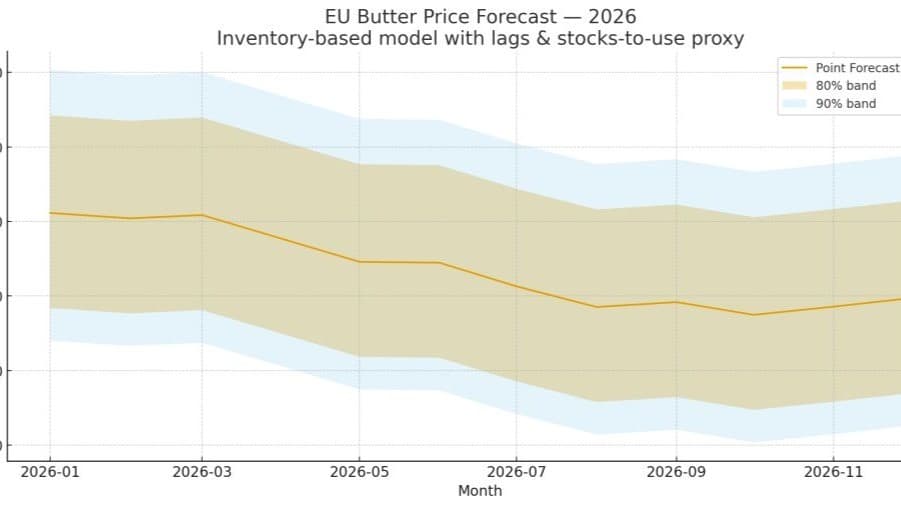
Summer Shopping or Summer Sale?
Last week was again a bit of a bearish week for the entire dairy industry. With cream prices under pressure and milk intake still strong, we keep seeing a market that has more supply than demand. Butter prices took another step lower, cheese prices cracked, and the powder market gave back a bit of its gains again.
The weekly report
Get it before it is anywhere else
Every market report, straight to your inbox the moment it is written. Butter, cheese, powder, liquids — pick what you actually trade.
Roughly weekly · Free · Unsubscribe any time