
Welcome to the Bullmarket Nobody Believed In
We thought we had seen it all. Years of trading and brokering have taken us through brutal sell-offs, panic-driven rallies, short squeezes, false dawns and every dead-cat bounce the dairy market could throw at us. But the first week of February has managed to outdo them all. This is not just volatile — this is outright absurd. EEX futures for butter, cheese and SMP are ripping higher, while SGX and CME are printing price moves we have never witnessed in our careers.
Welcome to the bull market nobody saw coming — and one that is making even seasoned market participants uncomfortable. Bits and pieces of data and anecdotal evidence are starting to emerge that help explain parts of the move, but large sections remain stubbornly irrational. A broad-based bull run in a world that is producing more milk year after year is not just counterintuitive — it flat-out breaks the rulebook.
This is the kind of market that punishes conviction, humbles fundamentals and rewards those who respect positioning, liquidity and timing over neat supply-and-demand models. Whether this move proves genius or madness is still an open question — but ignoring it is no longer an option.
"What if we did not have + 5% more milk in the EU, or + 4% in the US, or + 2,5% in NZ, think about that."
That sentence stayed with us all the way home that evening, somewhere between Amsterdam and the quiet rhythm of a late train ride. Earlier yesterday, Vesper had hosted a well-organised event, featuring a strong presentation on the Vesper Price Index and Euronext’s launch of dairy futures. Talking about risk management in a room full of traders, producers, and end users who, while listening, all were looking at their phones trying to manage their risk, had something absurd but fitting at the same time. Afterwards, we found ourselves mingling with these same traders, producers and end users — all exchanging the same raised eyebrows, the same silent question marks hanging in the air. Hands open, shoulders shrugged, like a passionate Italian at the dinner table asking only one thing: what the hell just happened?
The train ride back gave us time to reflect. What if that extra milk simply hadn’t been there? Would this rally have started earlier? Would it have been more violent? Or would it have looked exactly the same? Counterintuitively, our conclusion went the other way. Without the roughly 5% year-on-year increase in EU milk production, we likely wouldn’t be seeing a rally at all.
That surplus milk created the perfect setup. It convinced the market that supply was overwhelming, that prices had further to fall, and that being short was the sensible, rational position. Without that extra 5%, no one would have dared to lean so heavily against the market. And without that extreme positioning, there would have been nothing to squeeze. In other words, the very surplus that was supposed to cap prices may have been the fuel that ignited the rally.
But lets face it, rallies can have many triggers — from positioning and supply shocks to demand shifts or policy changes — but the current move is not driven by a single narrative. Instead, each product is rallying for its own reason, highlighting how fragmented the underlying market dynamics really are.
Powders: Fundamentally Bullish, Not only by sentiment
Powders (SMP) are moving as supply reality finally catches up with the market. Stocks are materially lower, production has been constrained for several months, and replenishment has simply not kept pace with ongoing offtake. What initially looked like comfortable availability has quietly disappeared, leaving buyers competing for limited volumes. This is a rally driven less by demand acceleration and more by the absence of product — the market is repricing scarcity rather than optimism.
From an EU perspective, the idea of an absence of product is admittedly harder to accept. With abundant milk flows and weeks of cheap SMC on offer, the intuitive question is why Europe is not swimming in powder — and whether prices should already be drifting toward intervention levels. On the surface, the balance sheet looked heavy.
However, powders are among the most internationally linked dairy products, and the global picture is cleaner than it appears from an EU-only lens. Lower SMP and nonfat production in the US, combined with structurally higher protein demand — driven by the ongoing “protein in everything” trend — has tightened the global balance. As a result, excess has been absorbed more efficiently than anticipated, keeping the market far from the distress pricing many expected.
Adding to that, with EEX prices around €2,800 for Q2 and €2,900 for Q3, the powder market increasingly feels oversold. While fundamentals alone may not force an immediate repricing, they do leave the market vulnerable to a higher move should a large buyer step back in. Sales-side liquidity remains thin, and history shows that thin markets tend to rally longer — and higher — than many expect.
With more than 2,000 mt of powder traded in just the first four days of the month, prices have moved sharply higher. Non-standardised material has climbed from around €2,300 to levels as high as €2,650, while Codex trades have ranged from as low as €2,150 for prompt loading earlier in the week to approximately €2,570 for Q2 business concluded late yesterday.
Butter: Textbook Short Squeeze
Butter, by contrast, is what we would call a positioning snap. Traders entered the market heavily short, convinced that fundamentals would eventually soften prices, but thin liquidity left little room for error. The bullish sentiment on powders overflowed to the butter market, and traders started to fear prices might also increase. As the market edged higher, stop losses were triggered, forcing shorts to cover and flip into long positions. The resulting forced buying accelerated the move, despite the fact that underlying fundamentals did not materially change overnight — positioning did. On butter, we are seeing a textbook short squeeze.
Following a short squeeze, markets rarely move in a straight line. While the forced buying that initially drove prices higher may be behind us, not every market participant has adjusted positioning yet. Some shorts remain exposed, sellers are cautious, and liquidity on the offer side remains thin. In such an environment, prices can stay elevated — and volatile — longer than fundamentals alone would suggest.
At the same time, end users this week have largely remained on the sidelines. Coverage for Q3 and Q4 has not yet meaningfully followed the price move, leaving room for additional upside should buyers be forced back into the market. Without consistent selling pressure and with parts of the demand base still under-covered, the market remains vulnerable to further upward extensions, even in the absence of fresh bullish news. As we are still a few weeks from stocks to start hammering prices back down, we see some room for some extra upside for butter, although limited for February-June contracts.
Ultimately, however, positioning dynamics fade and fundamentals reassert themselves. As higher prices start to ration demand and heavy supply-side data works its way through the balance, the market is likely to lose upward momentum. Once end-user coverage is restored and liquidity normalises, fundamentals are expected to pull prices back down, turning what began as a positioning-driven rally into a more measured and data-led market phase.
We traded over 1000mt of butter in the first 4 days of this week, with prices starting as low as € 4240 on Monday for Q3 butter, NL/DE/BE and trading yesterday as high as € 4850 for the same period. While the buy side faded a bit by the end of the day, we do expect the curve for butter to be roughly € 300 above the Monday market.
Cheese: Moving along with the sentiment
Cheese tells a different story again, one of demand that simply refused to fade. Despite persistent macro caution, export markets remain active and buyers continue to operate hand-to-mouth, returning repeatedly for nearby coverage. Rather than stepping aside, demand has stayed present, keeping the market structurally supported and limiting downside. In this case, the rally is less about surprise and more about resilience. And if the overall sentiment turns bullish, that sentiment should spill over into the cheese market as it is doing right now.
We continue to link the cheese market more closely to butter than to powders. As long as fat prices remain firm, cheese values are expected to stay supported as well. The recent strength in cheese, therefore, reflects resilience in the fat complex rather than dynamics in the powder market.
However, should butter prices start to give back the gains made during the recent rally, downside risk for cheese will re-emerge. While cheese typically follows the broader direction of fat markets, its price movements tend to be more measured. Where butter prices often adjust in large, abrupt steps, we would expect cheese to respond more gradually, playing a more modest role on both the upside and the downside.
More from the desk
Our Long View Before Our Long Break 
Our Long View Before Our Long Break
Last week the market found a bit of stability. After lower trades on cheese, the cheese market traded slowly up, although a real rally remains absent. Butter prices did dip a bit further, although at the start of this week we see some strength on the back end of the curve. And on powder, our bullish feeling just doesn't go away — and now we can find some confirmation in the market as well.
Dairy Carry Has a Shelf Life 
Dairy Carry Has a Shelf Life
Last week was bearish across the board — every product we broker leaned the wrong way. Powders lost more momentum, cheese slipped well below €3,000 for some products, and butter continues to impress with just how much keeps showing up. Supply, supply, supply.
Summer Shopping or Summer Sale? 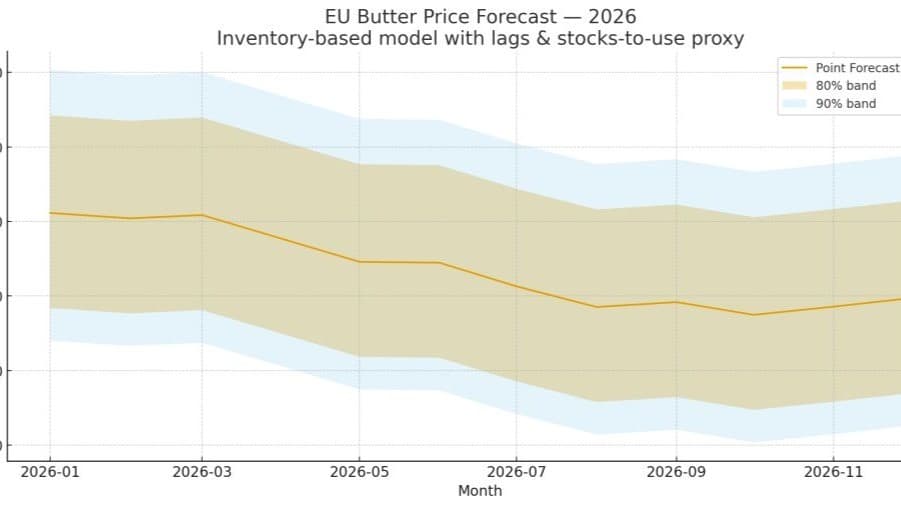
Summer Shopping or Summer Sale?
Last week was again a bit of a bearish week for the entire dairy industry. With cream prices under pressure and milk intake still strong, we keep seeing a market that has more supply than demand. Butter prices took another step lower, cheese prices cracked, and the powder market gave back a bit of its gains again.
The weekly report
Get it before it is anywhere else
Every market report, straight to your inbox the moment it is written. Butter, cheese, powder, liquids — pick what you actually trade.
Roughly weekly · Free · Unsubscribe any time