
Dubai Bulls Taking over the World

Last week, we highlighted the contrast between the bullish mood in Dubai during Gulfood and the far more cautious—if not outright bearish—sentiment back home in the EU. That caution seemed justified on Friday, when EU prices softened and it felt as though the optimism had been left behind in the Middle East. Turns out the bulls were just extending their stay. After the long weekend, they boarded flights back to the US, Asia and Europe—and they brought the party with them.
Yesterday, the EU butter market again found some upward traction, but it is the powder complex that is now stealing the spotlight. And while instinct tell us to treat this rally with scepticism, the underlying signals suggest this move cannot be brushed aside as sentiment-driven noise alone. Facts, at this moment, are starting to speak louder than gut feeling.
Those who know us well know that we take time—and pride—in writing our reports. We aim to strike a balance between data, fundamentals, hearsay, gut feeling and the actual trades we broker. We take particular pride in identifying shifts before they become consensus. Timing may not always be perfect, but directionally we are usually on the right side of the market.
This current bullish move, however, is one we did not foresee.
At the risk of sounding like one of our partners in denial, we continue to struggle to find the data that convincingly explains the market’s sudden rush to higher levels. Perhaps we are placing too much weight on the supply side—but that supply side continues to tell a distinctly bearish story. Milk volumes remain strong, spot liquids still imply lower commodity values than those currently being traded, and rising commodity prices increase the likelihood that farm-gate prices remain elevated, cancelling the break on milk production and putting the foot back on the gas pedal.
Milk collection data continues to surprise to the upside, while analysts we follow maintain forecasts for strong production growth in the months ahead. And this is not just an EU story: production in the US and New Zealand is also outperforming expectations. From a supply perspective, the message remains clear—and bearish.
On the demand side, however, we have to acknowledge that we missed part of the picture. Particularly in powders, EU exports continue to impress. While we did observe increased sales activity, we underestimated how quickly stocks were being absorbed. In hindsight, the cheese market offered a clear signal. Strong export demand in a low-stock environment leaves little room for error: the market tightens quickly. Even as reported EU cheese exports slow, low inventories keep the market clean, prices stable to slightly higher, and sentiment supported. The bid side of the market is well outpacing the offer side with no slow down in sight.
Where the bulls continue to surprise us most, however, is butter.
Here, both sides of the equation still point bearish. Supply indicators remain overwhelming: highest stocks in years, highest production in years, and the highest imports in years. Demand data echoes the same message, with slowing consumption and weaker exports. We have received multiple calls from partners asking us to explain the bullish momentum, as they see no additional sales, no increased demand from customers, and still relatively cheap cream compared to butter prices. As we noted in previous reports, the butter market currently feels more like a technical correction driven by sentiment than a move grounded in fundamentals.
That said, by focusing too much on fundamentals, we may be underestimating what a sentiment-driven correction can look like in butter. Price swings in this butter market are structurally larger than in cheese or SMP. If SMP can rally €200/t, a €500/t move in butter is not out of the question.
But once selling pressure returns—and once the sales side reopens—this bullish momentum may fade just as easily as it appeared. Dare we say it: butter has a habit of melting quickly when the heat changes. For powders, we clearly see a lot of bullish momentum, but for butter, the current rally feels more like a second chance for the sellers who forgot to sell on the current bounce.
GDT: Bullish All the Way
The bulls took full control of the latest GDT event. At the time of writing, official figures have yet to be published, but one thing is already clear: prices moved higher across the board—and by more than we anticipated.
Starting with butter, we had forecast Solarec prices around—or just above—€4,000/t on Sunday. After Monday’s increasingly bullish tone, we allowed for a move toward €4,100/t. Seeing prices print close to €4,200/t, however, caught us off guard. Mozzarella also exceeded expectations, outperforming our €3,000/t indication by roughly €100/t to close above €3,100/t.
The biggest surprise by far came from SMP. With all prices trading north of €2,400/t, EU powder values jumped almost €250/t versus the previous event. Interestingly, as these higher SMP levels filtered into the market, CME NFDM initially moved in the opposite direction, trading lower during the day. By the close, however, the CME screen had turned green again, recouping earlier losses and realigning—at least directionally—with the GDT outcome.
This bullish GDT result reinforces the optimistic sentiment we already sensed in Dubai. And while we may not always fully understand what is driving prices higher on all commodities, it is hard to dismiss a move of this magnitude as irrelevant for the EU dairy market. It will undoubtedly strengthen seller confidence and is likely to pull buyers—who have been cautiously waiting for a clearer bottom—back into the market.
Whether fundamentals catch up or sentiment cools remains to be seen. For now, the bulls remain firmly in control.
Butter: What’s Going On?!
Over the past 24 hours, we have received an unusual number of calls from regular partners. Normally, the question is simple: do you have any bids or offers? This time, the dominant question was far more fundamental: what’s going on?
End users who use our indications as a benchmark report seeing no increase in physical sales, yet they have noticed that traders and suppliers have largely stopped issuing fresh offers. Traders—who are typically quick to take profit during price spikes—weren’t asking where the bid was, but rather why the bids we are carrying are already so high. And producers? They simply didn’t pick up the phone yesterday.
Looking at the cream market, we hardly see any changes, although sellers are trying to profit off of the bullish sentiment. But it appears that sentiment is once again doing the heavy lifting. On Monday, opening offers were heard between € 3500 and €3,700/t. As the day progressed, we heard offers as high as €3,900/t DAP. Buyers largely refused to transact at those levels, but if fear starts to creep back into the market, cream trading north of €4,000/t next week cannot be ruled out—although several liquids traders remain highly sceptical. The spot market is all over the place as the cheapest loads also traded below € 3500
Milk intake is higher than it was two weeks ago, production capacity remains constrained, and with stronger demand for SMP, separators are expected to run at full capacity. From a fundamental standpoint, this does little to support the current upward momentum in butter.
For prices to sustainably lift further, the market likely needs either eager buyers or fearful end users stepping in to lock in Q3 and Q4 coverage at February/March price levels. Until then, the market feels thin, nervous, and sentiment-driven.
At the moment, we are carrying the following bids:
- Q2 NL / DE / BE fresh or frozen: €4,100/t for 330 mt
- Q2 Irish fresh or frozen: €4,050/t for 198 mt
- Q3 NL / DE / BE fresh or frozen: €4,300/t for 330 mt
- Q4 NL / DE / BE fresh or frozen: €4,400/t for 264 mt
For now, the butter market seems to be asking more questions than it is answering.
Powders: Where will we see resistance?
Looking at the powder market, we have now seen two consecutive weeks of upward momentum. A move of €250/t in such a short time—and more than €500/t from the lows—represents the strongest price action we have witnessed in the past 36 months.
Our gut tells us that some slowdown or even a correction would be healthy and logical, particularly now that we are entering €2,400+/t FCA territory. At these levels, resistance in export markets is bound to intensify. International buyers are suddenly being asked to accept $3,000+/t-plus offers, something they have not had to do for a long time.
The domestic market, meanwhile, is still coming to terms with the speed of this rally. Buyers remain cautious, largely staying on the sidelines and stepping in only when coverage becomes unavoidable. As long as producers do not feel genuine selling pressure, the market is likely to continue moving in waves: short bursts of higher prices driven by urgent buying, followed by periods of consolidation once demand temporarily fades. Importantly, this pattern suggests that the price floor is gradually shifting higher.
At the same time, early signs of resistance are already emerging in export destinations at these elevated levels. Demand may slow modestly, particularly as end users are still working with annual budgets and forecasts built on much lower price assumptions and will need time to recalibrate.
Taken together, this points toward a scenario of temporary softening driven by short-term oversupply and easing demand, followed by renewed upward momentum. As long as EU powders remain competitive on the global stage, underlying demand appears intact.
Final Note
We have said it many times before, and we will continue to say it. Markets rarely move in straight lines—and the past two weeks have been a clear reminder of that. While sentiment has clearly taken the driver’s seat across butter and powders, fundamentals have not disappeared; they are merely lagging the price action.
For now, volatility is likely to remain elevated. Buyers will continue to test their patience, sellers their confidence, and any shift in sentiment can move prices quickly in either direction. Short-term corrections should not come as a surprise, but neither should renewed upside if coverage needs resurface.
As always, the key question is not whether prices can move, but who blinks first. In a market where fear and urgency increasingly dictate timing, staying close to the flow of physical trade matters more than ever.
We will continue to separate noise from signal—and keep calling it as we see it.
More from the desk
Our Long View Before Our Long Break 
Our Long View Before Our Long Break
Last week the market found a bit of stability. After lower trades on cheese, the cheese market traded slowly up, although a real rally remains absent. Butter prices did dip a bit further, although at the start of this week we see some strength on the back end of the curve. And on powder, our bullish feeling just doesn't go away — and now we can find some confirmation in the market as well.
Dairy Carry Has a Shelf Life 
Dairy Carry Has a Shelf Life
Last week was bearish across the board — every product we broker leaned the wrong way. Powders lost more momentum, cheese slipped well below €3,000 for some products, and butter continues to impress with just how much keeps showing up. Supply, supply, supply.
Summer Shopping or Summer Sale? 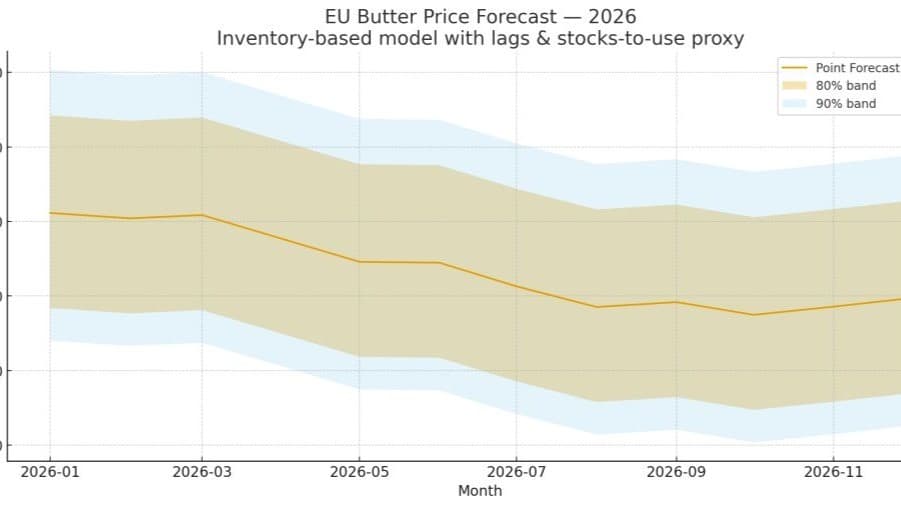
Summer Shopping or Summer Sale?
Last week was again a bit of a bearish week for the entire dairy industry. With cream prices under pressure and milk intake still strong, we keep seeing a market that has more supply than demand. Butter prices took another step lower, cheese prices cracked, and the powder market gave back a bit of its gains again.
The weekly report
Get it before it is anywhere else
Every market report, straight to your inbox the moment it is written. Butter, cheese, powder, liquids — pick what you actually trade.
Roughly weekly · Free · Unsubscribe any time