
Volatility On, Risk Off

Last week was one to remember — not only because of a few memorable nights in Dubai, but mainly because markets delivered one of the more volatile weeks in recent history. We have seen weeks with more aggressive net price moves, but this one was different. Markets bounced up, down, left, and right, offering plenty of movement but very little direction. And where high volatility usually creates opportunities for many of our partners, last week triggered something else entirely. Instead of leaning into the swings, most participants pulled the handbrake. Traders shifted risk-off, producers withdrew sales teams from the market, while purchasing departments were sent out to collect offers — just in case.
The first consequence of a risk-off strategy is often even higher volatility. Liquidity thins, conviction disappears, and price moves exaggerate. Once that phase settles, however, it typically gives way to a period of relative calm. In short: high volatility led to risk-off behaviour, which in turn fuelled even higher volatility. With February now underway, the question is not whether markets will move — but in which direction they will finally decide to do so.
Macro Volatility Sets the Tone
Looking beyond dairy, volatility has been equally pronounced across global markets. The broader macro environment continues to offer little in the way of comfort. Financial markets remain caught between persistent inflation risks, restrictive monetary policy, and escalating geopolitical tensions. Visibility is limited, confidence fragile.
Even alternative “safe havens” have not been spared. Bitcoin enthusiasts have watched more than USD 50,000 evaporate from peak levels, with over USD 15,000 lost in just the past week. Those who sought shelter in gold, silver, or other precious metals over recent months have also been reminded what a correction looks like.
Across asset classes, volatility has re-emerged as a defining feature rather than a temporary disruption. Risk premia are rising, liquidity is thinning, and markets are increasingly driven by positioning and headlines rather than fundamentals alone. Against this backdrop, capital preservation has taken priority over return optimisation. The shift toward a risk-off stance is not the result of a single trigger, but a cumulative response to an environment where uncertainty outweighs clarity.
Dairy Markets Are Noisy
This uncertain macro backdrop has translated directly into the dairy market. Price movements have become sharper and increasingly unpredictable, with wider intraday swings and noticeably thinner liquidity. Bid–offer spreads have expanded — not because fundamentals suddenly changed, but because commitment has.
In several products, prices moved meaningfully without new information to justify the magnitude of the swings. Positioning, timing, and sentiment have taken the lead. Markets are reacting first and explaining later — if at all.
As volatility rises, clarity fades. Decision-making becomes shorter-term, coverage windows narrow, and price signals lose reliability. In this environment, the market is noisier than it is informative, making patience and selectivity more valuable than speed or constant reaction to every price tick.
Why Risk-Off Makes Sense
We often look at markets through the eyes of traders — focused on selling and buying commodities to maximise returns. But conversations in Dubai once again highlighted a different reality for producers and end users.
Producers aim to sell at the market, not to beat it. Yes, selling six months ago would have delivered higher prices, but their objective is not speculation — it is execution. The same applies to many end users. Their value is created through processing and branding, not by positioning themselves in commodity markets. Buying below the market may bring short-term praise; buying below budget delivers long-term appreciation.
When market direction is clear, even the most cautious purchasing department may speculate — just as conservative cooperatives occasionally do. But speculation, anticipation, and risk-taking remain primarily trader strategies. As markets approach the edges of historical price bands, anticipating extremes becomes less of a strategy and more of a gamble.
Strategy Shifts in Practice
As long as markets trend lower, many traders remain committed to short strategies. As one experienced trader in Dubai put it: a strategy usually works — until it doesn’t. When it stops working, adaptation becomes mandatory.
Last week felt like that moment. SMP traders who played the short side over the past 12 months have been well rewarded. But as the market refuses to move lower, taking short risk off suddenly makes a lot of sense. Some traders have already started positioning for the long side, while others prefer to wait for clearer bullish confirmation. Looking at the US CME prices are shooting up. With the EU now the cheapest on the world stage, believing in lower EU prices for SMP only is justified by the EU oversupply, but ignores the broader worldwide picture.
In butter, the short strategy still appears dominant, although positions were clearly reduced over the past week. Some traders have reduced their market exposure by more than 50%, without believing in any fundamental change. They see no reduced milk, no higher demand and certainly still a lot of stocks. But the sudden bull run on the US CME served as a timely reminder that fundamentals do not need to change much for markets to rally. Traders risk-off positioning quickly translated into buying pressure, pushing prices up by more than € 250 as selling liquidity evaporated during the week, although prices by Friday traded flat v.s. the friday the week before.
Even in the traditionally stable cheese market — where risk-off behaviour had already been visible for weeks — selling-side liquidity thinned further last week, while buyers showed increased willingness to engage.
Fundamentals Set the Price
While shifts in risk strategy can have a visible short-term impact on price action, they do not determine market direction. Risk-off or risk-on behaviour influences sentiment, liquidity, and timing — but it does not change supply, demand, or stocks.
Ultimately, market prices are set by fundamentals. As long as butter stocks and production continue to outweigh demand and export flows, prices will remain under pressure. Strategy switches, like those seen last week, may temporarily amplify moves, but they do not alter the underlying balance.
As the market moves into the coming weeks, price action will once again be driven primarily by supply and demand dynamics. Sentiment may set the tone for a day or a week — fundamentals decide where the market settles.
Strategies move markets briefly — fundamentals move them sustainably.
GDT Outlook: A Firmer Tone Expected
Tuesday marks the third GDT event of the year and, if forced to put a label on it, the expected tone is modestly firmer rather than outright bullish.
SMP stands out as the product most likely to improve. Demand appears more engaged, and pricing still leaves room to move higher. WMP should follow in the same direction, albeit more cautiously. The recent firmness seen on CME and EEX has not fully translated into SGX futures, which is understandable given that New Zealand-origin prices remain at the upper end of the global price spectrum.
On the butter and AMF side, we remain hesitant to make strong calls. Recent GDT events have reminded us that this complex has a habit of surprising — often to the upside — even when the broader narrative argues otherwise. Higher trades on CME and EEX did little to lift SGX futures, reinforcing the view that global price leadership still limits how far NZ prices can stretch in the short term.
EU Perspective
From a European perspective, expectations for SMP are constructive. The last GDT results for EU-origin powders were achieved around the € 2,160 level. This time, we would expect prices to firm by at least € 100, reflecting improved sentiment and tighter nearby availability. Mozzarella also looks set for a positive outcome. Prices are expected to move up from the € 2,900 range toward — and potentially above — the € 3,000 level, supported by steady demand and limited selling pressure.
Butter remains the most uncertain element. While we do not rule out firmer results, conviction is lower. For Solarec butter, we would currently value the March/April/May average just below € 4,000. April and May may trade slightly higher, while March still appears clearly lower, reflecting near-term supply dynamics.
Butter: Sideways on a Slide
The butter market delivered aggressive volatility last week. Monday and Tuesday saw prices rally by more than € 250 per metric ton, only to give back most of those gains by Friday, returning close to the previous week’s levels.
NL/DE/BE butter for February/March traded around € 3,800 — and in some cases slightly below — while Polish butter was reported in a € 3,750–3,800 range. For the first time this year, Irish producers showed more active selling interest, with trades reported between € 3,750 and EUR 3,850.
Further down the curve, Q2 butter initially traded as high as € 4,100 early in the week, before bids retreated toward € 3,900 by Friday. Q3 followed a similar pattern: early trades reached € 4,350, but by the end of the week buyer interest had pulled back to around € 4,150, with offers — and the lowest reported trades — closer to € 4,200. Q4 saw little activity. Sellers remained largely absent, while buyer interest was visible around € 4,400, leaving the market effectively bid but not offered.
Cream prices moved higher in tandem with butter sentiment. Ex-works cream traded up to € 3,600, while DAP levels were reported as high as € 3,800.
Looking ahead, strategy shifts may continue to drive short-term price swings, but as risk-off behaviour dominates and liquidity remains selective, butter prices are likely to stay rangebound and increasingly dictated by underlying supply and demand rather than momentum. With our forecast that supply continues to outweigh demand for at least 5 more months we expect butter prices to trend sideways on a very slow slide downward.
SMP: Bullish Momentum Builds
SMP continues to stand out as the most constructive product in the complex. Price action over the past weeks has shifted from cautious to convincingly bullish, with momentum accelerating rather than slowing.
CME SMP prices are approaching parabolic territory, with upward momentum showing little sign of exhaustion. Each pullback has been shallow and short-lived, suggesting that buying interest remains firmly in control. On the European side, EEX prices are expected to follow once international buyers consistently push bids above USD 3,000 CFR. At that point, the gap between global demand and European pricing becomes increasingly difficult to ignore.
Currency dynamics remain a factor. The recent weakness in the USD may temporarily temper bullish momentum for EU powders, but should the dollar strengthen again, EU-origin SMP prices are likely to find further upside support.
Fundamentally, the market has also corrected some long-held assumptions. If the past weeks have taught us anything, it is that EU SMP stocks are not as burdensome as previously believed. Stock age remains manageable as we see little to no aged stocks being pushed in the system. While dryers are currently running full, additional milk flows are unlikely to translate into significantly higher SMP availability in the near term.
Looking further ahead, the outlook becomes even more supportive. Once milk volumes start to ease after the spring flush, supply-side pressure should diminish, leaving the market increasingly exposed to demand-driven price appreciation.
If traders begin to position more decisively for the long side and will push the risk-ON butter for powders, an additional € 200 upside over the coming weeks is not unrealistic. SMP has not looked this structurally bullish in a very long time — and this time, the fundamentals are starting to agree.
Closing Thoughts
The past weeks have made one thing clear: markets are not short of volatility, but they are short of conviction. Risk-off behaviour has dominated positioning, not because opportunities have disappeared, but because uncertainty has increased. In such an environment, capital preservation naturally takes precedence over aggressive positioning.
At the same time, risk-off does not mean risk-free — nor does it mean standing entirely on the sidelines. As seen across the dairy complex, short-term price action can still be heavily influenced by strategy shifts and positioning. However, once that noise fades, fundamentals inevitably regain control.
Butter remains constrained by supply-demand imbalances and continues to trade defensively, while SMP is increasingly supported by tightening fundamentals, improving demand signals, and a reassessment of available stocks. This divergence underlines the current market reality: broad-based bets are being avoided, while selective exposure is becoming more attractive.
As we move deeper into February, price direction will be determined less by sentiment and more by underlying dynamics. Volatility may remain elevated, but the next meaningful moves will come from real changes in supply, demand, and flows — not from risk strategies alone.
In a risk-off market, timing matters, conviction must be earned, and fundamentals still set the price.
More from the desk
Our Long View Before Our Long Break 
Our Long View Before Our Long Break
Last week the market found a bit of stability. After lower trades on cheese, the cheese market traded slowly up, although a real rally remains absent. Butter prices did dip a bit further, although at the start of this week we see some strength on the back end of the curve. And on powder, our bullish feeling just doesn't go away — and now we can find some confirmation in the market as well.
Dairy Carry Has a Shelf Life 
Dairy Carry Has a Shelf Life
Last week was bearish across the board — every product we broker leaned the wrong way. Powders lost more momentum, cheese slipped well below €3,000 for some products, and butter continues to impress with just how much keeps showing up. Supply, supply, supply.
Summer Shopping or Summer Sale? 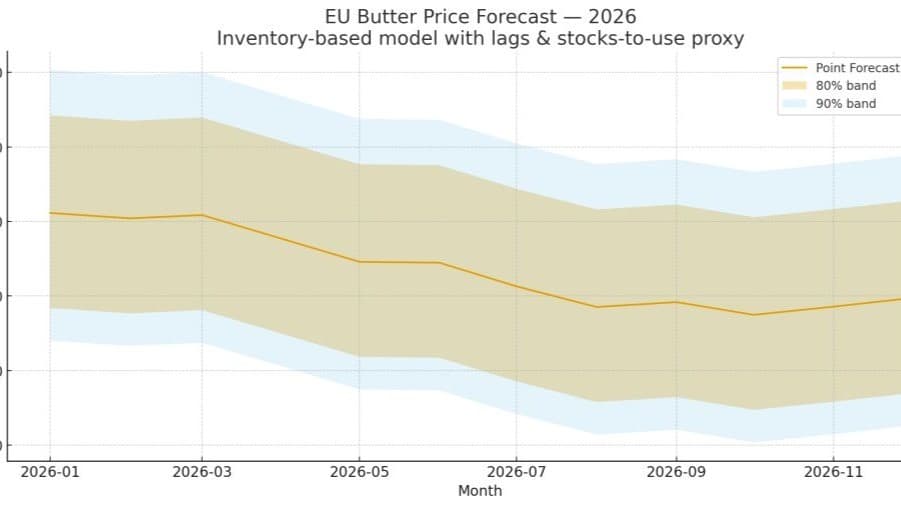
Summer Shopping or Summer Sale?
Last week was again a bit of a bearish week for the entire dairy industry. With cream prices under pressure and milk intake still strong, we keep seeing a market that has more supply than demand. Butter prices took another step lower, cheese prices cracked, and the powder market gave back a bit of its gains again.
The weekly report
Get it before it is anywhere else
Every market report, straight to your inbox the moment it is written. Butter, cheese, powder, liquids — pick what you actually trade.
Roughly weekly · Free · Unsubscribe any time