Bulls in Dubai, Bears Waiting at Home

After several intense days running up and down the dairy halls at Gulfood in Dubai, writing reports simply didn’t make the priority list. The pace of meetings — and perhaps a few late Dubai nights — didn’t exactly sharpen our focus either. As our time at the fair comes to an end, we did manage to carve out a moment to reflect on what we’ve seen and heard during meetings, and on what we expect lies ahead.
Monday saw the bulls storm back into the market, taking control across all major dairy commodities — butter, cheese, and powders alike. It has taken traders, end users, and even producers by surprise. The most asked question everyone kept asking: do you actually understand this rally?
The short answer: sentiment is currently leading the market, not fundamentals. While there have been some marginal changes on the demand side, the underlying fundamentals that supposedly justify this bullish takeover have not materially shifted. Short-term dairy markets have a habit of moving on emotion before logic. And while this rally has momentum for now, we continue to believe that fundamental values will eventually pull prices back toward more modest levels. That said, this week's bullish move has clearly exposed one thing — and that may prove more important than the price action itself; sales liquidity dries up fast in bullish markets
But first, a brief note of promotion. During the first three trading days of Gulfood, we were largely off the grid and not able to actively connect partners in bilateral deals. The good news: the GFD Marketplace didn’t miss a beat. While we were busy in meetings, more than 400 MT of product was traded through the platform, with traders actively bidding and offering in real time.
By placing your bids and offers on the GFD Marketplace, you stay connected to the market — even while focusing on other priorities within your business. The platform keeps trading moving, even when we’re not physically behind the screen. Sometimes the best trades are the ones that happen while you’re busy doing something else. Not yet active on our platform? or need help with setting up your first bid/offer, contact Twan via twan@getfairdairy.nl
EU Fundamentals Remain Weak
From a European perspective, there is still limited data to justify a clearly more bullish undertone. Milk intake continues to impress. While the recent winter cold temporarily dented production (or more collections) when zooming in on a single week, volumes quickly recovered as weather conditions normalised. Across Western Europe, milk intake is again running at +5–6% YoY, with parts of Belgium even reporting increases of up to +12% YoY. With RFC reducing the milk price by only 0.5 ct, farmers currently have little incentive to slow production — if anything, the opposite.
Spot liquid prices have improved, but perspective is key. Cream is trading in a range of €3,300–3,600, which is clearly above the lows seen two weeks ago. That said, even at €3,600, cream still implies a butter value well below €3,500. Skimmed milk concentrate prices have also lifted and now trade between €1,300–1,400, keeping SMP production viable below €2,000, even on relatively expensive towers. Raw milk remains the main pressure point. While we do see spot prices trading above 20 ct, we continue to hear of trades in France well below that level — in some cases as low as 15 ct. With milk intake rising both YoY and WoW, this spot pressure is unlikely to fade anytime soon.
On the demand side, we struggle to identify strong bullish drivers. Demand for spot liquids remains clearly weaker than available supply. Butter demand from EU customers for February–March is largely absent, and Q2 demand remains soft as well. However, as soon as futures prices started to move higher, end-user demand for Q3 and Q4 resurfaced — often bundled with some Q2 volume to soften overall pricing. This confirms what we have been saying for some time: buyer behaviour is driven less by consumption and more by fear of missing the bottom. Every uptick triggers some additional buying. Still, demand for Q3–Q4 tells us very little about actual EU consumption. On that front, the market remains weak. But end users buying Q3-4 says nothing about demand, but everything about buying strategies. And the fact that producers stop offering says nothing about shrinking supply, but everything about their sales strategy.
Cheese presents a different picture. While demand remains stable rather than strong, supply is also tight. Quotations have been flat for weeks, and around €3,000 the market appears to have found a temporary equilibrium. Despite ongoing scepticism about the sustainability of these price levels — particularly if exports slow — few are willing to bet on the downside. Fear of higher prices keeps buyers active, traders cautious about short positions, and producers reluctant to sell too far forward. The hand-to-mouth nature of the market currently reflects this balance, with €3,000–3,100 for Mozzarella, Gouda, and Edam appearing to be the clearing level.
The SMP market also surprised to the upside. EEX Q2 prices traded as high as €2,450, catching almost everyone we met at Gulfood off guard — including the most bullish producers. While SMP fundamentals are admittedly less bearish (EU prices are competitive on the world market and stocks remain relatively low), this rally was largely unexpected. Production has been running at or near maximum capacity for the past five months, and with the EUR/USD trading around 1.19–1.20, the fundamentals do not scream bullishness.
Taking a step back and looking at EU fundamentals overall, we would argue that while the bulls may have had some fun in Dubai, back in Europe the bears are likely to reassert control. Perhaps less so in cheese and SMP than in butter — but a correction from this week’s highs feels increasingly likely across all EU dairy commodities. Butter prices by the end of the day started to come down more than € 100,- per mt and futures on EEX dropped significantly.
Exports and US Sentiment
So what actually drove the bullish takeover in EU dairy markets?
The first signal emerged last week, when the second GDT auction of the year once again closed higher. Chinese buying interest surprised many participants and helped lift NZ prices, which in turn pulled EEX SMP futures higher. With the EU currently by far the most competitive origin for powders on the world market, it is hardly surprising that export demand for EU powders remains reasonably firm. Looking at the US, NFDM prices on the CME have been trending higher for weeks, with a sharp acceleration in recent days. In some delivery periods, futures are now trading around 25% above the December lows. Applying a similar move to EU lows of €1,800–1,850 suddenly makes €2,300 for Codex EU material appear far more logical.
That said, the sustainability of the current NFDM rally is questionable. We increasingly hear that buyers worldwide are showing less appetite at prices well above $3,000 CFR. At the same time, a strengthening USD/EUR exchange rate also starts to cap EU prices. EEX futures have already edged lower again, seemingly reflecting this logic. And for the EU, export performance remains crucial — especially as production continues to add product at a record pace.
True volatility in the US, however, has come from the butter market. Explanations of what happened on the CME range from new calendar-related effects in February to reduced production of salted sweet cream due to strong demand for exportable 82% butter (used for the CME spot call). Still, the recent bullish bounce appears far more technical than fundamental.
Once CME butter prices started to rise, several traders appear to have been squeezed out of short positions. The carry that had been present on the CME for months pushed not only February contracts higher, but the entire curve. Friday and Monday in particular felt like heavy liquidation days, driving butter prices up nearly 20% within a week.
Yet conversations with traders at Gulfood paint a different picture about the US: plenty of milk, plenty of cream, and plenty of butter. Fundamentally, the market still feels heavy. As soon as the liquidations faded and participants began to realise the move was more technical than structural, sellers re-entered the market. CME butter prices have since moved lower again and are now trading only 3–6% above last week’s lows. If this trend continues, the market could well slip back into its bearish trendline by the end of the week.
We are less deeply positioned in the US cheese market than in other commodities. However, from a technical perspective, CME cheese charts suggest a similarly aggressive and volatile swing — closely resembling the recent moves seen in butter.
When in Doubt, Zoom Out
We find ourselves repeating this line quite often when traders or partners call us, confused by what is driving the market. Our advice is always the same: when in doubt, zoom out. Markets can look volatile and extreme when viewed tick by tick, but stepping back often delivers a far more balanced picture.
Take the butter market as an example. It feels like prices jumped €200 within two days. Yet our deals done yesterday evening were roughly at the same level as where we left the market on Friday. Cream prices are holding steady, and EU quotations have even edged slightly lower. If you had been on holiday — or, as my wife calls it, my Dubai “business trip” — you might return next week and barely notice a difference.
Traders are paid to follow every move. Producers and end users, however, may benefit more from stepping back and letting sentiment run its course. In the long run, fundamentals always set the price, not short-term emotion.
Zooming out on the SMP market shows a different story. Prices have been rising steadily for several weeks in a row. The most recent acceleration may partly be sentiment-driven, but from a wider perspective there is little reason to expect a sharp reversal. A slower, more gradual price increase over the coming months still seems plausible. This does not rule out short-term pullbacks in the coming days, but the broader trend remains more bullish than bearish, which largely justifies the current sentiment.
Zooming out on cheese, however, we may need to call a doctor. The futures price trendline looks like a patient flatlining. For a broker, a flat line can be unsettling — but for the industry, it may actually be good news. With fat prices easing and protein values improving, a stable cheese market is exactly what the sector needs. Prices have moved sideways for weeks now, and unless something materially changes in the fundamentals, it would not be surprising to see cheese continue trading within the same range.
Sometimes, the most useful market signal is not found by zooming in on the details — but by stepping back.
Final Note
Markets rarely move in straight lines, and they certainly don’t ask for permission before confusing everyone at the same time. This week was another reminder that noise travels faster than facts, and that short-term price action often says more about positioning and psychology than about milk, cream, or demand.
The real challenge right now is not predicting the next €50 up or down, but deciding how much attention it actually deserves. Chasing every move may feel productive, but it rarely leads to better decisions. Discipline, patience, and a clear view of fundamentals remain far more valuable than perfect timing.
Or, to put it differently: if dairy markets were easy to read, we’d all be retired on a beach by now — preferably somewhere quieter than the Gulfood dairy hall.
Until then, we’ll keep zooming out, questioning sentiment, and trusting that fundamentals always have the last word.
In dairy, the market may shout — but fundamentals still do the talking.
More from the desk
Our Long View Before Our Long Break 
Our Long View Before Our Long Break
Last week the market found a bit of stability. After lower trades on cheese, the cheese market traded slowly up, although a real rally remains absent. Butter prices did dip a bit further, although at the start of this week we see some strength on the back end of the curve. And on powder, our bullish feeling just doesn't go away — and now we can find some confirmation in the market as well.
Dairy Carry Has a Shelf Life 
Dairy Carry Has a Shelf Life
Last week was bearish across the board — every product we broker leaned the wrong way. Powders lost more momentum, cheese slipped well below €3,000 for some products, and butter continues to impress with just how much keeps showing up. Supply, supply, supply.
Summer Shopping or Summer Sale? 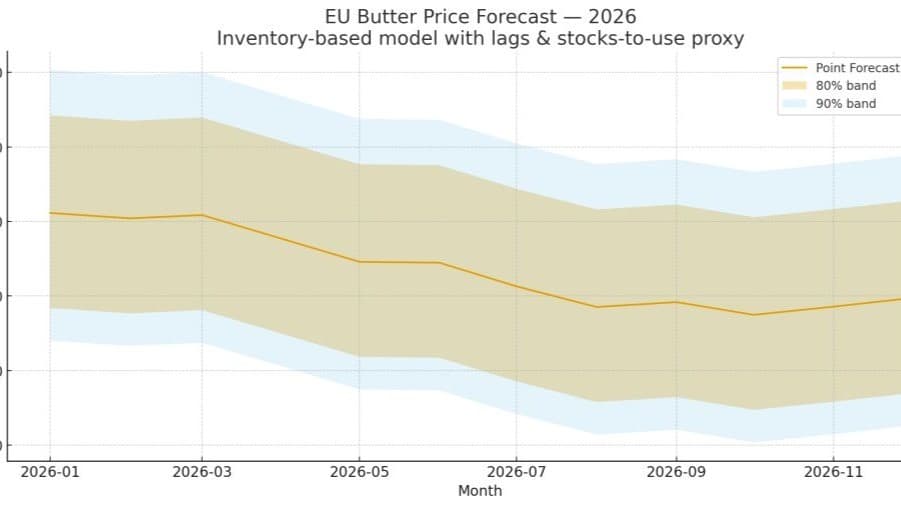
Summer Shopping or Summer Sale?
Last week was again a bit of a bearish week for the entire dairy industry. With cream prices under pressure and milk intake still strong, we keep seeing a market that has more supply than demand. Butter prices took another step lower, cheese prices cracked, and the powder market gave back a bit of its gains again.
The weekly report
Get it before it is anywhere else
Every market report, straight to your inbox the moment it is written. Butter, cheese, powder, liquids — pick what you actually trade.
Roughly weekly · Free · Unsubscribe any time