

Weaker Across All Commodities! (?)

The first three days of this week have been unusual. Where recent weeks saw volume and volatility moving in the same direction, it now appears that volatility is the only constant. We were able to broker just a fraction of what has been trading over the last weeks, while market dynamics keep changing roughly as fast. Markets feel weaker across the board, yet directional conviction is almost absent. EU dairy fundamentals remain deeply bearish from a supply perspective, and the spot market for liquids feels very heavy. Some expect prices to recover after Easter — we are not among them.
Liquids: Weaker, and Getting Weaker
The spot market for liquids remains under severe pressure. Raw milk prices are holding in the 10ct range, but most other liquid categories continue to slide. Cream traded between €3,800 and €3,900 for most of the recent period, but with additional supply entering the market, we are now hearing prices at €3,500 DAP France — with similar levels quoted for the following week.
SMC prices are well below €1,000, with most quotations in the €700 range.
It is worth remembering the seasonal pattern: cream prices typically drop around Christmas due to bank holidays and factory closures, then spike around Easter on short-term demand, only to revert to the trend that surrounded the holiday period. This year, the Easter spike was amplified by the short squeeze in butter blocks. That demand has now been filled. The short squeeze is over — and, to be direct, a long squeeze appears to be building. With Easter demand satisfied and most winter butter buyers having already filled their warehouse positions for the year, we see very little structural support for cream in the weeks ahead.
Cream, raw milk, and SMC are expected to remain at deeply suppressed levels relative to commodities for at least the next two months. SMC in particular looks approximately €1,500 undervalued relative to where it should trade against SMP. Cream we expect to range between €3,200 and €3,600 — which, incidentally, makes European butter churns exceptionally profitable. Expect EU butter production volumes to stay approximately 8–10% above 2025 levels for at least three more months.
Butter: Back in Bearish Territory
Butter prices have continued their descent. NL/DE/BE traded as low as €3,985 on April collection today, while Polish butter dropped to €3,900 for April. EEX futures followed, with Q3 now trading at €4,500 — and with the physical market consistently running around €300 below the futures curve, that places our physical market expectation at approximately €4,200. Our bid ask is € 4300 offer and € 4200 bid.
The market is clearly back in the bearish territory where it started this year. There is one meaningful difference, however: end users have filled their Q2 and Q3 coverage. Only Q4 and next year remain genuinely open. Most traders who were still heavily short at the end of January have reduced their positions, some even rotated long, and are now watching the bearish market unfold from the wrong side. A number of producers are still waiting for those €5,000 confirmations they nearly received two and a half weeks ago — they are going to be waiting for a while.
If cream does not recover above €4,000 in the coming weeks, we expect butter to trend back below that level as well. The difference this time is that there is no significant short gap on the trader side to absorb the weight of selling. End users are already beginning to push collections from Q2 into Q3, and we do not expect the major French buyers to open their storage sheds quickly either. There will be intermittent support from traders building stocks to hedge their forward books, but with new sales now focused on Q1–Q2 next year, the required cash-and-carry premium has expanded. The market is in no hurry to provide it.
We have spoken with several producers and traders who believe H2 will show renewed firmness. We remain very skeptical. As the year approaches its end, most market participants — producers, traders, end users alike — tend to close their books lean. Finding buyers willing to finance old butter into the new year will come at a price.
Our forecast from a few months ago remains unchanged. We had not fully priced in the short squeeze back toward €5,000, but we continue to believe the fundamental direction is clear. January was accurate. February was off but remained within our 80% confidence band (the February high was €4,700). The market will not follow a straight line, and with a macro environment this volatile, nothing is set in stone. But our fundamental analysis still points to €3,000 as a likely destination toward the end of Q2 and into Q3 (and maybe even Q4). See our forecast we made in October below.

Cheese: Finding a Ceiling
Cheese appears to have found its upper limit. Most traders we speak to — and even a number of producers — acknowledge they are not seeing the same export demand above €3,600. Mozzarella, which peaked last week at €3,700 via GFD, now has sellers at €3,600 willing to listen to bids. Gouda offers are down €100 from last week's highs. The tone across the cheese complex is softer, but this is a correction from elevated levels, not a freefall. Nobody is calling a crash here — nor should they.
SMP: Reactive and Thin and maybe still bullish?
The week opened with limited activity and a clearly weaker tone. After CME closed limit-up early in the week, it reversed lower the following session, while EEX futures dropped approximately €100 — leaving sellers in control and buyers absent. Physical offers followed, easing from €2,850–2,900 back toward €2,800.
The SMP market remains highly volatile, thin, and price-reactive, with physical levels closely tracking futures moves. As expected, however, futures recovered during the day and buying interest re-emerged.
We traded 200 MT French SMP LH, fresh, May–June loading at €2,750 FCA FR this week — a level that reflects how the physical market currently feels: tight at the front, less convincing further forward, and broadly in line with last week's trades. Still below the €2,800 threshold.
A Final Note
A few weeks ago, the market was screaming. Shorts were bleeding, buyers were panicking, and every call we received started with some variation of: "I should have covered earlier." That is the short squeeze in one sentence.
We are now watching the mirror image take shape in the butter market (and maybe a bit on cheese). Traders who rotated long near the top are sitting on positions in a falling market. Producers who held out for €5,000 are recalibrating. And the spring flush — the one fundamental that has been pointing at lower prices for months — has not even arrived yet.
The long squeeze tends to be quieter than the short squeeze. There is no single moment of panic, no dramatic intraday reversal that makes the news. It is slow, grinding, and demoralising in a way that short squeezes rarely are. Positions get averaged down. Storage fills up. And at some point, someone blinks.
We do not know exactly when that happens. But we know what the setup looks like — and this is it.
Stay sharp, stay lean!
GFD — Good trading 🤝
More from the desk
Our Long View Before Our Long Break 
Our Long View Before Our Long Break
Last week the market found a bit of stability. After lower trades on cheese, the cheese market traded slowly up, although a real rally remains absent. Butter prices did dip a bit further, although at the start of this week we see some strength on the back end of the curve. And on powder, our bullish feeling just doesn't go away — and now we can find some confirmation in the market as well.
Dairy Carry Has a Shelf Life 
Dairy Carry Has a Shelf Life
Last week was bearish across the board — every product we broker leaned the wrong way. Powders lost more momentum, cheese slipped well below €3,000 for some products, and butter continues to impress with just how much keeps showing up. Supply, supply, supply.
Summer Shopping or Summer Sale? 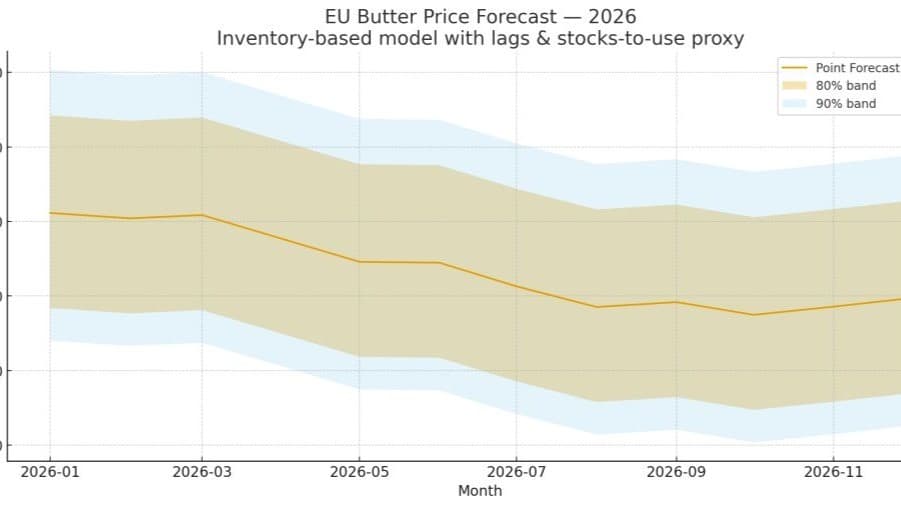
Summer Shopping or Summer Sale?
Last week was again a bit of a bearish week for the entire dairy industry. With cream prices under pressure and milk intake still strong, we keep seeing a market that has more supply than demand. Butter prices took another step lower, cheese prices cracked, and the powder market gave back a bit of its gains again.
The weekly report
Get it before it is anywhere else
Every market report, straight to your inbox the moment it is written. Butter, cheese, powder, liquids — pick what you actually trade.
Roughly weekly · Free · Unsubscribe any time