
Testing a Floor and a Ceiling
Last week was one of the busiest weeks of this year. With almost 5,000mt of product changing hands via Get Fair Dairy, the market showed us that buying and selling interest remains firmly alive on both sides of the trade. While complaints about inactive markets are never far away, actual volume — both on futures and between our partners — tells a very different story. The majority of last week's volume was concentrated in butter, but SMP markets were equally clear in their activity. This week, we expect the butter market to test the lower end of its trading range, while powder markets should probe the upper boundary.
It is funny to see that all of the volume trading on powder focuses on the Q2 trading timeframe, while butter trades are rough 50% of the volume on Q2, 30% of the volume on Q3 and 20% of the volume on Q4. Butter has a wider horizon (at least via us) than powder does.
From the Field — Literally
On a personal note: we took the kids to one of the local farms this week in Weert in Limburg in the Netherlands, where the farmer was turning his cows out to pasture for the first time this year. There is something grounding about watching cows hit fresh grass for the first time after a long winter — the kind of scene that reminds you what this industry is actually built on.
The farmer took the time to show us, and other families around his farm. Ollie enjoyed feeding the cows, and he got invited to start working on the farm as soon as he gets a bit older. Speaking with the farmer afterwards, the mood was cautiously positive. Margins remain under pressure, but the conditions around them are solid: good grass, feed secured, and milk prices where they are. His expectation is an acceptable year — not spectacular after an excellent 2025, but workable.
We thanked the farmer, enjoyed a icecream made from the farms milk in the sun and took home some farm-made cheese.

Macro: Difficult to Read, Impossible to Ignore
The macroeconomic backdrop remains genuinely hard to interpret. The conflict in the Middle East shows no signs of slowing — at the time of writing, at least — and while the US is doing what it can to keep oil prices under control, the war appears to be escalating on multiple fronts. One report we came across this week described Iran allowing vessels to transit through the Strait of Hormuz on the condition that payment is made in Chinese yuan. If that approach gains traction, the USD could weaken further — with knock-on consequences across commodity markets globally, including dairy.
SMP: Heading for €3,000
The export debate continues. In conversations with partners this week, the central question remains: how export-competitive is the EU right now? The world still remains very hungry for protein, the EU remains the most competitively priced source, and a potential weakening of the USD against the EUR would only add fuel to export demand. On balance, we expect strong demand to keep EU SMP markets well-supported — even against the backdrop of elevated production.
The €3,000/mt level is now clearly in sight. That price was last seen in November 2022. More than three years later, and after a sustained recovery, we believe we are approaching a test of that level. Resistance will be real — buyers do not cross psychological thresholds quietly — but if export demand continues at this pace, we see prices continuing to climb.
Our last traded prices for April remain at € 2760 but we see futures very close to € 2900,-
Cheese: A Market of Two Speeds
The cheese complex is sending mixed signals depending on which variety you look at.
On cheddar, the situation seems to be under pressure. Prices have converged to roughly the same level as Gouda and Mozzarella — a signal that cheddar is struggling to maintain its premium in the global export market. Competition from US and New Zealand product is capping prices, and with the Irish season ramping up, the expectation is that — absent a strong pull from export demand — EU cheddar prices will soften.
On Gouda, Edam, and Mozzarella, the market remains tight and clean. Nearby product is scarce. Strong export sales in Q4 and Q1 have kept these markets well-cleared, and some partners expect this tightness to persist. Others are less convinced. Even producers are acknowledging that selling Mozzarella and Gouda above €3,600 exw on exports is difficult — not impossible, but the volumes available at those prices are structurally lower than in the past four quarters. With milk intake rising sharply, our forecast for cheese prices over the coming quarter is flat to slightly lower.
Butter: Testing the Floor — And Then What?
The butter market is entering a critical few weeks. Last Friday, the lowest price brokered via GFD for Q2 NL/DE/BE butter was €4,175/mt. For context: the lowest price traded this year was €3,900/mt. Q3 is now also softening — the lowest done is €4,300/mt, just €100 above this year's low — and H2 is trading at €4,500/mt, only €200 above the 2025 floor. We are almost back to where prices were when the market last turned bullish.
Our medium-term view on butter remains directionally lower — toward €3,000/mt later this year. But the immediate picture is different. For the next several weeks, we expect prices to stabilise around last week's levels, or edge modestly lower — not collapse. Here is why:
A significant cohort of buyers failed to cover when prices were last near €4,000/mt. They will not make that mistake again. We expect a meaningful wave of short-covering and, in some cases, outright long-position building around the €4,000 level. That creates a strong technical and commercial floor in the near term. Even if cream prices fall sharply — and we expect they will — we believe butter will hold.
Once that short-covering wave has run its course, there is room for further downside. Milk intake is expected to remain elevated through Q2, keeping butter production high. Even strong export flows — potentially 40,000–50,000mt additional volume over the coming months — are unlikely to relieve the stock pressure building in the market.
But a collapse at the start of the flush? Too early for that. Our working range for a 3-month forward butter contract over the next few weeks: €4,000–€4,300/mt. All forward months should carry a carry premium of approximately €60–€75/mt per month.
The Milk Flush: Potentially the Biggest in EU History
If you are not already watching the milk intake data closely, start now. Every graph we are tracking is running above even the most optimistic forecasts. Both France and Germany are already above their historic seasonal peaks — and the flush itself is still roughly six to nine weeks away. We expect at least another month of accelerating milk volumes before the peak is reached. After that, even if the slowdown follows the normal seasonal curve, milk intake will not return to today's levels for another two to three months. That means sustained, full-speed commodity production well into summer.
In short: every product category — butter, powder, cheese — will feel the weight of this flush. How hard export can pull that weight of the internal EU market determines the price action on those commodities.
On Ireland: sentiment at the start of their season is positive. Birth numbers are up, the milking herd appears larger than in prior years, and weather conditions have been favourable. The Irish should become one of the bigges sellers for commodities over the next few weeks. Although, from our market perspective, Irish sellers have not yet moved aggressively into commodity markets — they typically take a few weeks to read the season before committing to price. But when they do move, volume will follow. Our expectation is that Irish supply will weigh more heavily on butter and cheese (particularly Gouda and Cheddar) than on powder. On cheese specifically, if their output comes in strong, the impact on EU prices could be substantial.
A Final Thought
Spring has a way of making everything look manageable. The cows are back in the fields, the grass is growing, and the sun is doing what it promised it would. It is easy, in moments like this, to feel like the market will take care of itself.
It will not.
What is coming — and it is coming — is the largest milk flush this region has seen in living memory. The graphs do not lie, and the fundamentals do not negotiate. The product will be made. The stocks will build. The pressure will arrive, quietly at first, and then all at once.
We have seen this before. Not at this scale, but we have seen what happens to sellers who wait too long, who assume the floor will hold forever, who mistake a brief period of sideways trading for a new normal. We still believe that the €4,000 / € 4300 level butter trade is an opportunity. It will not stay on the table indefinitely.
So enjoy the spring. Watch the cows. Appreciate the season for what it is — genuinely beautiful, and genuinely the reason we are all in this industry.
Just make sure your position is covered before your thought wonder off to tropical drinks, long warm evenings and worry-free blue skies.
GFD — Get Fair Dairy Good trading. 🤝
More from the desk
Our Long View Before Our Long Break 
Our Long View Before Our Long Break
Last week the market found a bit of stability. After lower trades on cheese, the cheese market traded slowly up, although a real rally remains absent. Butter prices did dip a bit further, although at the start of this week we see some strength on the back end of the curve. And on powder, our bullish feeling just doesn't go away — and now we can find some confirmation in the market as well.
Dairy Carry Has a Shelf Life 
Dairy Carry Has a Shelf Life
Last week was bearish across the board — every product we broker leaned the wrong way. Powders lost more momentum, cheese slipped well below €3,000 for some products, and butter continues to impress with just how much keeps showing up. Supply, supply, supply.
Summer Shopping or Summer Sale? 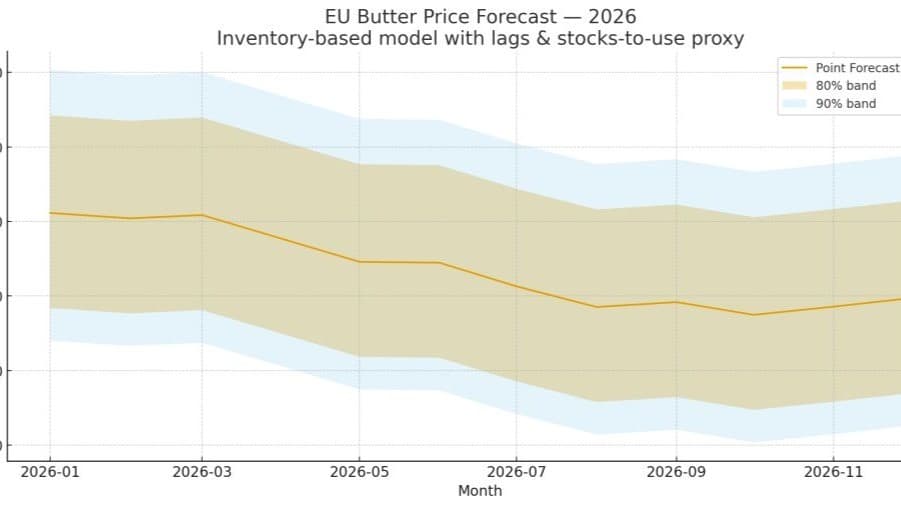
Summer Shopping or Summer Sale?
Last week was again a bit of a bearish week for the entire dairy industry. With cream prices under pressure and milk intake still strong, we keep seeing a market that has more supply than demand. Butter prices took another step lower, cheese prices cracked, and the powder market gave back a bit of its gains again.
The weekly report
Get it before it is anywhere else
Every market report, straight to your inbox the moment it is written. Butter, cheese, powder, liquids — pick what you actually trade.
Roughly weekly · Free · Unsubscribe any time