

Fat Cheaper than Protein?

The last two trading days may have been quieter in volume, but certainly not in volatility. Butter traded further down, SMP traded further up — and on the CME spot call, something happened that last occurred in April 2014: NFDM traded above butter. It happened again yesterday, with the gap between protein and fat continuing to widen.
What started as a joke among traders — should the EU follow, and price EU butter below EU SMP? — sent us back to the history books via StoneX Plus. From summer 2013 through spring 2014, NFDM in the US traded at a consistent premium over butter. Prices then weren't far off from where CME has been trading in recent weeks. In the EU, we could find no historical precedent for something similar.
And while "EU SMP above EU butter" still sounds extreme even to our bearish butter sensibilities, that same historical period shows the gap between Dutch butter and Dutch SMP quotations averaged around €500 (between €250 and €1,100). With EU butter trading this week at €4,300 Q2 and SMP at €2,760, the current spread of just over €1,500 is already narrowing the gap to that era. If butter continues its downward correction — as we expect — and SMP continues its upward momentum, we see a scenario where SMP approaches €3,000 and butter trades below €4,000, bringing the spread back in line with what was seen between June 2012 and April 2014.
Plenty of ifs and buts. But the direction of travel seems clear: the spread between fat and protein is going to shrink in the EU, just as it already has in the US.
Milk: Plenty Around
Spot milk continues to trade lower. Germany has found some support around €15ct, but in parts of France we keep hearing milk is nearly being given away. In the Benelux, prices are drifting toward €10–13ct. SMC has found modest footing at around €700, driven by SMP demand — hardly a bullish signal, but not collapsing either. The real surprise is cream. We should be in peak pre-Easter production, yet prices fell this week to as low as €4,500 — a long way from the €5,700 seen just ten days ago. If cream continues to slide in line with what milk and SMC fundamentals suggest, we expect cream to re-test sub-€4,000 levels around Easter.
Butter: Age is a Problem
We celebrated our son's birthday this week — nine kids in the garden doing old-fashioned games. The kids were brutally honest, as children tend to be: boring, and for old people. My age had never felt like a problem before. But suddenly, apparently, I am old.
Butter is having a similar identity crisis.
November 2024, May 2025, July 2025, August 2025. Production dates that were once entirely unremarkable are now becoming the story. Normally, older product surfaces at year-end when producers clear warehouses. But what we're seeing now is different: one of Western Europe's larger producers is delivering summer 2025 product to customers across the board. Shelf life is 24 months — so technically fine — but the volume and consistency of this age profile is something we haven't seen in a long time. French and Italian butter are showing the same pattern: large parcels, older than the market has become used to.
Add to that continued maximum EU production capacity, US butter undercutting EU on export markets, and strong SMP demand keeping cream in the butter vat — and the conclusion remains unchanged. Butter needs to correct further.
Last week H2 cooled from €5,150 to €4,900. This week H2 bottomed at €4,600, Q3 traded at €4,500, and the front of the market dropped toward €4,250 for fresh German product. We expect prices to continue sliding post-Easter — testing the lows seen earlier this year. At that point, the market will find out one of two things: either buyers return and pick up the bargains, or they don't — and sellers find themselves in an empty room.
SMP: How Soon to €3,000?
The powder market appears to have one gear at the moment: forward. CME, EEX — both keep moving up. Demand continues to pull prices, and exports are keeping the EU market well-cleaned. Conversations with traders confirm it's export demand driving this, not internal EU consumption screaming. That said, EU buyers are having to follow international price levels whether they like it or not.
This week we traded 900 MT, with the highest prices for Western EU low heat reaching €2,760 on April.
Traders with wide export books are broadly convinced that €3,000 is not a question of if, but when. Not next week, perhaps not immediately before the flush — but when milk volumes tighten and the market gets genuinely short, history suggests it can move fast. SMP has been rangebound for a long time. When it breaks, it has a habit of running. With all-time highs north of €4,000, talking about €3,000 doesn't even qualify as aggressive.
Final Note: The Glass Half Full
Here's a thought to end on — one that won't make the butter bulls feel much better, but might offer some comfort to the industry at large.
If SMP does test its all-time highs and butter tests its multi-year lows, the spread between fat and protein will have done something historically unusual. But the underlying milk value? It might hold up just fine. Fat down, protein up — the cow, as always, remains completely indifferent to our positions.
More from the desk
Our Long View Before Our Long Break 
Our Long View Before Our Long Break
Last week the market found a bit of stability. After lower trades on cheese, the cheese market traded slowly up, although a real rally remains absent. Butter prices did dip a bit further, although at the start of this week we see some strength on the back end of the curve. And on powder, our bullish feeling just doesn't go away — and now we can find some confirmation in the market as well.
Dairy Carry Has a Shelf Life 
Dairy Carry Has a Shelf Life
Last week was bearish across the board — every product we broker leaned the wrong way. Powders lost more momentum, cheese slipped well below €3,000 for some products, and butter continues to impress with just how much keeps showing up. Supply, supply, supply.
Summer Shopping or Summer Sale? 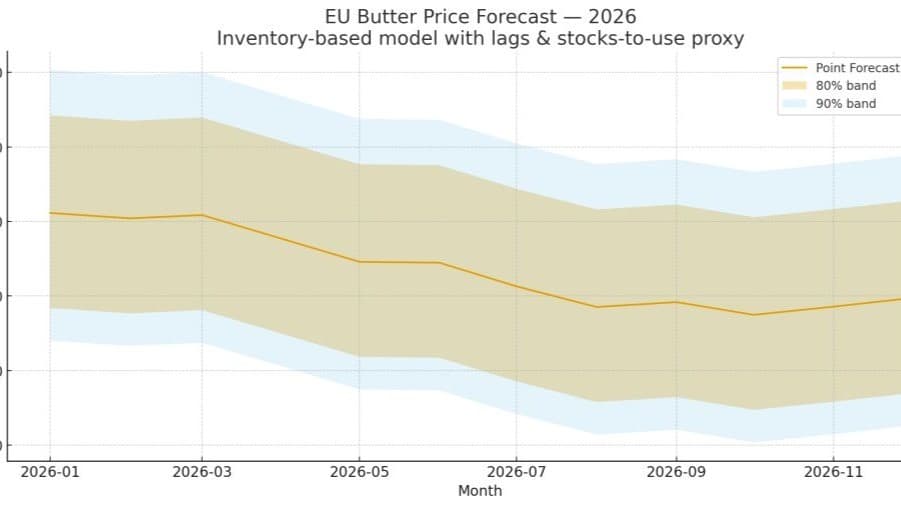
Summer Shopping or Summer Sale?
Last week was again a bit of a bearish week for the entire dairy industry. With cream prices under pressure and milk intake still strong, we keep seeing a market that has more supply than demand. Butter prices took another step lower, cheese prices cracked, and the powder market gave back a bit of its gains again.
The weekly report
Get it before it is anywhere else
Every market report, straight to your inbox the moment it is written. Butter, cheese, powder, liquids — pick what you actually trade.
Roughly weekly · Free · Unsubscribe any time