
The Illusion of Stability

The opening two days of this week have once again been highly active, with more than 1,600 metric tons of product transacted through our network. Activity was spread broadly across commodities—powders, cheese, and butter all featured prominently. The general trend is stabilising, but divergences within categories are evident. Cheese continues its gradual step-down, with each successive trade printing slightly lower. Butter forward values into 2025 remain steady, holding ground at last week's ranges. In powders, however, sentiment is increasingly fragile. While actual trade levels remain broadly unchanged, sellers are firmly rejecting bids below €2,100. Yet, with offers accumulating on the sell side, we question how long that floor can hold. At present, the market appears to be seeking a plateau—let’s explore why this consolidation may (or may not) persist.
Seasonal Dynamics – A Market at Its Peak
Historically, this period represents the seasonal “boiling point” for cream and skimmed milk concentrate (SMC). These typically peak at levels that outvalue butter and SMP conversion. As the industry gears up for the Christmas and New Year demand window, factories usually run at capacity and cheese offtake accelerates sharply. Retail campaigns for butter and full-fat dairy products generally amplify the seasonal pull.
In a “normal” September–October, this cocktail of factors would have buyers chasing supply. This year, however, the opposite dynamic is unfolding: suppliers are increasingly playing the role of salesperson, discounting aggressively and seeking demand. That push has drawn in some incremental buyers this week, particularly in cream and butter. The result could generate short-term price uplift, though sustainability remains uncertain.
Butter and Cream Spot Market
The German Retail October butter contract has been reset at €5,500–€5,600, a substantial reduction from prior levels. This adjustment is expected to unlock demand, with retail replenishment cycles and packed butter lines likely returning to full speed. Already, upward pressure is visible in cream values, trading up to €6,300 DAP Poland and Germany. Producer butter offers have moved a tier higher in response, signalling tighter seller discipline.
Nevertheless, structural demand remains absent. Retail butter demand into Q4 could spike, yet industrial block butter is notably absent from the bid side. With few exceptions for niche requirements, buyer appetite is muted. The key question: if current price levels are not enticing buyers back, what is the trigger point that will?
Cheese – Still in Retreat
Cheese remains under pressure. Edam trades are settling around €3,120 for Q4, with Gouda offered at comparable levels and mozzarella hovering near €3,050 for year-end positions. Industrial demand is subdued, and bids are scarce. Some producers and traders maintain that demand will reappear, but the incentive remains unclear. Historically, values at these levels would stimulate export and foodservice interest, yet this cycle seems to defy precedent.
For next year, we have seen some sizable trades for Gouda at prices between € 3120 and € 3150 with bids now back down to levels of € 3050 and plenty more offers on the last traded levels. The same demand can be seen for Edam at prices close to € 3050 for Q1
Market Sentiment – From Eucolait to Fundamentals
Feedback from industry participants at this week's Eucolait meetings is hardly encouraging. The prevailing consensus is that a dramatic rebound in demand or an abrupt supply correction is unlikely. Instead, the debate centres on whether today’s bearish fundamentals are fully priced in—or whether further downside remains.
Looking at production forecasts for 2025–2026, the supply side sets a heavy tone. Milk output is expected to rise this year and next. Even allowing for lower H2 2026 volumes, year-on-year growth in H1 will more than compensate.
-
Butter production: Already up 50,000 mt year-to-date through July, with a further 50,000 mt increase forecast for August–December versus last year—totalling 100,000 mt of additional volume.
-
Cheese production: Up 90,000 mt through July, with another 80,000 mt projected in the remainder of the year.
Imports are compounding the imbalance. Both butter and cheese imports are set to reach record highs in 2025, with butter imports in H1 2026 expected to exceed this year’s H1 levels. Stock models from StoneX and Vesper project butter and cheese inventories to hit decade-high levels by 2026.
Historical Parallels – Where Stocks Meet Prices
When stock levels for butter and cheese approached these projected volumes in the past, prices consistently tested the lower bounds of their historic ranges. Butter values, while establishing incrementally higher floors over time, fell close to structural lows in previous cycles. Based on overlaying stock forecasts with price history, we foresee butter testing the €4,000 threshold by late Q1 or early Q2 2026. Cheese could slip below €2,750.
These projections are unpopular, but historical patterns are difficult to ignore. History may not repeat, but it often rhymes.
Key Assumptions and Counterarguments
Our outlook assumes that milk supply does not contract meaningfully in Q1 and that exports remain flat. We fully recognise the counterpoint: if butter falls to €4,000 or cheese below €3,000, exports will inevitably rise. We agree—but history shows export orders lag, and milk supply reacts more slowly than economic logic would dictate. Markets generally need to test their lows before normalisation can occur.
From H2 2026 onward, we expect a gradual rebalancing: milk volumes stabilising, exports offsetting imports, and production easing back to trend. Elevated stocks will cap the upside and prevent runaway rallies. Many partners expect a rapid rebound, but we caution against such optimism. Past corrections have been followed not by sharp reversals, but by long, steady rebuilds.
SMP – The Outlier
Skimmed milk powder diverges somewhat from the butter/cheese trajectory. Stock levels remain comparatively low, and future accumulation is projected to be modest. Prices are anchored near €2,000, with currency fluctuations playing a critical role. A stronger euro (e.g., EUR/USD moving toward 1.20) would exert more downward pressure than temporary dips in cream values.
SMP’s long shelf life, low storage and financing costs make it attractive for long-term coverage. Buyers have little incentive to speculate further downside; hence, the forward curve is both well supported and tightly capped.
Conclusion
The current market plateau reflects the clash between seasonal expectations and overwhelming structural supply. Butter and cheese remain heavily burdened by production growth and imports, with stock overhangs pointing toward further downside before stability can return. The stock pressure is unlikely to materialise in even lower prices in October and November this year, but once stocks start to rebuild, that pressure can't be denied anymore. SMP, while not bullish, retains a degree of resilience due to different stock dynamics and buyer behaviour.
More from the desk
Our Long View Before Our Long Break 
Our Long View Before Our Long Break
Last week the market found a bit of stability. After lower trades on cheese, the cheese market traded slowly up, although a real rally remains absent. Butter prices did dip a bit further, although at the start of this week we see some strength on the back end of the curve. And on powder, our bullish feeling just doesn't go away — and now we can find some confirmation in the market as well.
Dairy Carry Has a Shelf Life 
Dairy Carry Has a Shelf Life
Last week was bearish across the board — every product we broker leaned the wrong way. Powders lost more momentum, cheese slipped well below €3,000 for some products, and butter continues to impress with just how much keeps showing up. Supply, supply, supply.
Summer Shopping or Summer Sale? 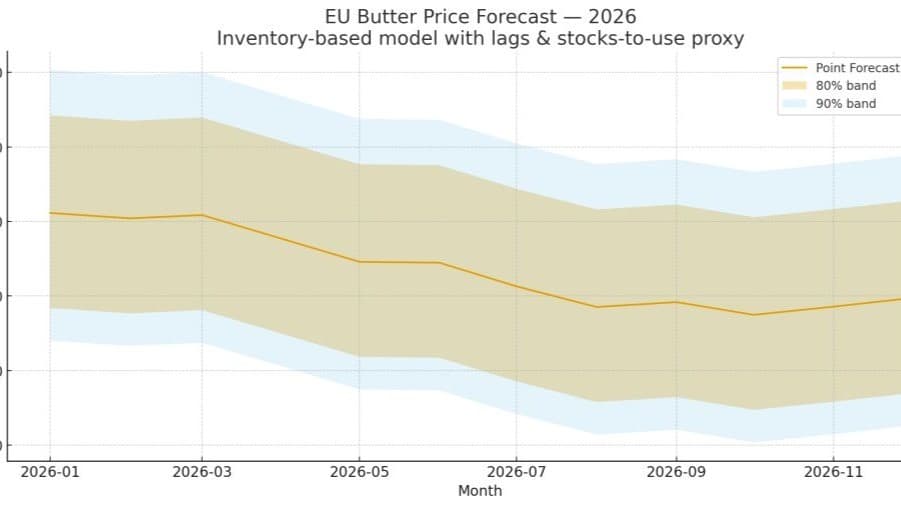
Summer Shopping or Summer Sale?
Last week was again a bit of a bearish week for the entire dairy industry. With cream prices under pressure and milk intake still strong, we keep seeing a market that has more supply than demand. Butter prices took another step lower, cheese prices cracked, and the powder market gave back a bit of its gains again.
The weekly report
Get it before it is anywhere else
Every market report, straight to your inbox the moment it is written. Butter, cheese, powder, liquids — pick what you actually trade.
Roughly weekly · Free · Unsubscribe any time