
Sentiment Says Calm, Milk Says Otherwise

Last week was nothing short of a whirlwind. With more than 3,500mt brokered across our partner network, we can only express our gratitude for the trust placed in our hands. Activity is firing on all cylinders: more cheese, more powders, more partners. Growth is coming from multiple directions at once. Normally, volatility is the spark behind such activity, but this time, most products are actually finding some price stability after weeks of downward pressure. Yet, while sentiment seems to be stabilizing, the fundamentals continue to weaken. Spot milk prices are revisiting levels long forgotten—thanks to milk collection data that nobody saw coming. If this trend continues, weaker fundamentals will eventually pull sentiment back down as well.
Weekly and monthly milk collection figures continue to surprise. Germany, in particular, appears to have torn up its historical playbook. The impact of bluetongue is most visible there, where late-July calving has pushed a large share of the herd into much later peak lactation—effectively giving Germany a “second peak” in milk flow. Last week’s collections (week 39) even outpaced those of ten weeks earlier (week 29), making the end-of-September milk collection stronger than the collections in June. With volumes up more than 4%, processors are scratching their heads on what to do with all the milk. Traders in the liquid business are seeing spot milk available below €0.30/kg—a level many thought was permanently retired, especially around this time of year.
But it’s not just Germany. The timing of this surplus milk is particularly awkward. Factories typically plan maintenance and downtime in mid-September through October, when collections are seasonally lower and milk can be more easily diverted. Instead, the EU finds itself with more milk just as plants are running on reduced schedules.
The broader picture doesn’t stop there. Poland and the UK both reported strong August collections, with UK milk solids up 6.6% and Poland up 5%. French week-on-week data points to collections staying firm, up more than 4%. Outside the EU, competitors are equally relentless: the US is pushing out 4.7% more milk solids, and New Zealand is up over 2.5%.
On a brighter note, cream prices found some footing last week. After dipping below €6,000, cream traded between €6,000 and €6,200 for most volumes. This seasonal uptick is expected, but even at €6,200, cream looks undervalued compared to butter at €5,250. If butter holds, cream has every reason to climb higher in the coming weeks. After all, if there’s any time of year cream should trade above butter equivalent, it’s now. Meanwhile, SMC hasn’t played along. Prices in France and Germany slipped to around €1,400—and some whisper of even lower levels—making SMP drying extremely profitable.
Still, with cream just above €6,000, SMC below €1,500, and raw milk below €0.30, the market has corrected far lower than many anticipated. Stronger milk collections in H2 were expected, but the magnitude has taken even the most bearish analysts by surprise. This isn’t just about more cows or higher yields—it’s about shifting lactation patterns. More milk now is bearish for the market, plain and simple. Yet, when debating the future with different sides of the trade, one thing is clear: nobody really knows what’s next.
There’s a fair chance EU collections for Q4 will outperform all forecasts, flooding the market with commodities and leaving year-end stocks far above expectations. The flip side? Lower collections might hit in Q1 or Q2 next year as seasonal patterns shift. Because those same high-performing cows that are now creating a surplus will dry off by mid Q1. And if that happens, history becomes less of a guide, and the market may turn even more erratic. Speculation could make the lucky few a fortune—or hand others an equally impressive loss. Risk management will be more important than ever as we move into 2026.
While 2026 feels like a foggy crystal ball, the rest of 2025 is straightforward: strong milk intake, weaker commodity prices, and little comfort for anyone still hoping for a sharp rebound before year-end.
Butter: Stable 2026
If we had to draw a line in the sand to divide the butter market, it would fall squarely between December and January. The butter market feels like two different stories depending on which side of that line you stand. Prices for Q4 are heavy: sellers are everywhere, buyers much harder to find. Factories across the EU are offering fresh butter, and frozen stocks seem to pop up around every corner. When we look back in a few months, it’s hard to imagine the data won’t show butter production exceeding every forecast currently on the table. Frankly, the market is lucky it started the season with such low stock levels. If it hadn’t, we’d already be talking about a collapse (and yes, some of you will argue we’re already there). If production keeps outpacing last year, end-of-year stocks could easily turn out to be among the highest of the past five years—an ironic twist after being at the lowest in twenty.
That said, demand further out—especially further into 2026—tells a more upbeat story. Here, the balance flips: more buyers, fewer sellers. Winter butter buyers in particular are delighted to secure volumes well below last year’s levels, in some cases more than €2,000 under their cost price. The irony isn’t lost on anyone. Last year, winter butter was scarce because butter production in October/November was throttled by cream prices north of €10,000. This year, production volumes are much higher, making next year’s winter butter supply look far less problematic.
Looking ahead, we expect buyers to continue locking in volumes over the coming weeks, but mainly from the traders' side. Availability in 2025 is ample, so securing product won’t be the challenge—it’s what happens afterwards that matters. Stocks will eventually need to be collected, financed, and moved. Once that phase kicks in—likely sometime after Anuga—the pressure should spill over into lower prices for 2026. Simply put, the group of players both willing and able to play the financing game is small. That will force the spread between Q4 and 2026 deliveries to widen beyond today’s levels.
As things stand, we would value NL/DE/BE butter for Q4 at €5,250–€5,350, for Q1 at €5,350–€5,450, and for Q2 at €5,500–€5,575. For other origins, the forward market looks less defined. Polish butter has seen fresh sweet cream trade at €5,300 for Oct/Nov, while frozen lactic finds buyers just under €5,200. Irish product, meanwhile, should find sellers at around €5,350 for Q4, with buyers circling closer to €5,200.
Cheese: Down Again
Where butter producers can always choose to produce for stock—or where traders can roll the dice with cash-and-carry—cheese doesn’t offer quite the same flexibility. Not all cheeses of course, but the big volume ones—Gouda, Mozzarella, and Edam—simply don’t lend themselves well to being stored and carried forward. Doing that would result in a lot more downgraded product. To avoid that, sellers lower their prices to attract business and keep the cheese moving. We therefore continue to see downward pressure on cheese. EEX futures for Gouda on Friday dipped as low as €3,150, while physical trades for Q1 Gouda were spotted at around €3,200. Not exactly the kind of levels that inspire a wave of buyers to rush in.
When speaking with partners active in cheese, the story is strikingly consistent: demand is painfully hard to secure. More and more players are reporting weaker offtakes, while suppliers—usually reluctant to talk forward contracts—are suddenly far more eager to negotiate. Mozzarella exports remain sluggish, and competition in that space is fierce. Everyone is chasing too few buyers with too much product.
For us, the cheese market serves as a good translation of the wider dairy story. Butter often dances to the tune of speculators and sentiment. Spot milk can be swayed by something as random as a few days of sunshine, or by factories shutting down for maintenance. Cheese, however, tends to cut through the noise. It reflects the fundamentals: real changes in supply chains, stock levels, and demand patterns.
And as long as the cheese market continues to weaken, we can’t help but worry the rest of the complex will eventually follow.
We expect to have sellers on the cheese market, looking to sell
- 9 trucks of Gouda for Q4 at € 3250
- 9 trucks of Gouda for Q1 at € 3225
- 12 trucks of Mozzarella for Q4 + Q1 at € 3225
- 6 trucks of Edam for Q1 at € 3225
Powders: If or When below € 2000
Powders remain firmly on a downward track. The small bumps we occasionally see are more a reflection of volatility in the USD/EUR exchange rate than of any meaningful change in the supply-demand balance for SMP. One of the most frequent questions we get is whether the market will break below €2,000. For us, the question isn’t if—it’s when.
Skimmed Milk Concentrate (SMC) prices between €1,400 and €1,500 already make for cheaper SMP production. While SMC cost prices don’t always translate directly into SMP values (the link is weaker than the cream-butter connection), they do point in the same direction. And that direction is lower.
With milk intake expected to keep growing in the weeks and months ahead, export competition intensifying, and producers eager to start the new year with stocks as light—and as fresh—as possible, the incentive is clear. Anyone able to produce fresh SMP below €1,900 won’t hesitate to clear out older stock just under €2,000. After all, nobody wants to carry stale powder into 2026 if they can avoid it.
Looking at the strong milk intake in NZ and the US we expect pressure from the export competition to get fiercer, leading to more downward pressure. Only significant changes in the fx rate would be a chance for the EU to escape sub-€2000 SMP prices.
Final Note
The dairy market is doing its best impression of stability, but don’t be fooled—collections are ballooning, fundamentals are cracking, and sentiment is just slow to catch on. Butter looks steady but cream still looks cheap, cheese is struggling to stay floating, and powders are lining up for the inevitable slip under €2,000.
The rest of 2025 isn’t exactly a mystery, we think: more milk, softer prices, and little room for a heroic rebound. What happens in 2026 is anyone’s guess, although most forecast a turnaround somewhere near the end of Q2 —though calling it a “forecast” might be generous. One thing’s certain: volatility hasn’t gone away, it’s just lurking, waiting to remind everyone why risk management isn’t optional. Those who forget that may discover the market has an expensive sense of humour.
More from the desk
Our Long View Before Our Long Break 
Our Long View Before Our Long Break
Last week the market found a bit of stability. After lower trades on cheese, the cheese market traded slowly up, although a real rally remains absent. Butter prices did dip a bit further, although at the start of this week we see some strength on the back end of the curve. And on powder, our bullish feeling just doesn't go away — and now we can find some confirmation in the market as well.
Dairy Carry Has a Shelf Life 
Dairy Carry Has a Shelf Life
Last week was bearish across the board — every product we broker leaned the wrong way. Powders lost more momentum, cheese slipped well below €3,000 for some products, and butter continues to impress with just how much keeps showing up. Supply, supply, supply.
Summer Shopping or Summer Sale? 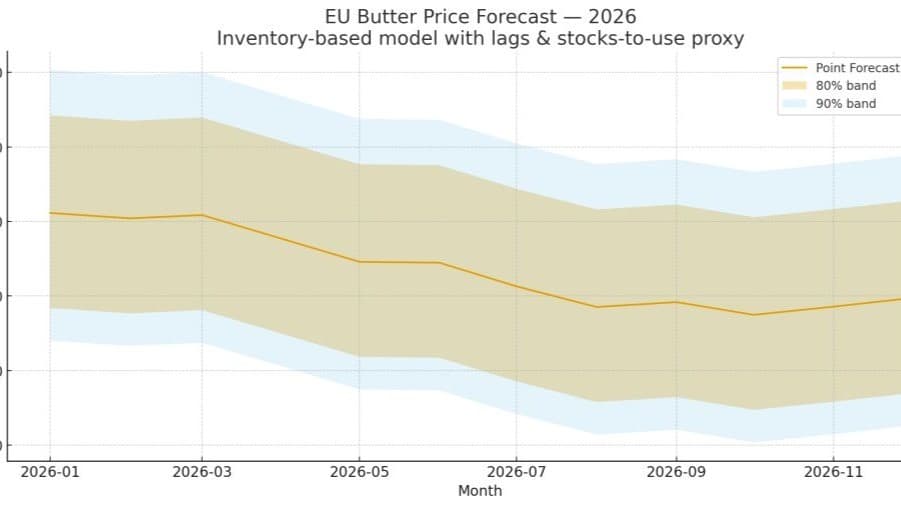
Summer Shopping or Summer Sale?
Last week was again a bit of a bearish week for the entire dairy industry. With cream prices under pressure and milk intake still strong, we keep seeing a market that has more supply than demand. Butter prices took another step lower, cheese prices cracked, and the powder market gave back a bit of its gains again.
The weekly report
Get it before it is anywhere else
Every market report, straight to your inbox the moment it is written. Butter, cheese, powder, liquids — pick what you actually trade.
Roughly weekly · Free · Unsubscribe any time