
Schrödinger’s Dead Cat Bounce

The first two trading days of this week once again brought their share of intrigue. With volumes slightly lower than in previous weeks, the steep decline in commodities has finally paused. Buyers and sellers alike are hesitating, unsure which way the market wants to turn. In total, we brokered just over 700mt across butter and powders, both showing firmer levels compared to last week. Butter rebounded by roughly €200 from last week’s lows to this week's highs, while powders gained around €25/mt. Some see this as a natural bounce after such a relentless drop, others are already calling it the start of a reversal. Our take? The price action may suggest fundamental changes, but this week it was psychology that dictated price action.
This week, the market played quantum tricks on us. Just as Schrödinger’s cat can be both dead and alive until you open the box, the dairy market managed to be bullish and bearish at the same time. On Monday, producers predictably stepped away from the market, draining liquidity from the spot and the forward market. The result was textbook: futures jumped, some buyers panicked, and offers reappeared for butter at €5,600–€5,700 — a clean €300 above last week’s levels. On powders, offers went up roughly € 50,- a mt and even our sellers in cheese suggested priced needed to rise € 200,- a mt. Producers proudly pointed at firmer numbers on futures, convinced the bottom had been set and the cat was purring.
The Bounce That Wasn’t
But Tuesday morning it seemed some partners opened the box. Traders seized the high bids, unloaded volumes, and by the end of the day the market had settled back to last week’s average. A bounce, yes — but more “dead cat” than lifeline. The futures rally was over almost before it started, proving our forecast right: liquidity shocks create spikes, but they don’t change the underlying balance. Because looking at the fundamental data that came out in the previous days, this dairy market is far from bottoming out. US milk collection data remains staggering, with cow numbers increasing, milk output increasing, and milk solids per litre increasing. French milk remains strong, weekly data still roughly up 3% v.s. last year, and it feels we will not be getting a seasonal supply dip in Europe. Milk volumes are plateauing instead of dipping, clearly holding firm pressure on the spot market that continues to feel incredibly weak.
Two Camps, One Cat
Still, no all market participants can agree on the market cat's diagnosis. Sellers insist the cat might still be very much alive, that prices can stage another rally as Monday's market suggested. Others argue we lack crucial real-time fundamentals to declare either way and that only time will tell how alive this cat bounces. Meanwhile, a growing group sees enough evidence to call it: the bounce is behind us, the cat is dead. At GFD, we lean toward the latter. The evidence points to a market that got ahead of itself and then reset to reality. A steep decline needs a short term bounce for profit takers and sellers to catch their breath. Schrödinger’s experiment may leave room for uncertainty, but in dairy we prefer hard fundamentals over quantum philosophy. For now, the cat has bounced, and gravity seems to be winning.
Spot Liquids: No Bounce
The spot market shows little reason to expect a rebound. Prices for raw milk, SMC, and cream continue under pressure, with no sign of recovery. Traders point to persistent offers from producers trying to clear milk, with some even indicating forward sales below 40ct — around 15ct under their contracted milk price. That signals a willingness to take a hit today rather than hold risk tomorrow.
SMC remains heavy. While these levels mean significant losses for some, others are happy to pick up product and convert it into SMP well below current spot values. With SMC trading between €1,600–€1,700, production costs under €2,100 are within reach.
Cream tells the same story. Offers linger around €6,100 but have been reported as low as €5,850. At those levels, conversion into fresh butter valorises back to roughly €5,100–€5,250. Recent production data confirms the trend: EU28 butter output in June rose 8.5% YoY, July followed with +7.5%, and given current cream-to-butter economics, August and September look set to print record-high production after years of muted volumes. In short: spot liquids remain under pressure, feeding into butter and SMP supply chains, and offering little hope for an immediate bounce.
Butter: More butter in 2025
The butter market showed its most volatile side again. On Monday evening, EEX futures for May–June spiked as high as €5,875 — a jump of nearly €400 compared to the week before. No fundamental shift explains the move; this was sentiment-driven, with buyers eager to secure forward cover and sellers reluctant to commit. It’s a reminder of how thin the forward market is, and how it reacts violently when psychology takes over.
Yet, looking at 2025 demand, it remains hard to spark genuine buying interest. Most industrial buyers appear done for the year, while traders covering forward positions are leaning heavily on discounted offers versus the curve. Even then, we see limited appetite. Many traders prefer December purchases — payable in 2026 — rather than taking on October or November volumes they don’t need. Most traders seem eager to sell their October volumes themselves as well, as demand from end users slows and delays keep showing up.
After Monday’s sprint, Tuesday’s fall was no surprise. Fundamentals remain weak, and low prices keep resurfacing. German producers are selling October–November butter at €5,250–€5,300, while French and Irish offers hover around €5,350–€5,400 without finding much outlet. Should cream slide toward €5,850 in the coming weeks, fresh butter offers could easily drift back toward €5,200.
We’re often asked: how deep can butter correct? If we had the answer, we’d give it. But the U.S. may offer a clue. Strong farmer margins, excellent producing conditions, and robust milk supply have pushed July’s volumes up 4.2%, with August showing similar strength. More cows are being added, and producers show little concern for forward pricing. Farming fundamentals in the EU are quite similar; perfect weather, high margins, low cost, and healthy livestock create the perfect conditions for maximum milk output. While some will argue that farmers in the EU are more limited than farmers in the US, we feel that's only true for a handful of farmers in the EU. Most countries would still offer plenty of room to expand while margins allow it. And farmers who were about to quit (in France for example) seem to be pushing out an extra year while margins are as the are.
CME butter values for October and November have slid to $4,000–$4,100/mt (80% salted) — equivalent to well below €3,500. Even after premiums, lactic unsalted butter is competitive below $5,000, implying EU-equivalent competition at €4,000–€4,250. With record exports already booked, U.S. butter will undercut Europe wherever it is approved. And despite those exports, the U.S. is still sitting at a five-year low.
In short, sentiment can push the market higher for a moment, but gravity keeps pulling butter back down. Unless EU fundamentals tighten meaningfully, international competition-led by U.S. exports will cap rallies and keep pressure on forward contracts. For 2026, the market looks more exposed than supported.
Cheese: On Pause
The cheese market continues to mirror butter’s sentiment, and the last two days were no exception. While butter sprinted higher before correcting just as quickly, cheese essentially hit the pause button. Sellers were hesitant to push further down, perhaps wary of a potential bounce spilling over from butter. But unlike the nervous butter buyers, the cheese market has yet to show the same urgency — forward cover remains less of a focus, and buyers are still looking at weaker 2025 fundamentals rather than the firmer 2026 narrative.
Cheese production numbers themselves have been relatively stable, showing none of the volatility seen in butter and smp output. This has provided some balance, though not enough to fundamentally alter sentiment. It’s worth noting that cheese prices in the U.S. have been showing some firmer tones recently, and that relative strength could spill into the European market at some point, at least on sentiment. And while we say firmer tones, we mean more stabilisation than continuous downward pressure as seen in butter.
Still, cheese prices in Europe have already corrected further than EU butter might have suggested, creating a bit of breathing space. That “extra room” may delay further freefall, but it doesn’t necessarily remove the pressure. The fundamentals remain fragile, and with butter expected to resume its bearish track, cheese is unlikely to decouple for long.
In short: stability in production and a stable U.S. tone may cushion the fall, but in the end, European cheese prices are still set to follow butter’s lead — downward, just with a slight delay.
Powders: No Use for Downward Speculation
From a distance, the powder market may look dull compared to the fireworks in butter and cheese. Price action is far less dramatic, though volumes remain just as important. On the back of firmer butter sentiment, SMP briefly showed a hint of upward potential — though that had as much to do with FX swings as with dairy fundamentals. The euro dipped toward 1.17 last week (down from above 1.19), but as the dollar weakened again and the rate returned to 1.18, that supportive undertone is already fading.
When we speak with traders, nobody feels an urge to speculate on lower prices. Powders lack the same downside volatility as butter or cheese, holding a relatively tight trading range for nearly two years. That stability limits the appeal of short bets. Yet when discussing fundamentals, it’s hard to uncover a bullish undertone: European and global demand remain sluggish, supply is strong, and inventories are building at pace. Fundamentally, powders are no less bearish than other commodities — the difference is simply that trader risk appetite isn’t.
And that risk aversion could become a weakness. With no large short positions in the market, a fresh supply wave may go unchecked by the usual balancing role of traders. As the EU nears its seasonal milk expansion, the risk tilts more bearish for powders.
The U.S. adds to that pressure. CME powder prices continue their downward slide — less extreme than butter, but firmly pointing lower. With American exporters increasingly competitive, this will weigh on forward sentiment in Europe as well. Taken together, the powder market may look calm, but beneath the surface, the fundamentals and international competition argue for more pressure ahead.
Final Note
The first days of this week’s market felt like a masterclass in psychology over fundamentals. Liquidity shortages triggered panic rallies, only to fizzle as quickly as they appeared. Spot liquids remain under pressure, butter looks increasingly exposed to U.S. competition, cheese is stable but still tied to butter’s fate, and powders are quietly bearish beneath the surface. The common thread is clear: fundamentals are heavy, supply is robust, and sentiment alone won’t carry prices higher for long.
At GFD, we see the bounce behind us. Gravity is pulling again, and while short-term shocks will continue to jolt the market, the weight of milk and product volumes — both in Europe, the U.S. and other major exporters — is keeping a firm lid on prices. Schrödinger’s cat may be alive in theory, but in dairy, we prefer facts: and when we look inside the box....
More from the desk
Our Long View Before Our Long Break 
Our Long View Before Our Long Break
Last week the market found a bit of stability. After lower trades on cheese, the cheese market traded slowly up, although a real rally remains absent. Butter prices did dip a bit further, although at the start of this week we see some strength on the back end of the curve. And on powder, our bullish feeling just doesn't go away — and now we can find some confirmation in the market as well.
Dairy Carry Has a Shelf Life 
Dairy Carry Has a Shelf Life
Last week was bearish across the board — every product we broker leaned the wrong way. Powders lost more momentum, cheese slipped well below €3,000 for some products, and butter continues to impress with just how much keeps showing up. Supply, supply, supply.
Summer Shopping or Summer Sale? 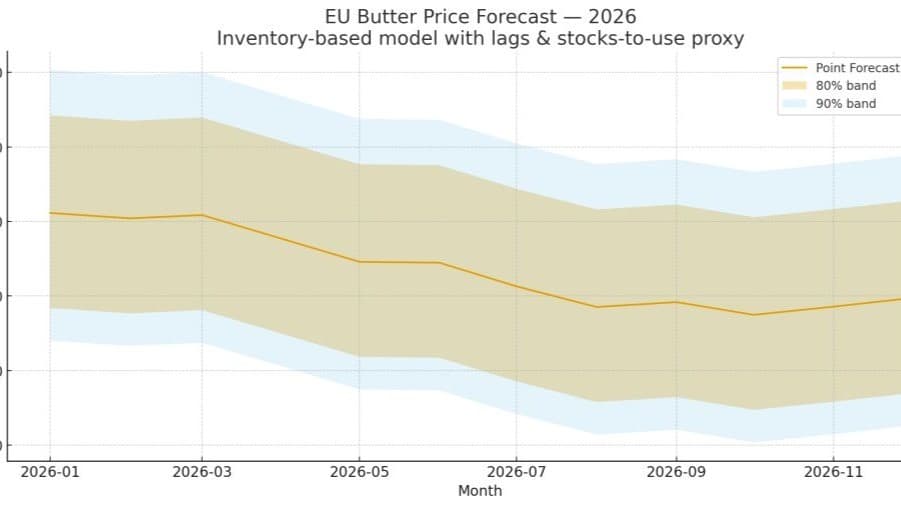
Summer Shopping or Summer Sale?
Last week was again a bit of a bearish week for the entire dairy industry. With cream prices under pressure and milk intake still strong, we keep seeing a market that has more supply than demand. Butter prices took another step lower, cheese prices cracked, and the powder market gave back a bit of its gains again.
The weekly report
Get it before it is anywhere else
Every market report, straight to your inbox the moment it is written. Butter, cheese, powder, liquids — pick what you actually trade.
Roughly weekly · Free · Unsubscribe any time