
Milk Floods Spotmarket, Demand Floods Forwardmarket

Last week was eventful when viewed from the sidelines. The week began with softer trades, but as sessions progressed the forward curve started to show firm support. The GDT outcome was surprisingly stable for us and most of our partners. Buyers seemed comfortable locking in additional coverage for 2026 at price levels now more than 25% lower than just two months ago. While forward demand for 2026 is adding a layer of support, the same cannot be said for 2025. Heavy milk intakes, elevated imports, and robust commodity production—combined with overbought buyers and undersold sellers—are weighing heavily on the balance. Discounted cream, lower SMC values, cheap butter stocks, aged cheese inventories, and exceptionally strong milk flows continue to pressure the spot market. The key question for the coming weeks: will forward demand establish a market floor, or will spot weakness drag the forward curve further down?
Let’s rewind to June, when Q4 values held firm. Gouda remained well above €4,000 and butter refused to break below €7,000. Particularly in butter, buyers sought to secure volume to avoid repeating the shortages of 2024. Cheese followed a similar pattern, with buyers more eager to commit than sellers. Producers—still haunted by 2024’s mistake of overselling forward at too-low prices and facing uncertainty on milk intakes—were reluctant to offer forward contracts. As we noted in several updates, Q4 prices were less a reflection of supply-demand fundamentals and more a reflection of buyer-seller positioning.
Now, when focusing on 2026 contracts, we see history repeating. Traders broadly confirm that their customers have already locked in significant volumes—mainly Q1–Q2, but in some cases all the way through December 2026. Compared with previous years, coverage is far more advanced. Speaking with buyers, the reasoning is clear: butter budgets for 2026 are largely set between €6,500–€7,000, and over the past eight weeks most buying has been completed below these thresholds. One counterpart disclosed covering nearly 60% of H1 2026 needs at an average €800 under budget. When asked whether he would wait for the rest, his answer was clear: if the remaining 40% can be secured at today’s forwards, the company locks in strong margins—no room for speculation. We therefore expect forward buying for butter at the € 5400 levels to remains strong.
Producer Reluctance
When asking how much of these forward volumes were contracted directly with producers, the answer was striking. Producers have barely engaged in 2026 forward sales. Their focus has been on stock management and allocating higher milk flows, not on locking in forward supply. The explanation feels familiar: producers claim they are not in the business of speculating, and with forward values trading below farmgate milk returns, they cannot act. In a tight market, that hesitation may be harmless, but in an oversupplied environment, producers risk being forced to sell into an already saturated market—where buyers will resist paying any premium versus the forward curve. The likely outcome: heavy carry values in the months where supply always outperforms demand.
Powder Market Dynamics
In powders, this type of forward buying is nothing new. Whenever buyers can lock in large volumes below production cost, they seize the opportunity. This dynamic has created a predictable SMP trading range for nearly two years. Even amid oversupply today, buyers continue to secure contracts at current lows, knowing that holding out for “even cheaper” rarely pays. But we know that once suppliers start to put their prices back up, most buyers have built enough stock to sit out any rally again.
Cheese: A Shorter Horizon
Cheese is the exception. Buyers appear less motivated to commit further forward as their customers also have a shorter horizon. Where contracts for cookies and chocolate bars sometimes go 12 months forward or longer, in cheese, this outlook is usually much shorter. Retail contracts tend to be shorter in horizon, and foodservice follows the same pattern. Cheese buyers sometimes reach six months ahead, but producers rarely commit beyond two to three months forward. Both sides continue to play the short game.
The Producer’s Dilemma
The current firmness in Q1 and Q2 contracts does not necessarily reflect shifting fundamentals. Rather, it reflects buyers’ willingness to cover forwards exceeding sellers’ willingness to commit. With trading risks increasingly managed by banks and CFOs, the appetite for forward selling continues to shrink. In fact, in recent days it has felt as if many traders would be more comfortable buying back shorts than adding fresh sales.
Producers face a critical decision. Stepping away from the market could reduce liquidity on the sales side, potentially creating short-term upward momentum on prices. Attractive on paper, yes—but this does nothing for the actual supply-demand imbalance. Instead, it opens the door for speculative sellers to capture higher prices to nervous buyers. Once buyers are filled and producers return, they may be forced into the same falling market they sought to avoid. And we have seen the fast-paced markets can fall at once its only traders left on the buying side.
The dairy markets continue to show us the same recurring playbook: buyers act opportunistically, locking in forward cover at attractive levels, while producers hesitate, constrained by cost structures and haunted by past missteps. The result is not a balance between supply and demand, but a tug-of-war between risk appetite and risk aversion. In a market where supply is tight, the strategy producers use gives them extra upside potential, but in a market with oversupply, it feels their potential risk is twice as big. As we move deeper into 2025 and 2026 positioning, one thing is clear: the winners will not be those who predict the perfect bottom, but those who execute timely coverage strategies and avoid being left chasing liquidity when the music stops.
Milk: Heavy Milkflows Unusual for the time of year
Some will argue that heavy speculation by traders is driving the market down at unprecedented speed. We would argue the opposite: speculation has actually limited the severity of this correction. Without traders selling forward at relatively high levels to end users, the imbalance between supply and demand would have triggered far steeper and faster declines. Let’s be clear: it’s not traders pumping an extra 3.5% of milk in France. It’s not traders behind Germany’s 5% YoY intake increase last week, pushing butter output 15% above last year. It’s not traders forcing CME lower on the back of heavy U.S. cream flows. Or traders reducing consumers' demand, or causing stocks of cheese to build. True, traders have facilitated imports of cheaper NZ and U.S. cheese, AMF and butter into the EU—but only because wide arbitrage opportunities were there to be exploited. The reality is straightforward: it is heavy global milk flows that are putting markets under pressure.
Farmer Perspective and Milk Dynamics
Conversations with farmers (and sons of farmers) confirm the same story. Bluetongue has shifted this year’s milk curve, suppressing the spring peak but amplifying the seasonal dip. Looking ahead, most expect these strong YoY gains in milk production to continue well into the new year. Once farmgate prices begin to slide, there will be an impact on supply—but the timing and scale depend heavily on how fast those prices adjust.
In France, farmgate prices are expected to rise further in the coming months before easing. And in markets where politics often outweigh pure economics—particularly within the larger cooperatives—it is unlikely we will see significant downward adjustments before year-end. Smaller coops will have a hard time surviving this market. Broad consensus is that meaningful farmgate pressure will only feed through to production by Q2, or more likely early Q3.
This is not a story of traders driving markets into freefall. It’s a story of abundant milk, structural oversupply, and producers insulated—at least temporarily—by farmgate politics. Speculation may appear as the villain, but in reality it has absorbed risk and slowed the crash. The true driver of market pressure remains the unrelenting flow of milk worldwide. The real test will come not from trader positioning, but from how long production keeps expanding before the farmgate realities finally bite.
Butter: Finding a Floor in 2026
Butter has corrected by over €1,400 in less than five weeks, but we believe the market has now found a floor from which it will likely stabilise for 2026. With end users consistently showing willingness to commit at €5,300–€5,600 DAP, it appears that substantial volume will need to trade before any further downside is realised. On Friday, we observed significant activity in futures around €5,600, nearly flat versus the current EEX average quotation.
The 2025 market, however, paints a very different picture. New producers are stepping in daily with spot offers, leaving nearby positions feeling unsupported. Frozen stock from April–May production is being marketed alongside unusually high volumes of fresh butter for September–October. Last year, Europe’s defrosting capacity was fully utilised to reprocess stock and prevent fresh production due to extremely high cream prices. This year, the flow of offers suggests most producers are opting to keep butter fresh, avoiding freezer costs altogether.
Adding to the imbalance, more factories that traditionally buy cream at this time of year are now selling volumes instead, aiming to avoid additional butter production. Yet the majority of this cream is absorbed by traders and producers eager to manufacture low-cost butter. Cream prices fell well below €6,000 last week, with some reporting this calculates to fresh butter output at €5,100–€5,200. We also heard direct sales from factories to traders in this range. French, Spanish, and Belgian butter traded between €5,100–€5,150 for larger volumes. In Poland, prices did not fall below €5,250, while in Ireland we recorded— and executed ourselves—the first trades below €5,250 FCA Ireland.
Production Data
July butter production figures underline the trend: substantial increases compared with last year. What is particularly striking is that milk collection numbers remain negative in some countries, even though we know volumes surged in August and early September. This suggests further upward surprises in production data are highly likely. Keep in mind that up until June, the higher production numbers in this year were compared against weak comparables, but in July last year, the butter production in most countries started to rise already. France and Germany in July 2024 started to increase butter production from July onwards YoY
| Country | Milk Increase | Butter Production Increase |
|---|---|---|
| France | -0.5% | 4.2% |
| Germany | -0.5% | 7.5% |
| Ireland | 4.6% | 11.8% |
| Poland | 4.4% | 9.2% |
| Italy | 0.8% | 10.0% |
| Spain | -2.5% | 39.0% |
| Denmark | 2.9% | 18.0% |
| Sweden | 4.6% | 39.0% |
| Finland | 0.4% | 9.0% |
| Belgium | -4.0% | -12.0% |
| Netherlands | -0.1% | -28.0% |
Butter Market Outlook
So where does this leave the butter market? On one side, we see robust forward demand, with buyers actively covering large volumes at €5,300–€5,600. On the other, the spot market remains oversupplied with milk, butter, and cream, with little appetite from the industry to absorb it. The Q4–Q1 spread will likely widen further, though a gap exceeding €500 feels unrealistic. (current lows are € 5100, fridays highs were € 5600)
Our advice: buyers should continue to secure coverage and consider averaging down their purchase price by taking extra Q4 volumes, which in turn supports suppliers. On the supply side, we recommend considering sales for Q1 or H1 2026 alongside current stock, even if it means averaging down forward prices—at least this strategy sustains liquidity and market health.
If both buyers and sellers stick rigidly to their usual behaviour—only buying immediate needs and selling what’s on hand—the door opens for traders to add value. Traders may offer relief to producers, but only at sharp discounts, while simultaneously placing forward volumes into 2026 with incentives attached. The risk: a Q1 market exposed, with buyers entering the new year overbought and sellers lacking forward placements—potentially triggering another downward spiral once Q1 begins.
We expect to start the week with the following markets.
Bids:
- 6 trucks Irish butter for Oct/Nov at €5,200 FCA Ireland
- 6 trucks NL/DE/BE for Q1 or H1 at €5,450
- 12 trucks Polish Sweet Cream butter for H1 at €5,250
Offers:
- 4 trucks fresh Belgian lactic butter for October at €5,350 (Solarec, Belgomilk, Corman)
- 4 trucks frozen French butter DAP NL at €5,450
- 4 trucks frozen Arla DK/SE DAP NL at €5,450
- 6 trucks NL/DE/BE fresh/frozen December at €5,600
- 6 trucks NL/DE/BE fresh/frozen for Q1 at €5,650
- 6 trucks Polish SC butter for Q1 at €5,550
Cheese: Looking for the Bottom
Looking at the cheese market, even traders have been unable to anticipate the speed of this decline. In our view, there are two main reasons. First, cheese held firmer in recent months than most expected, keeping traders reluctant to take on significant exposure. Second, most traders active in cheese are also active in butter, where the signals were far clearer. At the same time, few buyers engaged in forward cover, feeling less urgency about potential rallies.
This has created a market where both buyers and sellers remain close to home, with traders less inclined to act as speculators. As a result, supply and demand are reflected far more directly, and the pace of decline has been even steeper than in butter. Last Friday, we brokered Gouda in both Q4 and Q1 at €3,200, more than €1,000 below pre-summer levels. By rule of thumb, every €100 move in butter translates to roughly €50 in cheese. If that correlation holds, cheese has been correcting even faster than butter.
Another challenge for cheese is its perishability. Once it ages, it quickly loses value. We have already flagged the rising age profile of Gouda and Edam, and we continue to see more products reaching or exceeding expiration. The surge in downgraded products is a clear signal of oversupply and even a slowdown in demand. While we expected some stabilisation once butter found a floor, pressure on cheese remains intense. Reports of Irish Gouda sales below €3,000 ex-works, and just over €3,050 DAP into Europe, confirm the depth of the weakness.
Forecasting a floor for cheese is difficult—by now, we would have expected one to form. Perhaps stabilisation in butter will provide some support, but for now, the market remains under heavy pressure. We expect to have a market to start with as follows.
Bids
- 1 truck Mozzarella for W40 delivery at €3,200 DAP NL
- 6 trucks Mozzarella for Q4 at €3,100 FCA
- 3 trucks Irish Mozzarella for Q4 at €3,250 DAP NL
- 6 trucks Gouda for Q1 2026 at €3,150
Offers
- 4 trucks Gouda for October at €3,300
- 2 trucks Emmental for Nov–Dec at €4,350
- 6 trucks of Mozzarella for Q4 at €3,450
- 6 trucks Gouda for Q1 at €3,300
Powders: Influenced by More Than Milk
The powder market was by far the most active segment last week. Nearly 2,000 MT changed hands via Linda, marking a clear shift from the long period of relative dormancy. Unlike butter and cheese, where weekly moves of €200–300 are now commonplace, price action in powders remains more measured. And while butter and cheese are overwhelmingly supply-driven at present, demand continues to play the dominant role in shaping powder values.
Why? The FX rate is a major driver. A drop in EUR/USD towards 1.15—or lower—would immediately trigger fresh demand. This suggests global buyers remain present but are unwilling to pay at current European price levels. Other origins like NZ and US product, with strong availability, are also competing for this demand. Still, such a currency move would likely spark sales in powders much more than in butter or cheese.
Forward appetite also sets powders apart. Buyers are generally comfortable covering ahead at current levels, often taking a little extra into the forward curve. With lower financing costs, minimal risk from aging, and fewer storage constraints than butter or cheese, powders are easier to carry. That said, the comfort in buying forward should not blind us to what’s happening on the supply side.
Because more milk ultimately means more cream, it also means more skim concentrate. Last week’s German milk data showed a 5% increase in intakes, resulting in more than 35% higher powder output. With SMC prices trading cheaply, many with spare drying capacity will take advantage, adding incremental volumes into the market.
At present, producer offers are reported between €2,050–2,150, which aligns with our own market view. Sellers are willing to let go of volume, but resistance below €2,100 remains strong. On the buy side, there is sufficient interest, though no one seems prepared to pay beyond €2,100 at this stage.
Final Note
If last week reminded us of anything, it’s that the dairy market has an impeccable sense of irony. Just when traders are accused of being the wrecking ball, from our point of view, they’re actually the scaffolding holding the whole structure up. Meanwhile, milk keeps flowing like it hasn’t read the internal memo of co-ops who are hoping for a slowdown in milk volumes. Meanwhile, butter is finding a fragile floor, cheese is free-falling like it skipped breakfast, and powders are once again proving that a strong FX rate can do more damage than a overactive cow.
Our advice? Don’t waste energy searching for the perfect bottom. Nobody wins that lottery twice in a row. Focus instead on disciplined cover, realistic expectations, and leaving just enough room for luck to look like wisdom. Because when the market’s music stops — and it always does — it won’t be the cleverest prediction that counts, but who’s still holding a chair.
More from the desk
Our Long View Before Our Long Break 
Our Long View Before Our Long Break
Last week the market found a bit of stability. After lower trades on cheese, the cheese market traded slowly up, although a real rally remains absent. Butter prices did dip a bit further, although at the start of this week we see some strength on the back end of the curve. And on powder, our bullish feeling just doesn't go away — and now we can find some confirmation in the market as well.
Dairy Carry Has a Shelf Life 
Dairy Carry Has a Shelf Life
Last week was bearish across the board — every product we broker leaned the wrong way. Powders lost more momentum, cheese slipped well below €3,000 for some products, and butter continues to impress with just how much keeps showing up. Supply, supply, supply.
Summer Shopping or Summer Sale? 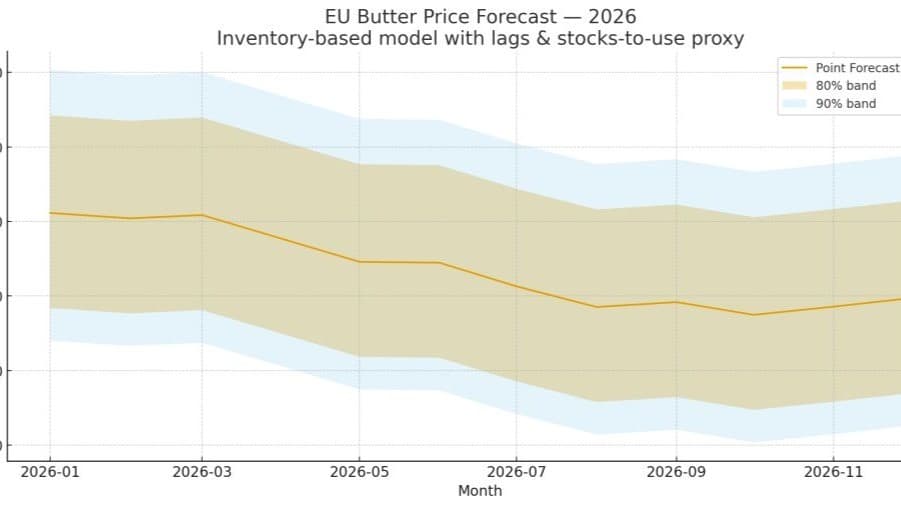
Summer Shopping or Summer Sale?
Last week was again a bit of a bearish week for the entire dairy industry. With cream prices under pressure and milk intake still strong, we keep seeing a market that has more supply than demand. Butter prices took another step lower, cheese prices cracked, and the powder market gave back a bit of its gains again.
The weekly report
Get it before it is anywhere else
Every market report, straight to your inbox the moment it is written. Butter, cheese, powder, liquids — pick what you actually trade.
Roughly weekly · Free · Unsubscribe any time