
Weaker Liquids Pressure Spot Prices

Again, it was an active trading day for us, with the bulk of volumes once more concentrated in powders. Cheese and butter found some movement as well, but it is powders that have clearly retaken center stage. Almost 500 metric tons changed hands, traded within a narrow range of €2100 to €2130, and every executed deal seems to push the market to carve out fresh lows. On butter we are starting to sense the beginnings of a floor, although the broader pressure on 2025 remains firmly in place. Cheese, however, is sliding without resistance—prices are on a slope that shows no visible end to this ongoing correction.
The underlying weakness continues to come from the liquid side of the market. More raw milk, CMC, and cream keep appearing, and there is no real buying appetite to absorb it. As a result, prices are pushed lower with each passing day. Raw milk is now barely holding above 40 cents, with multiple traders even claiming to have made purchases below that level. While spot milk trading under farm-gate prices is not unique, the timing makes it remarkable: Europe should almost be at its seasonal low, with buyers scrambling for volumes to cover the stronger demand that usually sets in this time of year. Instead, we are seeing flows of liquid product arriving from all across the EU, weighing on the balance further. SMC has traded down to average levels between €1600 and €1700. Cream also remains weak, touching a resistance point of €6000 that would in our forecast not be tested until year-end. By the close of the day, sizeable trades for western EU cream were confirmed even lower, between €5850 and €5900, levels that few would have expected to see this early in the season.
Butter: Stable H1 2026, but Pressure Persists on Q4
The butter market this week gives off a sense of stability, though the reality is somewhat deceptive. Prices are still trading €400 below last week’s levels, yet since Monday, values for H1 have found a level of consolidation around €5400. Q4, however, tells a very different story. Bids at current levels are increasingly scarce, and the signal from the industry is unambiguous: prices will need to soften further. With cream at €6000 DAP, factories across Europe are calculating butter production costs comfortably around €5250, leaving margins more than acceptable. Polish producers ended the day showing selling interest around €5300, and in parts of Western Europe we even heard whispers of slightly lower levels available for prompt collection.
Our conviction is that prices for 2026 may slow their descent, at least for now, but Q4 still has ground to give. The weight of offers far exceeds the pull of demand, and unless discounted against Q1 values, the market simply cannot absorb the tonnage. A €200–€250 discount should be enough to attract buyers, putting fair Q4 value in the €5100–€5150 range, in line with cream.
We expect to start with bids for:
- 12 trucks of NL/DE/BE butter Q4/Q1 at €5325
- 12 trucks of Polish SC butter at €5300 H1
- 4 loads NL/DE/BE butter Nov/Dec at €5300
- 4 loads Irish butter at €5300 FCA Ireland, November/December
- 1 load Irish SC butter for prompt FCA NL at €5450
Cheese: Melting Away
The cheese market is weakening hour by hour, and the downward pace is accelerating. More product keeps surfacing on the market, yet demand has virtually evaporated. Gouda is now reported as low as €3200 FCA, while Edam touched €3180. One buyer even claimed to have secured product at €3225 DAP Eastern Europe. Mozzarella is being offered in abundance around €3300, while white mild cheddar has been brokered at €3900. Even the cheeses that had appeared more resilient are now giving way: Emmental is quoted at €4300–€4500, a sharp adjustment.
We have the following offers:
- 6 loads NL/DE Gouda €3325 FCA NL/DE for Q4
- 6 loads NL/DE/BE/D Mozzarella €3300 FCA NL/DE/BE for Q4
Powders: Dropping Lower
Powders may look less dramatic in their decline, but the slope is still pointing downward. Yesterday nearly 500 mt again moved between €2100 and €2130. Resistance below €2100 is still visible, though with SMC this weak, it is hard to believe it will hold for long. Stocks are accumulating quickly, and while the FED’s rate cut is a notable development, the current USD/EUR exchange rate of 1.187 means exports for powders—as well as other dairy commodities—are unlikely to bring relief to the EU market anytime soon. Prices will need to continue adjusting before the balance can find new support.
Partners who are still hoping for the market to stabilise quickly may find themselves waiting longer than their finance department lets them. The heavy supply, weak demand, and structural imbalance between liquids and end products are creating conditions where only sharper price corrections will reawaken real buying interest.
More from the desk
Our Long View Before Our Long Break 
Our Long View Before Our Long Break
Last week the market found a bit of stability. After lower trades on cheese, the cheese market traded slowly up, although a real rally remains absent. Butter prices did dip a bit further, although at the start of this week we see some strength on the back end of the curve. And on powder, our bullish feeling just doesn't go away — and now we can find some confirmation in the market as well.
Dairy Carry Has a Shelf Life 
Dairy Carry Has a Shelf Life
Last week was bearish across the board — every product we broker leaned the wrong way. Powders lost more momentum, cheese slipped well below €3,000 for some products, and butter continues to impress with just how much keeps showing up. Supply, supply, supply.
Summer Shopping or Summer Sale? 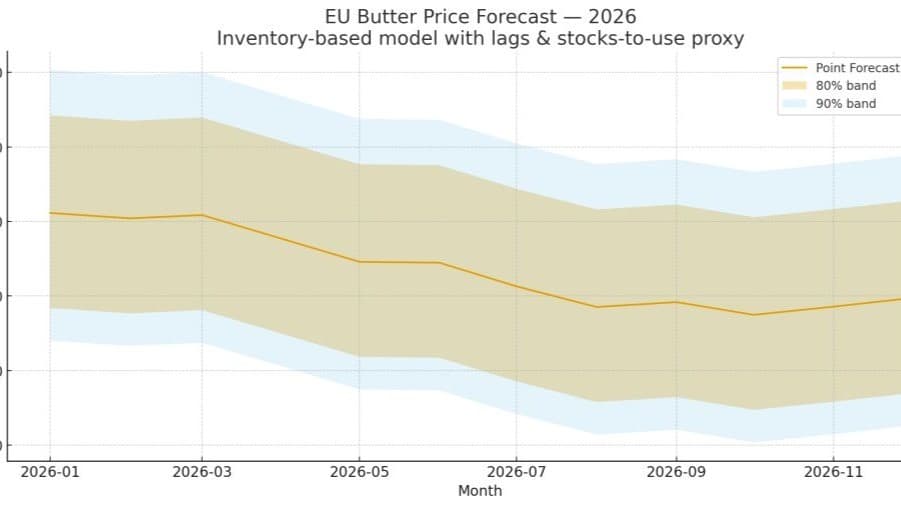
Summer Shopping or Summer Sale?
Last week was again a bit of a bearish week for the entire dairy industry. With cream prices under pressure and milk intake still strong, we keep seeing a market that has more supply than demand. Butter prices took another step lower, cheese prices cracked, and the powder market gave back a bit of its gains again.
The weekly report
Get it before it is anywhere else
Every market report, straight to your inbox the moment it is written. Butter, cheese, powder, liquids — pick what you actually trade.
Roughly weekly · Free · Unsubscribe any time