
Shakey Stability

The last three trading days have been, as predicted, uneventful. Prices are moving sideways and a slightly weaker GDT confirms the persistent soft sentiment among buyers worldwide. Butter could even be described as marginally bullish, though the roughly €100 uptick from last week’s lows looks more like a correction than a reversal. Activity has slowed: 750mt of butter, 132mt of cheese, and 400mt of powders changed hands in three days. A market not making new lows feels as stable as one could hope for, yet the foundation remains shaky — raw milk, SMC, and cream aren’t showing the same composure as finished commodities.
When looking at milk intake, it’s clear there’s no slowdown in sight. Spot raw milk prices continue to fall, averaging 33–34ct but with some trades well below 30ct. And this isn’t just short-term: Q4 contracts through January are being closed at these same depressed levels. Coops appear eager to move milk off their books, but dumping it cheaply elsewhere doesn’t solve the market's oversupply issue, but only their own. SMC prices have slipped to €1000–€1100 FCA, with pressure mounting to push below €1000 for remaining loads. Only cream remains relatively steady around €5900–€6000, though traders expect it to follow raw milk lower once mid-November hits.
GDT: As Expected
Tuesday’s GDT ended with a -1.4% result. All but AMF showed declines, with AMF still undervalued in our view. Butter fell less than expected — Solarec’s EU result landed around €5100, just above our forecast. NZ butter didn’t move much either, suggesting loyal buyers are still taking their regular volumes, keeping prices higher than fundamentals justify. Mozzarella settled at €2770, exactly where we expected it. SMP slipped 1.6%, slightly better than our forecast, while WMP dropped 2.4%, slightly worse. The fifth consecutive negative tender continues to drag global sentiment lower.
Butter: Higher Forward Prices
It’s hard to call butter bullish, but forward trades for Q2 at €5200 and Q3 at €5400 show mild improvement versus last week. Near-term prices (Nov/Dec) have crept from €4500–€4600 to €4600–€4700. As long as cream holds near €6000 and producers resist selling Q1 below €5000, the market should drift sideways. Traders are working spreads between cheap Q4 and higher Q2/Q3 bids, effectively absorbing old stocks into 2026. That strategy keeps 2025 oversupply alive. Producers still seem reluctant to follow our advice: use current stability to sell forward instead of chasing fresh lows. And while 2026 demand gets filled, the unsold forecast remains... unsold.
Another reason prices remain sticky is that quotations can’t keep up, keeping EEX futures inflated. Yesterday’s EEX settlement came in at €5390 — roughly €400 above where we would see fair value. The Dutch quotation tried to stay realistic at €5150, but the French (€5420) and German (€5600) are miles off actual deals. With French butter selling around €4700–€4900 and the VPI index showing Western EU butter at €4900 (a full €500 below EEX and € 700 below the German quotation), the current settlement is losing what was left of its credibility. We’re encouraged that new EEX and VPI initiatives aim for a truer reflection of the market.
Meanwhile, the US market keeps sliding. The CME spot call hit its lowest level in nearly five years, taking butter back to prices many thought we’d never see again. With the EU–US spread widening, EU import flows are likely to rise while exports take another hit.
We expect trading to remain slow and anchored near current levels, depending on how eager either side is to get deals done.
Indicative Butter Levels Bid/Ask
NL/DE/BE – Dec: €4900 / €5100
Irish – Dec: €4800 / €4950
NL/DE/BE – Q1: €4900 / €5100
Irish – Q1: €4750 / €4990
NL/DE/BE – Q2: €5150 / €5250
NL/DE/BE – Q3: €5400 / €5450
Cheese: Slightly Firmer
As butter firms, cheese follows. As long as butter doesn’t collapse, cheese should stay stable. We traded Q1 Mozzarella at €2840 and see Gouda interest at similar levels. Buying for Q2 is even firmer, but sellers are scarce — few are willing to commit that far out. A correction in butter would likely drag cheese lower too, so cheese traders should keep a close eye on the fat market.
Exports are offering a glimmer of optimism. With US cheese slightly firmer, the EU may pick up more overseas business — a welcome outlet as milk flows rise in coming months. Exports below €3000 could relieve some domestic pressure, though not enough to stop the broader decline we think.
Indicative Cheese Levels Bid/Ask
Gouda – Nov: €2600 / €2800
Mozzarella – Nov: €2700 / €2900
Edam – Q1: €2750 / €2900
Gouda – Q1: €2825 / €2925
Mozzarella – Q1: €2775 / €2875
Powders: Stable, but Pressure Building
Powder prices have shed significant value recently, though the rapid fall has paused for now. We’ve seen trades below €2000, but newer deals are back above that threshold. Still, with SMC far below SMP production cost, stocks will likely rise quickly and renew downward pressure. The GDT slowdown adds competition for EU powder and limits room to rebound.
The real issue isn’t demand — it’s production. With SMC near €1000 and raw milk around 30ct, output is bound to surge. As the fiscal year closes, expect more stocks to hit the market and SMP to dip below €2000 again.
Final Note
The market may look steady, but steadiness born of fatigue isn’t strength. We will give our advise once more, use this calm to position smartly, not comfortably — the next move will come from those who act before the crowd wakes up.
More from the desk
Our Long View Before Our Long Break 
Our Long View Before Our Long Break
Last week the market found a bit of stability. After lower trades on cheese, the cheese market traded slowly up, although a real rally remains absent. Butter prices did dip a bit further, although at the start of this week we see some strength on the back end of the curve. And on powder, our bullish feeling just doesn't go away — and now we can find some confirmation in the market as well.
Dairy Carry Has a Shelf Life 
Dairy Carry Has a Shelf Life
Last week was bearish across the board — every product we broker leaned the wrong way. Powders lost more momentum, cheese slipped well below €3,000 for some products, and butter continues to impress with just how much keeps showing up. Supply, supply, supply.
Summer Shopping or Summer Sale? 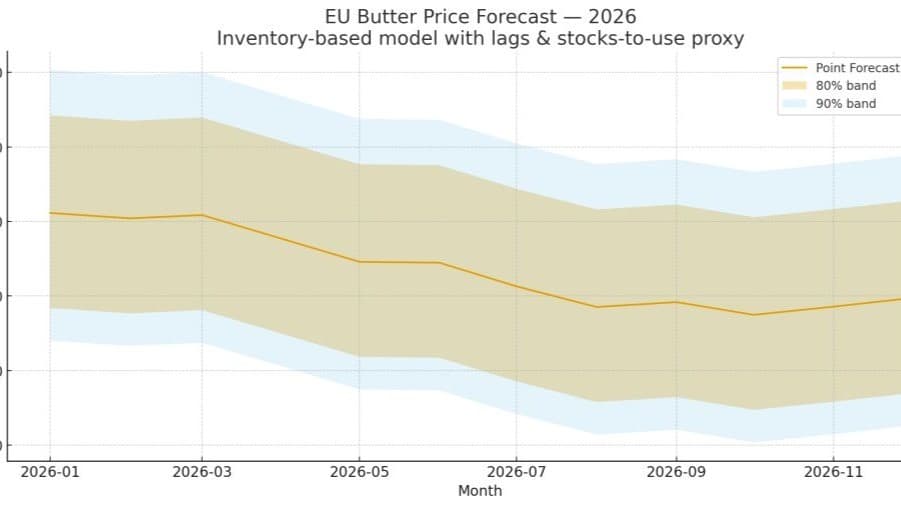
Summer Shopping or Summer Sale?
Last week was again a bit of a bearish week for the entire dairy industry. With cream prices under pressure and milk intake still strong, we keep seeing a market that has more supply than demand. Butter prices took another step lower, cheese prices cracked, and the powder market gave back a bit of its gains again.
The weekly report
Get it before it is anywhere else
Every market report, straight to your inbox the moment it is written. Butter, cheese, powder, liquids — pick what you actually trade.
Roughly weekly · Free · Unsubscribe any time