A Chance for (short term) Stability

Last week saw another busy round of trading, with the full dairy complex trimming a few more percentage points off its prices. Fundamentals still point to a market awash with product, while demand remains hesitant — but that doesn’t mean we expect the market to continue its freefall. As milk collections approach their seasonal low and the typical year-end demand window nears, the market could finally find some footing. Last Friday showed some early signals. Supply may be more than ample, and buyers remain selective, yet assuming no seasonal imbalance at all would be a stretch. Many suppliers have already cleared a fair share of their 2025 positions, leaving the spot balance looking a touch healthier. Add to that a continuous willingness from end users to secure coverage into 2026, and we might just be heading into a few weeks of relative stability. For now, we foresee prices looking set to move sideways — a period that might give sellers a false sense of calm. But with sentiment fragile and downside corrections still likely across the complex, this might also be the moment to capture forward volumes without chasing a falling market.
When we mentioned our short-term stability forecast in our phone calls last Friday, a few partners asked what had changed — what suddenly made us bullish? Especially after our Bearish Market report we sent out Friday morning. Some might have the same idea, reading the title of the article and the introduction. If that’s how it comes across, we need to be clear in our phrasing. We’re not turning bullish, we believe (a lot) more downside lies further down the road. But for now, we believe the market has already priced in much of the bad news for the remaining months of 2025 and cleared some of the issues in front of us.
Over the past ten weeks, the entire complex has shed significant value, and current market price levels seem to reflect the balance between supply and demand fairly well, also when looking at historic patterns. Butter stocks are clearly higher than last year, though not at record levels yet, and the same can be said for cheese and SMP inventories. We still forecast record stocks, but only after the milk peak of 2026. Supply is more than sufficient to carry us through the coming months, but the correction we’ve seen already accounts for that reality.
If cream values manage to hold within the €5,800–€6,200 range over the next four to five weeks, we expect butter to stabilise. Without renewed pressure on butter, cheese prices should also find some footing.
The outlier remains the powder market. The SMC market feels particularly weak, and if cream stays steady, sellers may allow SMC prices to drift lower without much resistance. Production remains high, and with additional pressure from the international market, SMP is the one segment where we see little near-term stability.
A Window Worth Using
The coming weeks might offer a brief but valuable window for producers to tidy forward books in a market that finally might show some stability. After weeks of relentless pressure, prices might find a temporary floor — not because fundamentals have improved, but because the market has reached a level that both sides can live with, for now. Once seasonal milk volumes start to increase again, and stocks start to build again, the market will feel the supply pressure push on prices again, we think. The relative balance the market might show over the next weeks gives sellers a rare chance to commit forward volumes without chasing a falling market.
But caution is key. Any attempt to lift prices up again could easily invite speculators back into the game, undercutting sellers. We would urge producers not to push sentiment out of line with fundamentals once again. That would likely result in another heavy correction further down the line — one that benefits mainly traders, not producers. The outlook for milk collections remains very positive to the upside, and the expectation of higher collections in the months ahead means supply will stay more than comfortable.
In all honesty, our outlook remains very bearish for the entire dairy complex for next year. Stocks are likely to keep rebuilding in the first six months, while exports remain slow, with a real pickup in shipments not expected before the end of Q1. On top of that, ongoing imports continue to add weight to inventories, and demand is very unlikely to pick up quickly. The message we would give to producers is simple: be wise, use the calm while it lasts, and lock in sales while the market still feels steady — because once November draws to a close, the bearish undertone is likely to return.
GDT: Expecting Mildly Lower
This week’s Global Dairy Trade event will once again serve as a checkpoint for international demand. With the past four auctions closing in the red, we would expect another mildly negative outcome. Starting with the butter complex, EU values are likely to take a noticeable hit. With NL/DE/BE butter now trading below €5,000, it’s worth questioning whether Solarec’s prices can stay afloat — a slip there would mark an 8–10% drop versus two weeks ago. New Zealand butter is also expected to soften, as reports of U.S. butter moving into Asian markets are eroding some of the regional strength. Loyal tender buyers may prevent a full correction, but a 3–4% decline would look justified.
Mozzarella seems set to follow a similar pattern. Even after the previous GDT saw prices fall toward €2,900, nearby EU trades have since slipped lower. Any result above €2,800 would, in our view, signal an encouraging note from the market. SMP, on the other hand, appears under renewed pressure. After falling to €2,130–2,150 at the last event, EU values have weakened further — now near €1,950 for current-year delivery and just over €2,000 for next. With CME, EEX, and SGX futures also trending lower, a 2–3% correction across both EU and NZ origins seems realistic.
On WMP, the downside risk looks milder. Prices have already adjusted significantly, and we see less justification for another sharp correction. Still, a slightly negative result would fit within the broader tone of the market — one of cautious trading, softer sentiment, and buyers unwilling to commit beyond the short term.
Butter: Stable to Slightly Higher
The butter market has lost substantial value over the past week, but the rapid decline now seems to be running out of steam. In fact, we may even see some slightly higher trades over the coming weeks. Markets that fall this sharply rarely stay quiet — they tend to bounce around before finding a new balance, and this one we feel will be no exception. While near-term demand remains thin, forward interest for Q2 and Q3 next year continues to look strong. The biggest stock pressure has shifted from producers to traders, and without renewed selling from origin, there’s little reason to expect traders to keep offering lower forward prices.
That said, oversupply remains the elephant in the room. Producers may have moved stock from their own warehouses into traders’ hands, but the product hasn’t disappeared — it’s still sitting in storage. U.S. butter remains cheaper in key export markets, retail demand isn’t strong enough to absorb the excess, and slow offtake from buyers only adds to the unease.
For Q1, we believe most large buyers are already well covered, and those still in need appear comfortable waiting. Prices below €5,000 DAP look attractive, but anything higher struggles to find traction. The story changes beyond Q1: big industrial buyers still hold budgets well above €5,500 — some even up to €6,500 — and their focus remains on securing volume below those thresholds. We don’t expect them to chase the market much higher, but we do expect steady buying to continue. As a result, Q2 butter should remain above €5,000, while H2 2026 business is likely to trade between €5,300 FCA and €5,500 DAP in the near term.
The real question is who will move first — traders willing to take on risk, or producers looking to de-risk before the next downward turn.
Cheese: Reacting to Butter’s Stability
The cheese market appears to be taking a breather. After weeks of steady declines, we may finally see some stabilisation or at least a slowdown in price reductions. With butter showing signs of finding its footing, cheese is likely to follow a similar path — the two rarely move far apart for long. Still, the stock situation in cheese remains more concerning than in butter. There’s limited capacity to freeze or store product, meaning any surprise in supply can quickly turn into renewed downward pressure.
Forward demand, however, looks stable and we even see/hear more demand from export markets, although their focus is end of Q1 forward. Last Friday saw a noticeable increase in Q2 inquiries, while fewer sellers seemed inclined to speculate. Unlike in butter, where stored product offers a good hedge, cheese doesn’t benefit from the same hedge. Unless producers step in and start selling forward for Q1 and Q2, we expect the pace of price declines to slow rather than reverse. Only if butter turns lower again would we anticipate cheese following within a matter of weeks. Producers do have an opportunity to lock in sales in a market that doesn't decline.
Beyond that, retail demand and export flows will likely decide how stable this balance remains. Domestic consumption has held up relatively well, but export interest has been just slow. With buyers there waiting for confirmation that prices have truly bottomed out, the current calm could prove fragile. For now, a few weeks of sideways trading look realistic, giving both sides room to reassess before the next move sets in.
Powder: Searching for a Positive Signal
The powder market continues to feel heavy, with SMC prices languishing in the €1,100–€1,300 range and some spot loads changing hands for as little as €800. Such levels underline just how weak sentiment has become. Buyers are in no rush, and sellers appear resigned to moving volume simply to clear space. The market is clearly oversupplied, and with liquidity thin, every new offer seems to find a lower bid waiting underneath.
The coming Global Dairy Trade event will likely set the tone for the next leg of the market. With SGX, CME, and EEX futures all pointing lower, expectations are subdued, and most participants seem content to wait for confirmation before acting. In practical terms, that means the next few days are likely to remain slow, with minimal trading activity as both sides hold back to see whether GDT provides a spark — or just more of the same.
Optimism is in short supply. Export demand remains patchy, domestic consumption is quiet, and inventories continue to grow. For now, the best-case scenario may simply be a period of sideways trading until fresh demand emerges or intervention becomes a talking point again. The fundamentals offer little reason for a rebound, and sentiment across the powders remains one of caution and fatigue rather than confidence.
Final Note
The dairy market seems to have reached a point where exhaustion meets equilibrium. The pace of decline is easing, and stability — however fragile — has returned to parts of the complex. But it’s a calm born out of balance, not recovery. Prices have adjusted to reflect the current reality, and while that brings short-term breathing room, it doesn’t yet offer comfort for the long term.
In the weeks ahead, steady markets will reward discipline more than ambition. For sellers, this is the time to act pragmatically rather than opportunistically — to manage exposure, not chase prices. The industry may have stopped falling for now, but the next direction will be shaped not by hope, not by demand, but by milk.
More from the desk
Our Long View Before Our Long Break 
Our Long View Before Our Long Break
Last week the market found a bit of stability. After lower trades on cheese, the cheese market traded slowly up, although a real rally remains absent. Butter prices did dip a bit further, although at the start of this week we see some strength on the back end of the curve. And on powder, our bullish feeling just doesn't go away — and now we can find some confirmation in the market as well.
Dairy Carry Has a Shelf Life 
Dairy Carry Has a Shelf Life
Last week was bearish across the board — every product we broker leaned the wrong way. Powders lost more momentum, cheese slipped well below €3,000 for some products, and butter continues to impress with just how much keeps showing up. Supply, supply, supply.
Summer Shopping or Summer Sale? 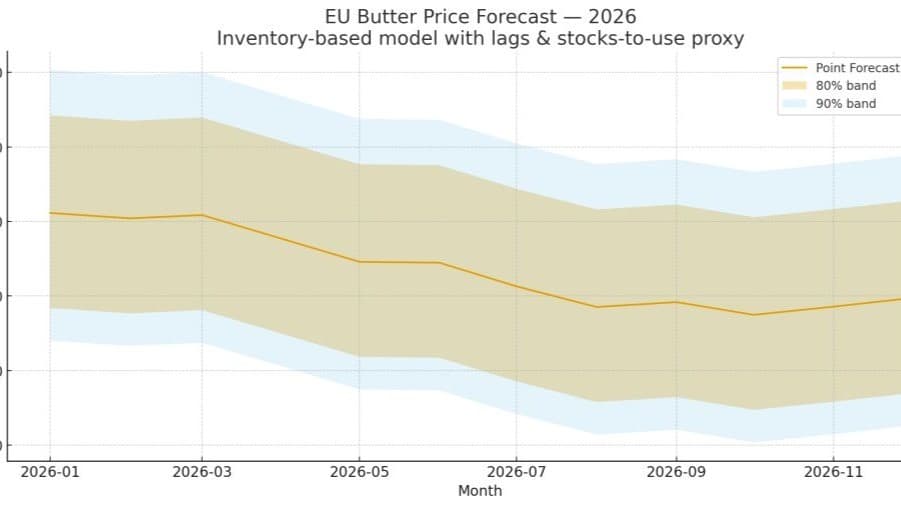
Summer Shopping or Summer Sale?
Last week was again a bit of a bearish week for the entire dairy industry. With cream prices under pressure and milk intake still strong, we keep seeing a market that has more supply than demand. Butter prices took another step lower, cheese prices cracked, and the powder market gave back a bit of its gains again.
The weekly report
Get it before it is anywhere else
Every market report, straight to your inbox the moment it is written. Butter, cheese, powder, liquids — pick what you actually trade.
Roughly weekly · Free · Unsubscribe any time