A Market Drowning in Milk

The past two trading days have been nothing short of exhausting — not just active, but almost feverishly so. Another 2,700 metric tons of product changed hands through GFD, and once again we are witnessing one of the most turbulent and relentless markets in recent memory. Yet, as volumes keep flooding in, exceeding what the market can easaly digest, prices are being crushed under their own weight. It’s a simple equation that everyone understands, and no one enjoys watching play out. Q4 demand has evaporated into near nothingness, leaving behind an echo of offers — endless, heavy, and almost desperate.
Conversations with producers over the past days have done little to inspire confidence; if anything, they’ve sharpened the sense of unease. All report the same grim story: exports slowing, offtake collection dragging, and more milk pouring in than anyone could have possibly forecasted. Not a single one of them expects this flow to stop within the next four to six months. And with every major export region simultaneously overproducing milk, stacking commodities like unsold relics, and facing sluggish demand, a chilling consensus is starting to form — one that points towards the unthinkable: a full-blown milk crisis taking shape before our eyes.
Writing with a bearish tone without overdoing it is becoming a lost art for us. After the past two trading days, it feels like trying to whisper during a hurricane. Every one of our forecast targets has been reached, and the market now seems determined to fall faster than gravity itself. One producer we spoke with put it bleakly but perhaps honestly: “Better to take all the pain now and let the market bleed out, so we can rebuild later — than to drag this misery out for months.” It’s hardly comforting advice, but perhaps there’s wisdom in surrendering quickly to the inevitable.
The real problem is that most producers seem ready to endure the pain of Q4 but remain unwilling to face the pain beyond it. Many hold on to the hope that Q1 and Q2 next year will somehow find footing around today's prices or higher, that some unpredictable event will stop the fall. But by refusing to sell forward, hoping to outsmart a market, they seem to be inviting deeper losses. This collective hesitation — the fear of selling too low — gives the market exactly what it needs: more time to drop even further.
Liquids: Losing the bottom
Nowhere is the pain more visible than in the spot market for liquids. In the Netherlands, spot milk has been changing hands between 25 and 27 cents per liter, a level that would have seemed unthinkable not long ago. Cream is putting up a brave front, managing to hold between €5,700 and €5,800 with end users confirming those levels. But skim milk concentrate (SMC) is being brutally punished — prices averaging between €1,100 and €1,300, with some spot deals plunging as low as €800 to €900.
One producer expressed a faint glimmer of hope that the bluetongue effect (with delayed calving) might slow down milk growth in the coming weeks. Without that, they fear the current surge of +5% to +7% milk versus last year will continue through November into February, pushing European commodity prices to test the absolute lows of the previous years once again. When pressed for a concrete forecast, he refused to commit, simply saying, “If historic production declines lead to historic highs, then historic production increases will surely lead to historic lows.” Grim logic, but hard to argue with. As much as we try not to overplay the bearish angle, we find ourselves in a market where optimism has gone extinct. Not a single trader, producer, or buyer we’ve spoken to genuinely believes we’re near a bottom. The silence of hope is deafening.
Butter: Another €200 gone, just like that.
Last Wednesday (three days ago!), we reported Q1 butter trading at €5,050. Today, it’s €4,800. For Q2, prices slid from €5,250 to €5,025, and Q3 fell from €5,450 to €5,275. The speed of this decline is staggering — just ten days ago, during Anuga, Q1 was still at €5,450. It feels as though stability itself has packed up and left the room.
At these lower levels, there does seem to be a faint sense of support, as we continue to see some bids sticking around. But we’ve been fooled by this illusion of stability before — each time it evaporates the moment a few lower trades hit the tape.
For Q4, producers continue to push bigger volumes into the market, perhaps hoping that sheer persistence might bring a buyer to the table. Irish butter is offered between €4,500 for winter butter and €4,700 for summer profile. German producers are searching for bids between €4,850 and €5,000, while French offers are reported between €4,500 and €4,600. Ukrainian butter is being quietly offered at €4,400 FCA NL. But with almost no demand left for Q4, it’s hard to imagine these offers finding homes without further concessions. Lower prices seem not just likely but inevitable.
Also the futures market has joined the freefall. EEX futures for Q1 have now slipped below €5,000, and the full 2026 strip trades around €5,350.
As of now, we expect the market to open with the following buyers:
- A buyer for November NL/DE/BE at €4,750.
- A buyer for December NL/DE/BE at €4,700.
- A buyer for Q1 NL/DE/BE at €4,800.
- A buyer for Q2 NL/DE/BE at €5,025.
- A buyer for Q3 NL/DE/BE at €5,300.
Cheese: Sliding Along with Butter
The butter slide is an old and familiar story — and, as history tends to repeat itself, a cheese slide rarely lags far behind. Then, of course, another butter slide usually follows to complete the tragic cycle. This week is proving to be no exception. Just three days ago, we noted the first cheese trades dipping below €3,000. Yesterday, that line became a distant memory as we brokered more than 770 metric tons, every single one below €3,000. Gouda changed hands through us for Q1 at €2,680, for H1 at €2,800, and for Q2 at €2,850. Mozzarella followed suit, trading for Q2 at €2,950. The question haunting every conversation now is painfully simple: how much further can it fall before we start calling it freefall?
At these levels — with cheese prices hovering around €2,700 to €2,800 for Q1 — one would expect at least some flicker of life from the export market. But when we speak to the producers, any hint of optimism quickly evaporates. They all echo the same frustration: the window for meaningful Q1 export relief has already slammed shut. The buyers who could have absorbed this volume have moved on, and the focus now shifts reluctantly toward March and beyond. Until then, the EU market must endure its own excess.
The inevitable conclusion is grimly clear: the stocks of cheese produced in the coming months will have to find a home within the EU itself. In other words, the continent will soon be swimming in its own surplus — and as butter and cheese continue their synchronised descent, it seems only a matter of time before one drags the other down again.
We start with the following bids
- 6 loads of Mozzarella NL/DE/BE/DK € 2650 Q1
- 12 loads of Gouda NL/DE 48% € 2750 H1
- 6 loads Mozzarella NL/DE/BE/DK € 2850 Q2
Powders: Losing the €2,000
For nearly two years, the powder market has been trapped in a dull but stable comfort zone, drifting lazily between €2,200 and €2,500 — a range so familiar it almost felt safe. But since the end of summer, that fragile equilibrium has cracked, and what once looked like a sturdy floor at €2,000 now appears more like thin ice giving way underfoot. We are hearing, and in some cases witnessing firsthand, trades scattered between €1,900 and €2,000. It’s not a collapse with drama or noise — just a slow, grinding erosion of value, as though the market has quietly accepted its own decline.
This downward spiral is partly fed by the collapse in SMC prices. Traditionally, SMC only trades a little below powder valorization during the milk peak and around the Christmas holidays, when production rhythms distort the balance, but it trades at a premium in the Q4 months. But this year, the logic has broken. There is simply too much milk. SMC now averages around €1,200 — a figure that would have seemed absurdly low not long ago. Across the EU, drying towers are running flat out, squeezing every drop of value out of an oversupplied system. Those fortunate (or unfortunate) enough to have spare capacity are drying SMP at cost prices between €1,600 and €1,700. For a short burst — one or two weeks — this might be survivable. But if this continues for months, it won’t just dent the market; it will redefine it. In that case, expect EU powders to linger between €1,800 and €2,000 for an uncomfortably long stretch.
Let’s hope SMC prices don’t sink any lower — because if they do, the EU may soon find itself forced to reopen intervention, a word that hasn’t echoed seriously in the halls of Brussels for quite some time. But as one of our partners rather dryly put it, that won’t happen until the milk price itself collapses well below cost levels. And he’s right. There’s no appetite in Brussels to subsidise a market that’s still, on paper, profitable for farmers. As long as milk prices hover comfortably above production costs, policymakers will keep their hands in their pockets and watch from a safe distance while the industry quietly bleeds. Intervention may come eventually, but by the time it does, it’ll likely be out of necessity — not mercy.
The fleeting relief we got from a stronger dollar has evaporated as quickly as it came. The EUR/USD exchange rate briefly dropped to 1.15, offering a glimmer of support, but has since crept back up to 1.17, pulling the rug out again. Meanwhile, CME prices in the US keep sinking deeper, and with New Zealand’s production season running at full tilt, global competition is merciless. Q1 prices are now barely holding above €2,000 for fresh, exportable goods — though “holding” might be too optimistic a word. At this point, it feels less like a question of if we will take another leg down, and more like a matter of when the floor finally disappears beneath us.
Final Note: After the Flood, the Fields Will Dry
It’s hard to talk about hope when every market indicator seems intent on scraping the bottom of the barrel. The past weeks have felt like watching a storm that refuses to pass — every attempt at optimism drowned by another wave of offers, another drop in bids, another round of disbelief from those who thought prices couldn’t possibly go lower. The dairy market right now feels like a house built on wet sand: everything shifting, nothing steady, and everyone pretending to believe in foundations that no longer hold.
But even as we stand knee-deep in this mess, it’s worth remembering a truth so old it’s almost cliché — after rain comes sunshine. It may not feel that way now, when forecasts are dark and sentiment darker still, but this, too, will pass. Markets have an unkind way of pushing everyone to the brink before turning, as if to remind us who’s really in charge. The dairy crisis we’re living through will eventually burn itself out, not because of policy, or intervention, or divine mercy, but because it always does. Milk dries up, tanks empty, inventories clear, and the same producers who now stare into the abyss will one day be selling into a tightening market again.
Until then, we keep reporting, watching, trading — aware that despair and opportunity often travel together, just never at the same speed. The rain may keep falling for a while yet, but somewhere ahead, the clouds will break. And when they do, the same market that punished us without mercy will, inevitably, reward those still standing in the mud.
More from the desk
Our Long View Before Our Long Break 
Our Long View Before Our Long Break
Last week the market found a bit of stability. After lower trades on cheese, the cheese market traded slowly up, although a real rally remains absent. Butter prices did dip a bit further, although at the start of this week we see some strength on the back end of the curve. And on powder, our bullish feeling just doesn't go away — and now we can find some confirmation in the market as well.
Dairy Carry Has a Shelf Life 
Dairy Carry Has a Shelf Life
Last week was bearish across the board — every product we broker leaned the wrong way. Powders lost more momentum, cheese slipped well below €3,000 for some products, and butter continues to impress with just how much keeps showing up. Supply, supply, supply.
Summer Shopping or Summer Sale? 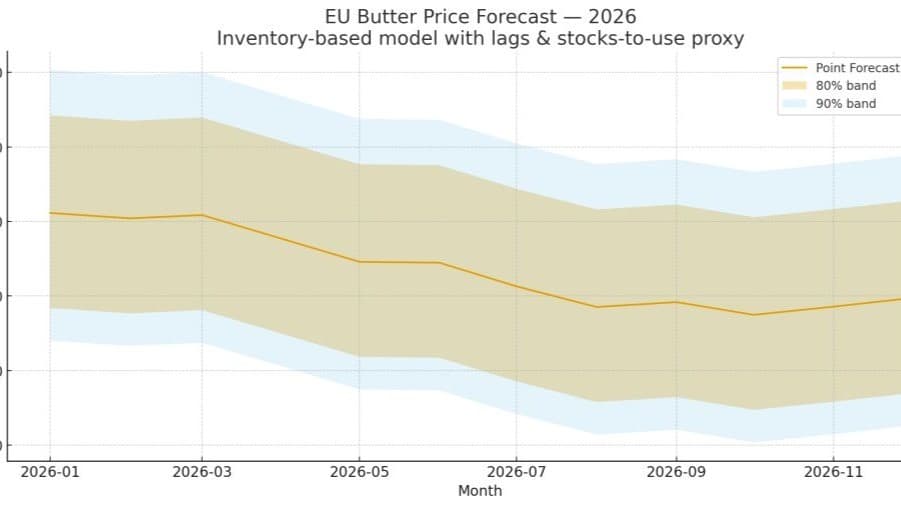
Summer Shopping or Summer Sale?
Last week was again a bit of a bearish week for the entire dairy industry. With cream prices under pressure and milk intake still strong, we keep seeing a market that has more supply than demand. Butter prices took another step lower, cheese prices cracked, and the powder market gave back a bit of its gains again.
The weekly report
Get it before it is anywhere else
Every market report, straight to your inbox the moment it is written. Butter, cheese, powder, liquids — pick what you actually trade.
Roughly weekly · Free · Unsubscribe any time