The Cost of Indecision

The first two trading days of this week have been lively again. With over 2,000 mt brokered across cheese, butter, and powders, market activity continues to show real strength, unlike commodity prices that have lost value again in the past 2 days. Volatility and volume have always been linked — once the market calms, we expect liquidity to ease just as fast. But something else stood out this week — the contrast between those who act quickly and those who hesitate. Looking back over the past eight weeks, two clear groups emerge: buyers and sellers who move decisively, and those who wait. The latter often postpones, hoping for confirmation that never comes. Afraid of making a wrong decision, they end up chasing the market instead. And when we zoom out — whether it’s now or a year ago — one truth keeps repeating itself: "Most value is lost through indecision, not through wrong decisions."
Most value isn’t lost because people make the wrong call — it’s lost because they never make one. In volatile dairy markets, waiting for “certainty” is the surest way to destroy value. The fear of being wrong paralyses, but markets don’t wait for you to find courage. While some partners overanalyse data points and forecast models, others trade on feel — and win simply because they move.
Slow decision makers act on data. Quick ones act on both data and sentiment. The difference isn’t recklessness — it’s agility. Markets turn on whispers, not reports. By the time the numbers confirm the story, the story’s already priced in. Those who demand perfect clarity usually end up buying or selling someone else’s conviction at a premium/discount.
Agility and value are inseparable. Every hesitation is an opportunity passed to the trader on the other side. In this dairy world, a few euros per tonne can vanish faster than confidence in a quiet bid round. The best traders, producers and end users aren’t lucky; they’re flexible. They pivot when sentiment shifts, hedge when volatility spikes, and aren’t afraid to be early or wrong if it means staying relevant.
A little over a year ago, it wasn’t the sellers who suffered — it was the slow buyers. Unable to adapt, they postponed purchases, waiting for lower prices that never came back. By the time they re-entered, the market had climbed, supply was thin, and they were fighting for volume. Fear of being wrong turned into the guarantee of being late.
In dairy, as in any market, indecision is the silent killer. The butter doesn’t care how confident you feel. The powder doesn’t pause until you’re ready. Quick movers act while others analyse. They read tone, timing, and sentiment, not just spreadsheets. In volatile times, doing nothing is the riskiest trade of all.
Liquids: Overflowing
The true weakness in this dairy cycle comes from the supply side — best seen in the spot market for raw milk, SMC, and cream. Instead of buyers fighting for product, it’s sellers searching for outlets. Both Germany and France continue to post YoY milk increases that exceed every forecast. Germany last Friday reported +6.2% milk vs. last year, resulting in +23.5% butter, +10% SMP, and +4% cheese production. The French weekly data shows 4.8% more milk, with week 39 of 2025 now showing just as much milk intake as week 49 in 2024.
Those arguing this year’s strength comes off “weak comparables” should look again. German butter data for example, 2024 butter output has already overtaken 2023 levels, and even 2022 was lower than current volumes. French milk intake in 2024 was already much stronger than 2in 023, and this year's data exceeds even 2022 in milk volumes.
If similar production increases are seen in Belgium, France, Ireland, Poland, and the UK, it’s no surprise Europe’s commodity market feels unusually heavy for this time of year. Data for other countries travels slowly, but what we have is clear: August butter output rose +8.6% in Ireland, +6.3% in Belgium, +40% in Spain, +33% in Sweden, and +10% in Germany. We are still waiting on data of the other countries.
Spot prices reflect this surplus. Cream trades around €5,950 for next week, though smaller volumes are reportedly changing hands below €5,900. SMC continues to slide, with trades seen up to €1,300, but some reporting levels again below €1,000. Raw milk is widely available, with prices mentioned between 25 and 35 cts.
Butter: Well Below €5,000 Now
Last week’s first dips below €5,000 have now turned into a broad correction. Significant volumes are trading between €4,850 and €4,975, and more tonnage remains available at these levels. Some producers are adjusting to sentiment, while others continue resisting, quoting €200–300 above the physical market and pointing to high cream valorisation (normal for October) and much higher futures and quotations (wich they are a part of themselves).
The divide between adaptive producers and defensive ones is becoming stark. As co-ops begin lowering farmgate prices, the difference between those who averaged down through the fall and those who trailed the market will become visible. It’s a harsh observation, but fair: And we know the producers' excuse of claiming “they don’t speculate” But in our view, that doesn’t excuse them for staying disconnected — not selling forward is a speculative decision in itself.
But the market continues to be bearish, and recent trades confirm the shift:
- Arla butter Q4: €4,850
- NL/DE/BE Q1: €5,050
- NL/DE/BE Q2: €5,200
- NL/DE/BE Q3: €5,400
We expect the market to open around these levels, with sellers increasingly focused on clearing 2025 positions before further pressure builds.
- November / December bid 6 trucks at € 4800 v.s a € 4900 offer for Arla DK/SE
- Q1 NL/DE/BE 6 trucks bid € 4850 v.s a € 5050 offer
- Q1 Polish SC 6 trucks bid € 4850 v.s. a € 5150 offer
- Q2 NL/DE/BE 6 trucks bid € 5150 v.s. a € 5250 offer
- Q3 NL/DE/BE 6 trucks bid € 5400 v.s. a € 5450 offer
Cheese: Slipping Again
After briefly showing signs of stability, cheese markets have softened once more. Mozzarella trades are now regularly concluded below €2,900 for both spot and forward positions, with more offers appearing each day. Gouda manages to hover just above €2,900, though bids are scarce after Q1 futures traded lower earlier yesterday at € 2900.
With producers effectively selling milk below 30 cts, confidence in selling cheese above €3,000 has evaporated. Buyers sense weakness, and sellers seem more focused on clearing stock than defending price levels. In sentiment terms, the market feels heavy, with the forward curve flattening as risk appetite fades.
Our outlook remains bearish, though we see deeper downside in butter (potentially towards €3,500) than in cheese. For cheese, we expect the market to find a floor near €2,500 — a level now relatively close. In addtiion we see some buying interest from outside of the EU at levels just below € 3000, potentially putting some floor in the cheese market.
As in past cycles, price recovery will depend less on demand revival and more on how quickly milk supply normalises. Until then, cheese remains under pressure, with liquidity shifting to those willing to act fast while others keep waiting for a bottom that might already be forming, or not.
We expect to have the following market
- Gouda for November / December on offer at € 2950 with a bid against it at € 2750
- Mozzarella for November / December for export at € 2800
- Mozzarella for Q1 on export, 10 loads, Frozen from Germany at € 2700
- Mozzarella offer for Q1 NL/DE/BE/DK at € 2950
- Gouda offer for Q1 NL/DE origin at € 2950
Powders: Slow and Steady
The powder market feels just as heavy as the rest of the complex. With cheap SMC in October, there’s little reason to be anything but bearish. If milk volumes continue to climb in the weeks ahead, SMC could structurally fall below €1,200, opening opportunities for dryers to produce below intervention-equivalent levels. We’re not calling for a return to intervention pricing, but it’s clear that cheap powder will enter the market over the next four months — and with limited EU demand, Europe must hope export partners continue to absorb volume. That, however, looks increasingly uncertain.
Demand remains weak, buyers are well-informed, and transparency is working against sellers. Everyone knows Europe has cheap product and pressure to move it. Trades through our book reflect that tone: this week over 400 mt changed hands between €2,040 and €2,075, with offers for Q1–Q2 2026 appearing at €2,150–2,180 DAP NL — still without finding a home.
WMP and BMP also feel softer. We’ve heard WMP Q1 futures below €3,400, a level few expected to see again. Across the board, sentiment is heavy, liquidity thin, and confidence low.
We expect the market to open with the following offers:
- 300mt Hochwald WMP Regular, 25kgs/BB, Q1 €3550 fca
- 300mt Arla UK codex SMP MH, fresh, Q4, 25kgs, €2165 FCA UK
- 200mt Limelco codex MH, fresh, Nov/Dec ETD; 75mt for Nov, 125mt for Dec, 25kgs, €2130 FCA BE
- 200mt Uelzena/Rucker/DMK/Arla DE, codex MH, fresh, Oct/Nov, 25kgs, €2140 FCA DE
- 175mt Lactalis codex LH, fresh, Oct ETD, 25kgs, €2140 FCA BE
- 125mt Dairygold codex MH, 25kgs, June or fresher, €2120 FCA NL
- 100mt West EU codex mh, fresh, 25kgs with standard docs €2070 ex plant
- 60mt Tirlan codex MH, 25kgs, June or fresher, €2120 FCA NL
Final Note
The market tone this week is clear: heavy supply, soft sentiment, and a widening gap between those reacting to data and those acting on instinct. Liquids are flooding the system, butter is breaking down, cheese is slipping, and powders are quietly grinding lower. The fundamental picture is bearish across the board — yet the biggest difference in outcomes won’t come from milk volumes or export flows. It will come from how fast players adapt.
Those waiting for certainty will likely find themselves trading against it. In a market this volatile, hesitation is more expensive than being wrong. The traders and producers who stay connected, move with sentiment, and keep adjusting positions — they’re the ones preserving value when others lose it to delay.
The coming weeks will test that agility. If milk flows stay this strong, the market will need real demand or disciplined selling to stabilize. Until then, volatility remains the only reliable constant — and speed, not caution, might be in the sort term the better strategy.
More from the desk
Our Long View Before Our Long Break 
Our Long View Before Our Long Break
Last week the market found a bit of stability. After lower trades on cheese, the cheese market traded slowly up, although a real rally remains absent. Butter prices did dip a bit further, although at the start of this week we see some strength on the back end of the curve. And on powder, our bullish feeling just doesn't go away — and now we can find some confirmation in the market as well.
Dairy Carry Has a Shelf Life 
Dairy Carry Has a Shelf Life
Last week was bearish across the board — every product we broker leaned the wrong way. Powders lost more momentum, cheese slipped well below €3,000 for some products, and butter continues to impress with just how much keeps showing up. Supply, supply, supply.
Summer Shopping or Summer Sale? 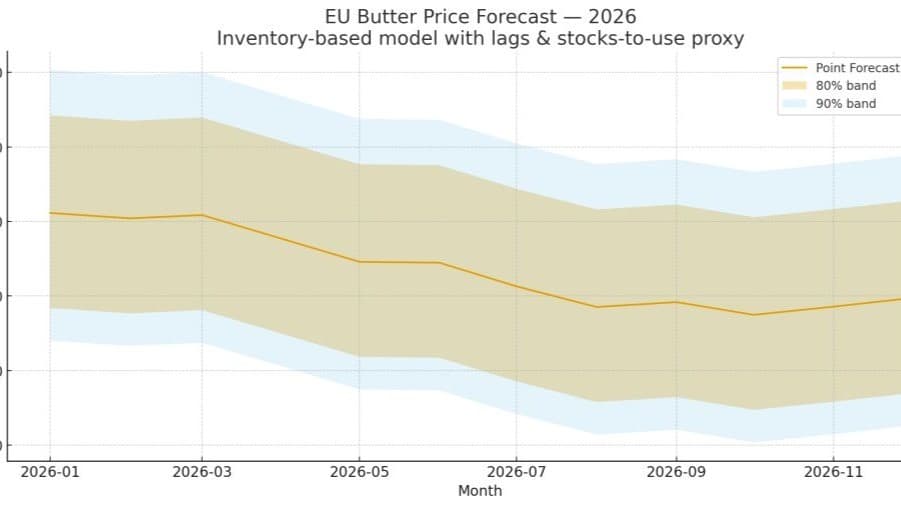
Summer Shopping or Summer Sale?
Last week was again a bit of a bearish week for the entire dairy industry. With cream prices under pressure and milk intake still strong, we keep seeing a market that has more supply than demand. Butter prices took another step lower, cheese prices cracked, and the powder market gave back a bit of its gains again.
The weekly report
Get it before it is anywhere else
Every market report, straight to your inbox the moment it is written. Butter, cheese, powder, liquids — pick what you actually trade.
Roughly weekly · Free · Unsubscribe any time