
The Slow Build Beneath a Calm Market
Last week, the market behaved exactly as expected. With European milk collections now at their seasonal low and demand climbing toward its annual high, the pressure that dominated recent weeks has eased—if only slightly. The forward curve for most 2026 commodities edged higher as industry buyers kept covering volumes for next year. Yet, with less product entering the market than in previous weeks, demand is outpacing supply. Nothing unusual for this time of year: Q4 reliably combines the tightest supply with the strongest demand.
Short-term pressure seems to have lifted across most commodities. Producers who had to move stock have done so, while others, encouraged by firmer demand, are holding out for slightly better values. We expect this dynamic to carry through the next week or two until the usual seasonal pivot arrives—when demand cools and milk flows pick up again. Buyer who need to buy for short term pickups will have to pay up, but buyer who can wait should get better value in a few weeks we think. By mid-November, the market will likely recognize that despite a steadier tone, the balance between supply and demand has actually worsened, and the market is weaker than current sentiment suggests.
It’s probably a good thing the market has taken a breather. Another few weeks of relentless downward pressure might have broken the mood entirely. Still, looking through the data and speaking with partners, the numbers don’t appear as stable as current prices suggest. In Q4 the EU dairy market usually eats through it stock, so each week the supply pressure eases a bit. But it's masking the bigger picture about increased stocks and weaker demand. So, what’s keeping our outlook bearish? Let’s walk through it.
Stocks: Fast Build Up Slow Drawdown
European stocks tend to follow a wave pattern: they build from January to July and draw down from July to December, reflecting seasonal milk collections and the late-year demand surge. Using StoneX Plus as our reference—one of the more complete sources for EU and US butter, powder, and cheese stock data—we see clear confirmation of this year’s buildup. And yes, for anyone active in making dairy commodity purchases and sales, it’s worth having access to such solid data sources, we would recommend taking it here.
Butter: Record Increase will Lead to Record Stocks
Starting with butter, the buildup this year is remarkable—the fastest in two decades. December 2024 stocks were estimated around 36,000 metric tons and climbed to roughly 265,000 by July, a jump of nearly 230,000 tons in just six months. Last year’s increase over the same period was only 140,000. This surge comes from a mix of factors. Production has been exceptionally strong, up about 50,000 tons through January - July compared to 2024, and with August data now in, 2025 ranks as the strongest butter production year in five years, 4% higher year-on-year. It can be seen as remarkable, because this increase is realised despite modest milk growth early in the season. Since August, several EU countries have shown milk output rising up to 6% above 2024 levels, suggesting H2 butter output could outperform H1 even further. That forecast is represented in slow drawdown from July to December this year. Latest German production data for week 42 shows a 6.5% milk intake increase YoY combined with a 18.4% butter production growth.

The smaller-than-usual drawdown between July and August also says a lot about both production and demand. Strong demand would have cleared more product, yet stocks barely dipped. A slowdown in demand might be the cause of that slower drawdown, and it might explain the fast increase in H1 as well. Because imports have also risen sharply, while exports held up fairly well during the first seven months, meaning the production increase plus net imports still don’t fully explain the stock jump. The logical conclusion: domestic demand has weakened. And that should worry the EU more than it currently does. Several partners point to partial product replacement as a contributing factor—a shift that won’t easily reverse.
Cheese: More Production Capacity means More Product
Cheese isn’t telling a very different story. After starting the year with some of the lowest stocks in four years, inventories have now rebuilt at record speed. EU cheese stocks are at their highest point in recent memory. Prices, however, haven’t collapsed to record lows yet, largely because consumption has been strong enough to absorb part of the overhang. Still, with milk supply expected to stay robust, additional production capacity is turning quickly into extra stock. Unless exports pick up, next year could bring another wave of heavy inventories.

The EU’s trade balance adds to the concern: cheese imports are higher, exports lower. If EU cheese prices continue to trade below €3,000 for Gouda, Edam, or Mozzarella, and below €3,500 for Cheddar, we would expect imports to slow and exports to pick up again. If they don’t, those additional 60,000 tons of cheese projected by July next year could become a serious drag on price stability.
Powder: Less Pattern, But More Product
SMP is harder to read from a seasonal perspective, but the pattern feels familiar: stocks are building. Imports from Ukraine remain stable, offset by higher EU exports, meaning the accumulation is primarily an internal EU matter. Production is slightly higher, but the real weakness lies on the demand side.

The question is whether SMP stocks can influence prices more than global trade dynamics do. If world buyers start bidding up, EU stocks aren’t burdensome enough to block a rally. But if international demand stays sluggish, EU traders won’t want to carry expensive inventory in a market that already looks well supplied. But in our view stocks are less an influence on EU prices, the real impact on prices lies outside of the EU.
THE US: Slower Drawdown Should be Concerning
Across the Atlantic, the US market paints a mixed picture. Commodity prices are still well below EU levels. SMP might be roughly aligned, but butter remains far cheaper. Butter stocks in the US are lower than last year, but only because exports have exploded—up 150% year-on-year. Even that hasn’t eased domestic pressure, which says plenty about internal demand. Production remains high, so US exporters will need to keep shipping aggressively just to stay balanced. That same export strength will continue to challenge EU sellers and weigh on import dynamics. Even EU prices have come significantly down, the price gap between the EU and US is wide enough that European buyers might still find it worthwhile to import product for next year. All while EU producers will have a harder and harder time exporting their butter. The final question on the butter side remains how long US consumers will favor the Irish butter over US butter. Export throughout this year remained strong, but will it remain on the same high level? We wonder.
On the cheese side, US consumption is clearly slowing. Stocks are drawing down, but the pace is more sluggish than usual—a familiar signal that production is outrunning demand. In addition, the US has added significant new cheese production capacity over the past two years, and those plants are not sitting idle. As long as American farmers keep pushing out record milk volumes, cheese production will remain strong, adding further weight to already heavy inventories.
Powder stocks in the US tell a similar story to Europe’s: rising, though not alarmingly so and not near records highs either. Higher output is feeding inventory growth while softer demand is doing little to pull product off the market. With milk flows remaining robust across the US and EU—and New Zealand now also pointing to a stronger production season—the next six months are shaping up for further stock accumulation. As long as buyers dont see fundamental changes, we don't expect any aggressive forward covering either. That combination typically leads one way: down. If production stays this strong through year-end, the surplus will need to find a home somewhere, and that home is unlikely to be at today’s prices.
Why Not Acting on Forecasts?
The more we dive into the data, the more convinced we are that markets are setting up for another heavy correction. We understand why it doesn’t feel that way yet. Even though stocks are clearly rising year on year, they’re still drawing down week on week. That short-term movement creates a sense of stability—but anyone tracing the broader trend lines can see where this is heading: more stocks, globally, across almost every major commodity.
Yet outside the trading desks, there’s remarkably little urgency. Neither end users nor producers seem particularly bothered by what the data implies. Buyers—especially on butter—are still comfortably covering their 2026 needs at levels well above where forward models suggest prices should trade. Producers, meanwhile, show no appetite for selling forward into 2026, even when it means locking in milk prices above 40 cents for Q2 next year. Current spot commodity values still only return around 36–37 cents, but even the better forward valorizaton v.s. the current spot market valorization, the absolute level is apparently too low to trigger forward sales.
One producer we spoke with last week put it plainly: they’d sell forward if their farmers were willing to lock in part of their 2026 milk. But when asked how many farmers would settle for 40 cents in 2026 while they’re still being paid 50+ cents today, the answer was simple—none.
On the buying side, the logic isn’t all that different. Most purchasing managers see the same data we do, and most agree the outlook is bearish. But when asked why they’re still contracting for 2026, their reasoning is consistent: their finished product sales are already locked in at higher cost levels. Securing raw materials below that cost base is sound risk management. If prices fall further, they’ll gain on new business. If not, at least the margin on existing contracts is protected. After the bruising price cycles of the past few years, that’s their top priority.
This cautious selling versus proactive buying has created a widening gap between producers and end users. Buyers are already focused and largely finnished on Q2 2026 coverage, while many sellers still haven’t finished clearing their Q4 2025 positions. That mismatch will likely hit hard once 2026 sales begins: record production volumes expected in Q1 will meet a market that’s already largely covered for the first half of the year.
If stock building in the first half of 2026 mirrors—or even exceeds—what we’ve seen in 2025, then the stock projections showed visualized in the article above might actually be conservative. And while commodity prices don’t always move in perfect sync with production, they do move with stock accumulation. Every uptick in inventory has historically come with a downward price correction. The setup this time looks no different. Below a reminder how butter prices respond to butter stocks, and how Gouda prices respond to Cheese stocks.


Butter: Stable Weeks Ahead
Despite our bearish broader outlook, we don’t expect a bearish week for butter. Prices have held firm over the past two weeks, and we see little reason for that to change in the immediate term. As long as cream values remain near €6,000, butter should continue to trade sideways. Historically, cream prices tend to ease by the second or third week of November, and we expect this year to follow a similar path. Supply dynamics may differ from previous seasons, but cream demand typically fades around that same period.
Last week, we continued to see selling pressure from Ireland, with prices reported and traded between €4,700 and €4,800 ex-works—both for the remainder of this year and the early weeks of 2026. A slowdown in US exports is reported to put some unexpected stocks back in the system. Producers in France, Germany, Poland, and Belgium appeared less active, having largely managed their October pressure. With sentiment turning slightly more positive, many have raised their sales targets rather than chasing the market. We expect only limited spot activity this week. Forward positions for Q1 remain mostly untouched, except for some Irish offers.
In the trader market, attention is already shifting further out. Demand for Q2 and Q3 2026 continues to surface, with prices holding around €5,200 for Q2 and €5,400 for Q3.
Cheese: Increased Levels Q1 + Q2
After dipping two weeks ago, cheese prices have firmed again over the past sessions. “Firm” might not be the word most producers would choose, though—especially when we mention the current bid levels. With Mozzarella demand sitting around €2,800 for Q1 and Gouda buyers targeting €2,900, the tone feels a touch stronger, but valuations still trail well behind butter and SMP. In relative terms, cheese might look a bit undervalued compared to the rest of the complex.
That said, turning outright bullish on cheese would be a stretch. We know from experience that once butter prices resume their downward path, EU cheese prices tend to follow closely behind. Until that happens, we expect Q1 cheese values to stay broadly stable to slightly firmer. Still, conversations with buyers and sellers focused on November business reveal a market that feels soft: ample supply, slow demand, and little urgency on either side. Spot Mozzarella trades continue to surface below €2,800 as older parcels reappear in circulation.
For Gouda, we expect active buyers in H1 2026 around €2,900, and for Mozzarella near €2,800. Beyond that, much depends on how the butter market behaves—and whether buyers’ patience outlasts producers’ optimism.
Powders: Active on the Way Down
The SMP market finally came back to life last week. With more than 1,500 metric tons changing hands in just five days through Linda, activity clearly picked up. Early in the week, prices felt relatively steady, but by Friday, sellers outnumbered buyers, and liquidity began to thin. Production data out of Germany for week 42 tells the story well: a 58% surge in SMP output—a direct consequence of cheap SMC. That kind of production momentum suggests more low-priced product will keep flowing into the market.
Q1 sales are now settling below €2,100 for fresh product with standard export documentation, while Q2 volumes traded under €2,200. These levels reflect a firmly bearish sentiment that could persist for several more months. With SMC prices still quoted between €900 and €1,200, we can safely assume that most of Europe’s drying capacity is running flat out. Output increases similar to Germany’s are likely across the continent. For context, SMC averaged around €2,250 last year October 2024 —almost double last week’s spot levels. The last time prices fell this sharply was April 2024, right in the middle of the flush.
We expect to find sellers at roughly last week’s values: exportable Q1 product around €2,100 and Q2 near €2,200. Older product from this year’s collection, however, will probably need to move below €2,000 to find homes.
Final Note
The current steadiness across commodities shouldn’t be mistaken for strength, we said it many times before. What feels balanced today is built on soft foundations: strong milk, slow demand, and growing stocks. The market might look stable now, but the weight underneath is shifting. When it does, it will move fast. Partners who wait for clarity will be too late—those who position early might get paid for their patience.
More from the desk
Our Long View Before Our Long Break 
Our Long View Before Our Long Break
Last week the market found a bit of stability. After lower trades on cheese, the cheese market traded slowly up, although a real rally remains absent. Butter prices did dip a bit further, although at the start of this week we see some strength on the back end of the curve. And on powder, our bullish feeling just doesn't go away — and now we can find some confirmation in the market as well.
Dairy Carry Has a Shelf Life 
Dairy Carry Has a Shelf Life
Last week was bearish across the board — every product we broker leaned the wrong way. Powders lost more momentum, cheese slipped well below €3,000 for some products, and butter continues to impress with just how much keeps showing up. Supply, supply, supply.
Summer Shopping or Summer Sale? 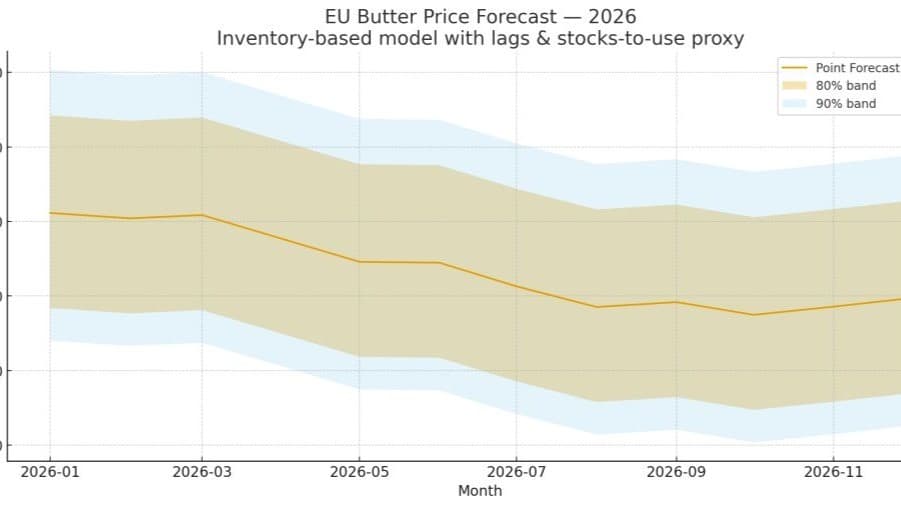
Summer Shopping or Summer Sale?
Last week was again a bit of a bearish week for the entire dairy industry. With cream prices under pressure and milk intake still strong, we keep seeing a market that has more supply than demand. Butter prices took another step lower, cheese prices cracked, and the powder market gave back a bit of its gains again.
The weekly report
Get it before it is anywhere else
Every market report, straight to your inbox the moment it is written. Butter, cheese, powder, liquids — pick what you actually trade.
Roughly weekly · Free · Unsubscribe any time