
Patience, the Most Underpriced Commodity.

We’ve grown accustomed to calling the start of the week “active” — a rhythm of trades that usually sets the tone for the days ahead. But this time, the market has shifted into a dramatic slowdown. Only 44 metric tons of butter and 120 metric tons of powder changed hands since Monday, making it one of the quietest starts in recent months. The natural question is whether this is the calm before the storm or simply a sluggish week where only a faint breeze will move the market.
At this stage, there’s little to read from the last two trading days. Buyers appear comfortable sitting on their hands, having already covered a fair portion of their Q1 and Q2 needs, Q4 demand is nonexistent. Sellers, meanwhile, are testing higher offers, seemingly expecting the market to edge up — though that optimism has yet to meet any follow-through. The bears, for now, are relaxed and patient, while the bulls are showing their hand, offering more volume at firmer prices. But if the bears refuse to chase higher… well, we may find ourselves drifting sideways on a slightly downward slope once again.
We continue to approach the market with as much balance as possible, examining both bullish and bearish indicators. Historically, this period tends to bring a touch of bullish momentum as we move deeper into Q4, but the muted tone of the past two days hardly supports that seasonal narrative. In fact, it’s primarily the sell side that seems to be searching for action.
Liquids: No Real Uptick Yet
It might still be early in the week, but so far there’s little sign of renewed activity in the liquid spot market. Skimmed milk concentrate (SMC) prices are inching upward, though they remain heavily discounted relative to powder equivalents. Raw milk and cream continue to be readily available and easy to source — a clear indicator of subdued demand combined with sufficient supply.
That historical upward momentum we’ve referenced in recent reports hasn’t yet materialized this week. Cream remains around €6,150 FCA, but lost a touch of support by the end of the trading day, echoing what’s visible in spot milk. Spot milk is hovering near €0.30, while “Christmas milk” is creeping down toward €0.20 — a psychologically important threshold that traders expect to break in the coming weeks. The overall tone in liquids suggests comfort in supply and no sense of urgency among buyers.
GDT: More Bearish Data
The latest GDT auction didn’t offer much relief for the bulls either. With an overall negative 2.4% outcome, this was the sixth consecutive bearish event and the tenth in the last six months — a consistent downtrend that’s hard to ignore. Cheddar led the decline with a 6.6% drop, while butter and AMF fell 4.3% and 1.9% respectively. These results further cement the bearish undertone across global markets.
That said, there were small positives to extract. Solarec butter traded above €5,000 — slightly above expectations, though in line with recent trades for fresh EU butter from our side. Mozzarella was the only bright spot, gaining 1.6%, reflecting the slightly improved cheese sentiment within Europe. Still, with mozzarella prices below €2,900, the cheese market remains far from any meaningful bullish momentum.
Whole milk powder once again disappointed with a 2.7% decline, despite reduced tender volumes. The real surprise came from skimmed milk powder (SMP): the headline result was flat, yet EU SMP prices above €2,100 caught many off guard. Currency effects played a key role — in euro terms, prices rose, even as EU spot trades on our platform continue to show lower values. SMC levels suggest that fresh production remains achievable at far more competitive costs.
In sum, the GDT reinforced the prevailing bearish tone across global dairy markets. A bullish reader could point to marginal strength in mozzarella, SMP, and stable EU butter values — suggesting a floor may be forming. But on the broader canvas, the data leaves little comfort for anyone taking a bullish stance.
US: Fat Keeps Dipping Lower
The US market isn’t offering any bullish inspiration either. CME butter prices continue to tumble, and sentiment among American partners is turning increasingly pessimistic. Several now suggest $1.35/lb as a realistic target — alarmingly low, yet not impossible given current trajectories. With CME spot calls around $1.50/lb, it would only take two more sessions of similar declines we have seen yesterday to reach that level. Should butter fall below $1.50, the US market would effectively lose its €3,000 European support equivalent, and EU butter would once again trade at a €2,000 premium.
Cheese is showing a similar, though slower, slide. While declines haven’t been as sharp as in butter, the downtrend is clear. Combined with another bearish GDT event, the risk of this sentiment spilling over into Europe is rising. Gouda and Edam may remain somewhat insulated for now, but if US exporters begin pushing cheddar and mozzarella aggressively onto world markets, Europe’s fragile window for quick offloads could close fast.
Butter: Q4 Offloading Pressure Building
The butter market currently feels steady on the surface, yet the balance underneath is shifting. Q2–Q3 prices have held up, but the spread between bids and offers is widening. Sellers remain reluctant to commit far forward, while buyers show no willingness to pay up. What’s more, Q4 offers are beginning to return — especially from German sellers who appear to have set their November and December retail prices and are now looking to clear excess stock.
We’re seeing more offers for older butter, but at the offered levels just below € 5000, we expect sellers not to find any buyers; a downward correction in Q4 prices seems almost inevitable. Q4 Demand is weak, and with cream failing to provide meaningful support, it feels a few thousand extra tons entering an already saturated market could push prices lower. We also expect Germany to finally adjust its official quotations downward — they’ve kept them artificially high for weeks, likely to bolster negotiating positions for new retail contracts. With fresh offers from Germany now visible at €5,000–€5,100, a correction in the published prices looks overdue.
Unless meaningful demand reappears soon, the butter market seems poised for another leg down. We’re already hearing from end users being approached by producers offering AMF and butter well below futures levels — an early signal of sellers trying to secure Q1 business before the year-end pressure intensifies.
Cheese: Sellers on the Sidelines
Of all sectors, cheese feels the most balanced — perhaps even marginally bullish compared to two weeks ago. The spot market has tightened slightly, and buyers seeking product are finding themselves paying up as availability narrows. Several sizable tenders for late 2025 and early 2026 are now active, and in most cases, demand is outweighing supply. Sellers, for their part, are holding back as long as they can, confident that buyers will eventually have to meet their levels.
While powder and butter markets are being driven by the need to clear stock, the cheese market feels more demand-driven. The balance of power, at least temporarily, has shifted toward sellers. We do note, however, that dynamics can change quickly — especially if export opportunities slow or milk volumes rise unexpectedly.
For now, we see moderate upside potential in cheese prices. Gouda, Edam, and Mozzarella above €3,000 look unrealistic, but equally, levels below €2,800 seem a distant prospect for the weeks ahead.
Powders: Still Bearish, GDT Optimism Short-Lived
While the GDT results might superficially suggest some support for powders, we’d hesitate to call sentiment bullish. The EU market remains saturated with offers, and finding genuine bids continues to be the main challenge. A small uptick in SMC prices could narrow the short-term arbitrage window for drying, but that’s likely to reopen by late November if current trends persist.
The downside for SMP might feel limited, but so does the upside. With producers needing to clear stock before year-end and Q1 offers already circulating just above €2,100, it wouldn’t take much for prices to slip back below €2,000 once SMC weakens again. The combination of year-end clearing pressure and cheap fresh product potential leaves the powder market stuck in a holding pattern — heavy in tone, light in demand, and offering little incentive for the bulls to re-enter.
Final Note
As we move deeper into the week, the dairy market feels caught between conviction and complacency. Volumes are low, sentiment is fractured, and neither side of the trade seems willing to lead. Bulls may find comfort in historical trends or minor signals of support, but the broader tone remains cautious. Until buyers return with intent and liquidity shifts from waiting to acting, momentum will likely stay muted.
In markets like these, overinterpretation can be just as risky as inaction. Every quiet phase tempts us to predict what must come next — yet sometimes, the market’s silence is the message. Patience, as ever, remains the most underpriced commodity.
More from the desk
Our Long View Before Our Long Break 
Our Long View Before Our Long Break
Last week the market found a bit of stability. After lower trades on cheese, the cheese market traded slowly up, although a real rally remains absent. Butter prices did dip a bit further, although at the start of this week we see some strength on the back end of the curve. And on powder, our bullish feeling just doesn't go away — and now we can find some confirmation in the market as well.
Dairy Carry Has a Shelf Life 
Dairy Carry Has a Shelf Life
Last week was bearish across the board — every product we broker leaned the wrong way. Powders lost more momentum, cheese slipped well below €3,000 for some products, and butter continues to impress with just how much keeps showing up. Supply, supply, supply.
Summer Shopping or Summer Sale? 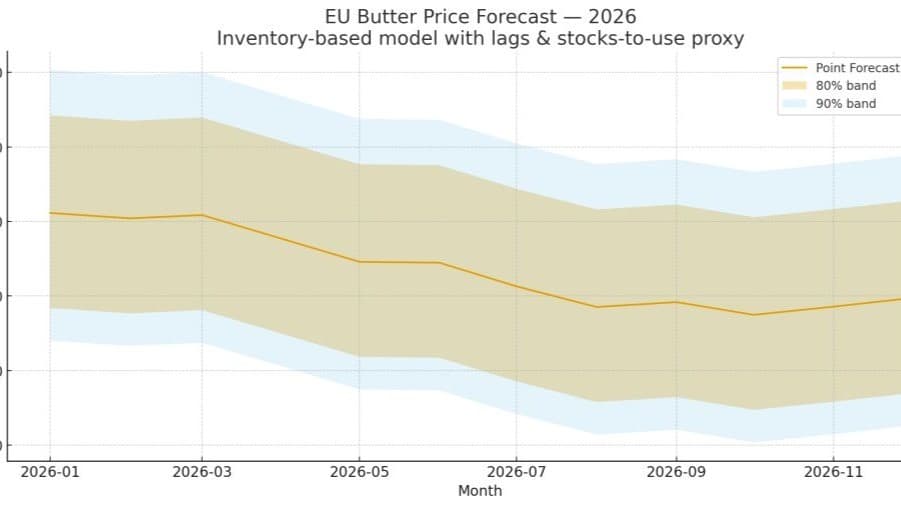
Summer Shopping or Summer Sale?
Last week was again a bit of a bearish week for the entire dairy industry. With cream prices under pressure and milk intake still strong, we keep seeing a market that has more supply than demand. Butter prices took another step lower, cheese prices cracked, and the powder market gave back a bit of its gains again.
The weekly report
Get it before it is anywhere else
Every market report, straight to your inbox the moment it is written. Butter, cheese, powder, liquids — pick what you actually trade.
Roughly weekly · Free · Unsubscribe any time