Correction Complete?
November has arrived, giving us time to reflect on an exceptionally active October. With 16,082 mt traded across butter, powders, and cheese, October 2025 marked the busiest month in our history. Despite intense price swings, markets didn’t correct as sharply as they did in September. A degree of balance is returning, and the pressure on sellers has eased considerably. Historically, November brings milk collections to their annual low and demand to its seasonal high — though that hasn’t always meant a bullish market. So, before we predict November sentiment, let’s take a quick look at history.
Looking back at October, the volumes moving through our books now give a fair reflection of the broader market. Butter was particularly active, with nearly 10,000 mt traded between October 1st and 31st within a range of roughly €500 per tonne. Early-month Q1 butter deals were done around €5,450, before easing to €4,900 in the final week. For H1 deliveries, prices moved between €5,550 and €5,000, while spot prices for this year traded between €5,350 and €4,800. As our regular readers know, we like to compare cycles — and once again, history seems to rhyme. When we look back at previous butter corrections over the past decade, it’s striking how often the same patterns repeat themselves.
| Period | Starting Quotation | Ending Quotation | Difference |
| October 2017 | € 6.690,00 | € 4.970,00 | € 1.720,00 |
| October 2018 | € 5.000,00 | € 4.300,00 | € 700,00 |
| October 2022 | € 7.120,00 | € 6.400,00 | € 720,00 |
| October 2025 (GFD data) | € 5.350,00 | € 4.800,00 | € 550,00 |
Every time butter entered a correction phase in the second half of the year, October marked a sharp downturn — with 2017 standing out as the most extreme example. Yet what’s more interesting is what follows. In every case, November brought a clear slowdown in the pace of decline, suggesting that once the market finds its floor, sellers step back and stability gradually returns.
| Period | Starting Quotation | Ending Quotation | Difference |
| November 2017 | € 4.970,00 | € 4.910,00 | € 60,00 |
| November 2018 | € 4.300,00 | € 4.180,00 | € 120,00 |
| Novembver 2022 | € 5.900,00 | € 5.600,00 | € 300,00 |
| November 2025 | ?? | ?? | ?? |
We believe the key lies in the development of cream prices during November. As milk volumes decline and demand peaks, the balance between supply and demand tightens, often creating upward pressure. Historically, cream prices tend to firm throughout November, regardless of whether the broader market is bullish or bearish. Interestingly, the first signs of weakness usually appear in the final week of the month, aligning with the timing of the sharpest butter corrections. Looking back over the past five years, 2021 was the only exception to this otherwise consistent pattern.
| Period | 1th week | 3rd Week | 4th week |
| November 2020 | € 3.775,00 | € 4.125,00 | € 3.900,00 |
| November 2021 | € 7.225,00 | € 6.800,00 | € 6.775,00 |
| November 2022 | € 7.350,00 | € 7.700,00 | € 7.550,00 |
| November 2023 | € 6.975,00 | € 7.500,00 | € 7.400,00 |
| November 2024 | € 10.200,00 | € 10.900,00 | € 10.600,00 |
So what do these numbers tell us about the November ahead?
We expect cream prices to firm, as they traditionally do this time of year. However, the rise is unlikely to be substantial, given that milk volumes remain higher than in most previous seasons. As in earlier bear markets, this should temper the pace of decline in butter prices rather than reverse it. In short, we don’t foresee a price recovery — but a scenario similar to 2017, where the market steadies after a steep correction, appears the most plausible.
Cheese: No Significant Historical Pattern
With over 2,000 mt of cheese traded, October marked a record month for our brokerage — driven entirely by Mozzarella and Gouda. Despite a generally bearish sentiment, prices moved within a relatively tight range. Mozzarella traded between €3,100 and €2,840, while Gouda followed a similar pattern. Although quotations dropped by roughly €300 for Mozzarella and €290 for Gouda, the pace of decline slowed noticeably in the final week of the month.
We looked for structural similarities to butter but found no strong seasonal correlation for either Mozzarella or Gouda. Instead, the clearest relationship remains with butter movements: when butter rises, cheese follows — and when butter falls, cheese tends to soften too, though usually less sharply. Mozzarella, interestingly, appears to react slightly more strongly to butter’s movements in both directions.
Given our bearish view on butter, we expect cheese to move in the same direction, albeit with less intensity. The correction is likely to continue, but not mirror the magnitude of butter’s adjustment.

Powders: Softening Sideways
The powder market remained active in October, with nearly 4,500 mt changing hands between the 1st and the 31st. Prices moved mostly sideways, yet the overall tone felt slightly weaker as the month progressed. Early October trades for older product were done around €2,100, while by the end of the month, summer production big bags traded as low as €1,935.
Identifying clear statistical trends for SMP is far more difficult than for butter. Still, there are familiar parallels with the wider dairy complex: prices tend to move in line with butter and cheese, reflecting underlying shifts in milk supply. However, SMP reacts less sharply to supply swings — its pricing is more closely tied to global market dynamics.
With ample milk availability across Europe and soft SMC prices, a continued downward correction seems the most logical scenario. Historical patterns support this view: in previous Q4 periods, weak SMC values have consistently preceded further declines in SMP. While the magnitude of moves may differ, the direction remains aligned, and given our broader weak outlook across commodities, SMP is likely to follow suit.

Why a Butter Short Still Makes Sense — and the Rest Don’t
The dairy market as a whole appears ready for a more stable November. Cooperatives are now deciding on next year’s farmgate prices, a delicate balance between retaining farmers and protecting margins. Dropping prices too sharply risks pushing producers toward competitors or even out of dairy farming altogether. Many processors have recently expanded capacity and now need to incentivise milk production while maintaining financial discipline.
On the other side, end users are finally seeing the chance to recover margins after several difficult years. But at the same time, the high prices have already eroded demand and competitiveness, and lowering prices could help win back some volume. Yet doing so carries risk: these lower prices often require long-term forward commitments, which are difficult to secure on the supply side amid current uncertainty. Selling on the expectation that these lower prices are here to stay is simply too risky. End user balance their need for margin and their need for growth.
And then there are the traders — asking themselves whether to keep shorting after months of correction or start building long exposure ahead of a potential turn. Looking across the complex, the downside in SMP appears limited, and any shift in global sentiment could quickly lift the market. Cheese is also nearing its historical floor, where prices rarely fall much further. While modest downside in Q1 remains possible, betting heavily on further declines offers high risk and little reward.
The exception remains butter. Prices around €5,000 and higher into next year may seem low compared to the past 18 months, but when viewed over a longer horizon, levels between €4,000 and €4,500 are closer to a historical average than a bargain. With supply-and-demand dynamics clearly more bearish than in other commodities, butter stands out as the only product with meaningful further downside potential.
Wrapping up:
As we move into November, the market feels like it’s catching its breath. The steep corrections of recent months have brought prices back within a more rational range, but supply still outweighs demand. Volatility has eased, but that doesn’t mean confidence has returned. What we’re seeing is not a market turning back bullish; it’s a bit more balanced, and in a market this sensitive, balance is often temporary.
Butter remains the outlier. The fundamentals still point toward oversupply, although we do expect spot liquids to trade at typical seasonal uptick levels. Partners who expect a rebound in the short term may find the upside capped by ample stocks and a cautious buyer base. In short, butter still has room to test its floor before it can build a base.
For powders and cheese, the story is different. Prices have already adjusted to more sustainable levels, and global parity is limiting further downside especially on powders. SMP and cheese appear closer to consolidation than collapse. With international markets steadying and flattening, further price erosion would require a fundamental trigger — one that, for now, is missing.
In conclusion, November may not bring recovery, but it does bring perspective. The worst of the correction seems behind us, leaving space for markets to stabilise and rebuild confidence. Butter will likely define the tone for the rest of Q4, while other commodities quietly consolidate. The next decisive move will come not from sentiment, but from milk — and how Europe manages the balance between production, processing, and patience.
For now, stability is the trade — and butter still holds the risk card
More from the desk
Our Long View Before Our Long Break 
Our Long View Before Our Long Break
Last week the market found a bit of stability. After lower trades on cheese, the cheese market traded slowly up, although a real rally remains absent. Butter prices did dip a bit further, although at the start of this week we see some strength on the back end of the curve. And on powder, our bullish feeling just doesn't go away — and now we can find some confirmation in the market as well.
Dairy Carry Has a Shelf Life 
Dairy Carry Has a Shelf Life
Last week was bearish across the board — every product we broker leaned the wrong way. Powders lost more momentum, cheese slipped well below €3,000 for some products, and butter continues to impress with just how much keeps showing up. Supply, supply, supply.
Summer Shopping or Summer Sale? 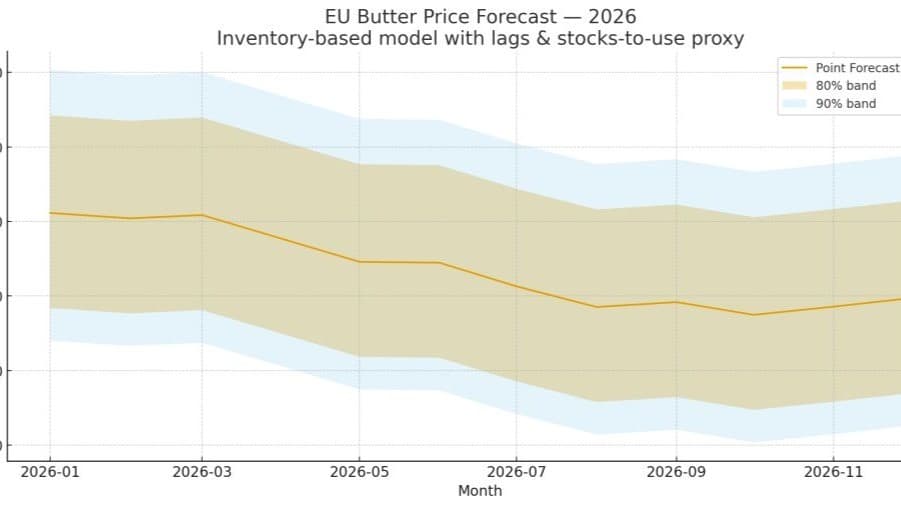
Summer Shopping or Summer Sale?
Last week was again a bit of a bearish week for the entire dairy industry. With cream prices under pressure and milk intake still strong, we keep seeing a market that has more supply than demand. Butter prices took another step lower, cheese prices cracked, and the powder market gave back a bit of its gains again.
The weekly report
Get it before it is anywhere else
Every market report, straight to your inbox the moment it is written. Butter, cheese, powder, liquids — pick what you actually trade.
Roughly weekly · Free · Unsubscribe any time