Expecting More Downside, Preparing for the Bounce

Last week, we were a little less active than usual. A mix of exhaustion, out-of-office meetings, and a slower market gave us a rare moment to breathe. On cheese, we had zero trades. Butter saw only a handful — around 220mt — and powders were the only bright spot, with 1,600mt brokered, all thanks to our wonderful colleague Linda.
Watching the market from a bit of distance, we noticed something striking: almost everyone we speak to seems to follow the same logic — expect more downside, but prepare for the bounce. For some, that’s a signal the bottom might be in. For us… that’s a clear sign we still have some distance to fall.
The Father–Son “Macbook Meeting”
One of last week’s meetings was with my parents, 74 and 76 years old. I went over to install a new MacBook, which I thought would take thirty minutes. Five hours later, the MacBook was working (sort of), I was starving, and we were still debating the purpose of the green dots and red dots. I decedid to stay for dinner. After dinner, my father — as always — asked about work.
He’s not from the trading world; he spent his life as a special-needs teacher. He used to tell me that the only way to help a child learn was to understand their logic — how they saw the world. If he could see through their eyes, he could adjust the school material so they could understand it. So when he asks me about markets, he does it with that same curiosity. And in trying to explain things to him, I often end up explaining them better to myself. For today, let me invite you to a summery of my conversation with Ad Reijntjes
“Expecting More Downside”
Me: “Almost everyone we talk to expects more downside. Producers, end users, traders — no one really believes the bottom is in yet. Milk volumes are still coming in a lot higher than last year, stocks of butter and powders are building, and demand remains fragile. Add weaker global growth, and you don’t get much bullish fuel.”
Dad: “So nobody’s buying and everyone wants to sell?”
Me: “Not quite. Everyone wants to buy, and almost nobody wants to sell.”
Dad: “Wait, so buyers expect lower prices but don’t want to wait — and sellers expect lower prices but don’t want to sell?”
Me: “Exactly.”
He laughed, the kind of laugh that says ‘Those partners of yours really do complicate things, don’t they?’
We talked about whether our partners might be bluffing — saying they expect lower prices but secretly positioning for a bounce. But knowing most of them as we do, I don’t think so. The bearish tone is consistent, and the data supports it.
Fear: The Ghost of the Past
My father has a framed quote in his study:
“Behavior in the present is a reflection of the experiences that shaped us in the past.”
He went upstairs to show it to me while we talked. “Markets aren’t so different from people,” he said. “They act the way they do because of what hurt them before.”
He’s right. Producers, buyers, traders — we’re all reacting to memory, to fear, to that one time we got burned.
Producers, for example, still carry scars from 2024. Many were oversold and missed out when prices rose sharply later. Now they’re doing everything to avoid being caught in that same trap again. They sell conservatively — month to month, not much forward — and even we, with our trader brains, understand that logic. With high feed costs, tricky politics, and shifting calving patterns, milk intakes could turn sooner than expected. Fear of overselling is stronger than fear of missing higher prices.
Dad: “So, how far forward have they sold?”
Me: “Hard to say, but it feels like most producers have sold through their current stocks and some of their November–December volumes, but every litre of extra milk needs to be sold. Q1 offers have been very limited, keeping them extremely cautious.”
Buyers: Cheap Feels Safe Enough
Next, we talked about end users. Many are still buying with a long horizon. Prices might go lower, even according to most purchase managers, but current levels — especially for butter and powders — already feel cheap and fit in current cost models. They’ve seen what happens when you wait too long in a down market: the bounce always comes faster than expected.
So they buy gradually, week by week. No one’s trying to time the absolute bottom — they’re just making sure they’re not left chasing.
Dad: “And how far forward are buyers covered?”
Me: “Depends on the product. Butter buyers are furthest ahead — some are already well into H1 2026. Powders less so. Cheese buyers… let’s just say they never liked long coverage, but even they’re showing more interest now.”
Traders: Sitting on Their Hands (and Profits)
Then came the traders — his favorite group to question. When I was still working as a trader, he kept calling me a gambler.
Dad: “So what are the traders doing?”
Me: “Honestly? They’ve done very well these past months. They saw the production growth, the demand slowdown, and positioned accordingly. Many shortened the market and played it right. But they’re not eager to add more exposure now. Many seem to be reducing their exposures”
Dad: “Why not? If they’re winning, why stop?”
Me: “Because they remember what it felt like to lose. A lot of traders only just recovered from past losses. Fear of being wrong again is powerful. We’re close to the bottom — no one wants to be caught short when the market turns. Sitting out a flat market feels safer than chasing a reversal.”
We both smiled at that. It’s the same logic he used to apply to his students: after getting one answer wrong, kids hesitate to raise their hand again — even when they know the next answer is right.
Where That Leaves The Market
Me: “So, where does that leave us, you think Dad?”
I could see my father leaning in, half-interested, half-preparing for another metaphor about teaching.
Me: “For powders and butter, I think both traders and end users are largely covered for Q1. Most of the activity we’ll see in the coming months will come from the cheese side — that’s where buyers are still actively filling gaps.”
Dad: “So for butter and powder, it’s quiet time?”
Me: “More like a waiting room. The market will move month by month, reflecting the ongoing supply and demand balance. For now, production keeps adding more butter and powder than the market can absorb. Until June, we probably see more product entering warehouses than leaving them.”
He nodded. “So, too much supply. Prices fall?”
Me: “Exactly. And that’s why the only time end users or traders step in is when they’re offered a clear discount compared to the forward months. They’ll buy more nearby positions only if the curve gives them a reason — a healthy contango. Both butter and powder need that structure to move volumes. Without it, producers will otherwise have to continue to build stock. But with they are probably forced to sell commodities to be able to pay farmers”
Dad: “And what if milk drops sharply year-on-year? That would mean less production, right?”
Me: “That’s the one thing that could flip the picture. If milk volumes suddenly decline, the back of the curve — say, the later half of 2026 — could lift quickly. If the market get fearful again, today's prices will start to look really cheap and end users and traders will start to buy what they feel is relatively cheap. That would pull nearby months up too, as the market starts to price in tighter supply. But as long as that fear hasn’t reached the market, we expect the pressure from growing stocks to keep the forward curve soft. The back might try to rise, but the front end will keep dragging it down.”
He leaned back. “So, it reacts only when pressure builds.”
Me: “Pretty much. Markets, like people, don’t move out of comfort — they move out of discomfort.”
Closing Thoughts
The conversation ended there — him quietly nodding, me realizing that I’d spent the last hour explaining to my father what the market already knew: it’s not data that moves people, or fundamentals, but emotion disguised as logic.
For now, the dairy market remains cautious — expecting more downside, yet preparing for the bounce.
And just like that new MacBook on his desk, it’ll probably start working perfectly… the moment everyone stops trying to understand it.
More from the desk
Our Long View Before Our Long Break 
Our Long View Before Our Long Break
Last week the market found a bit of stability. After lower trades on cheese, the cheese market traded slowly up, although a real rally remains absent. Butter prices did dip a bit further, although at the start of this week we see some strength on the back end of the curve. And on powder, our bullish feeling just doesn't go away — and now we can find some confirmation in the market as well.
Dairy Carry Has a Shelf Life 
Dairy Carry Has a Shelf Life
Last week was bearish across the board — every product we broker leaned the wrong way. Powders lost more momentum, cheese slipped well below €3,000 for some products, and butter continues to impress with just how much keeps showing up. Supply, supply, supply.
Summer Shopping or Summer Sale? 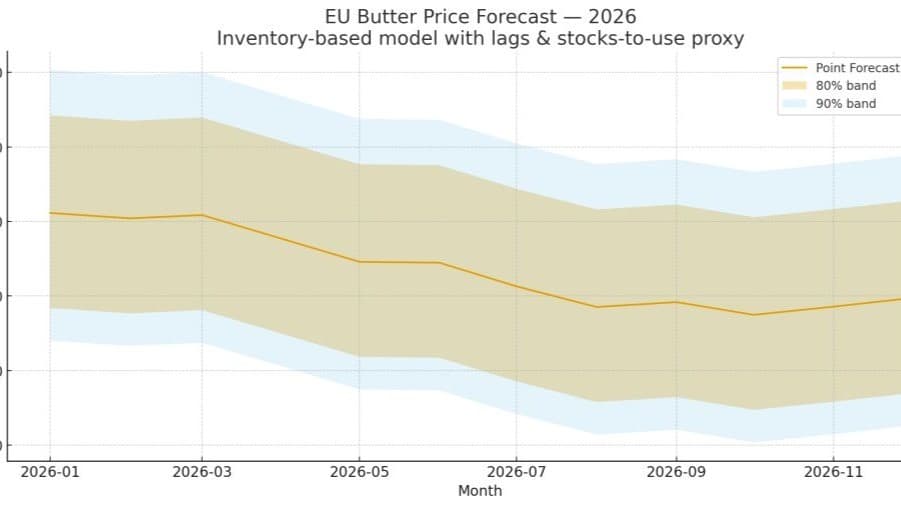
Summer Shopping or Summer Sale?
Last week was again a bit of a bearish week for the entire dairy industry. With cream prices under pressure and milk intake still strong, we keep seeing a market that has more supply than demand. Butter prices took another step lower, cheese prices cracked, and the powder market gave back a bit of its gains again.
The weekly report
Get it before it is anywhere else
Every market report, straight to your inbox the moment it is written. Butter, cheese, powder, liquids — pick what you actually trade.
Roughly weekly · Free · Unsubscribe any time