
Hoarding as Hedging: The Stock-Stretch-Hedge Strategy

Last week was a broadly bullish one for EU dairy commodities. Butter prices edged higher, cheese prices climbed, and cream saw a notable jump — SMP was the outlier, moving largely sideways. Whether this week continues in the same direction is, from where we stand, a big question mark. Because the past 48 hours have been dominated by something far bigger than dairy markets: the US and Israel launched military strikes on Iran, triggering immediate concerns around oil prices, inflation, and broader financial market volatility. Oil markets are bracing for a spike towards $80–$100 per barrel when trading opens Monday, while safe-haven assets like gold and the dollar are expected to go on the move — effects that every commodity market, including dairy, will feel indirectly through energy and transport costs. For this update, we're deliberately leaving the conflict aside and staying focused on our own market dynamics — but it would be naive to pretend it isn't there.
Let's start with the numbers, because the numbers are doing something strange.
Part I: More Milk, More Stock, More Questions
European milk production is running at levels that would make a dairy farmer from the past genuinely uncomfortable. Output is up, collections are strong, milk solids are high, and across key producing regions the message from the farm is consistent: cows are milking well, feed is available, and there is no structural reason to expect a fast slowdown anytime soon. By every traditional measure of supply, this market should be under pressure. And yet — here we are.
Stocks (especially on butter) are building at a pace not seen in recent memory. Coldstore and warehouses are getting cosy. Private storage is filling up. And still, prices are holding — in most cases climbing. If you're trying to make sense of that with a classical supply-and-demand framework, you're not alone in struggling. In fact, more than half of our partners have told us they genuinely cannot make sense of what this market is doing. And the real news: the majority of those same partners are quietly shifting their outlook from bearish to something closer to cautiously bullish. Fear of missing a move higher tends to have that effect.
Buyers, across almost every commodity, are becoming increasingly nervous about where prices are heading — and that nervousness is pulling them into the market rather than keeping them on the sidelines.
Cheese: Near-Term Focus, Empty Shelves
Cheese buyers are operating in survival mode. They are not covering forward, they are not building positions — they are buying what they need, when they need it, and keeping the market as clean and empty, just like our savings account. The result is that EU cheese markets are effectively empty, with little spot availability to speak of. Strong export demand is doing the rest of the work, providing consistent buying support that is mopping up whatever does come available. As long as export markets remain engaged — and right now they are — there is simply no credible argument for prices to weaken. Cheese is tight, buyers are reactive, and producers are happy. A tidy situation, for now.
SMP: Covering the Full Curve — and Then Some
The SMP market is where things start to get interesting. Buyers who were focused purely on near-term coverage a few months ago are now extending their buying appetite aggressively — covering not just the coming quarter, but in some cases the full forward curve through year end. Large buyers with deep pockets are filling warehouses wherever capacity allows.
The supply side tells a different story on the surface. Germany — never one to undersell its productivity — reported its weekly SMP production growth of 118% versus the same period last year. Read that again. One hundred and eighteen percent. By any normal measure, that kind of supply surge should be putting serious pressure on prices. And it is not a one of number. SMP production has been in the double digits for months. But here is the twist: virtually all of that extra volume is going straight onto stock. It is not hitting the spot market, it is not looking for a home — it is being put away, deliberately, as a hedge against forward demand and future sales.
Traders and large end users are doing exactly the same. In the feed ingredient market, the effect is particularly visible — buyers operating on flexible contracts who typically call off standard volumes are now requesting double, sometimes triple quantities. Why? Because there is a meaningful lag between quotation prices and where spot is trading, and anyone paying attention is using that window to accumulate while they still can. When everyone from individual farmers to feed traders to commodity desks is stocking the same product for the same reason, warehouse operators tend to notice. And the ones we speak to — or whose clients speak to us — are telling us capacity is filling up fast.
The market consensus on SMP has quietly shifted. Yes, €2,500 looks high relative to where spot SMP has been trading and too expenisve to where SMC prices are trading. But relative to where prices could go? It starts to look like a sensible entry point. The incentive to wait for lower prices is small. The risk of waiting and being wrong is considerably less small.
Butter: Hedging 20 Months Into the Future
Butter is telling a version of the same story, just on a longer timeline and with higher stakes.
Where SMP buyers are covering through year end, butter is a different game entirely. Traders are reporting active sales into 2027 — not tentative enquiries, actual booked business — with large end users such as industrial bakeries locking in prices just below €5,500 per metric tonne for delivery well into next year. On paper, that looks expensive. Spot butter is sitting roughly €1,000 lower. But zoom out to the three-year average, and €5,500 starts to look like a reasonable price for someone who needs to plan a production schedule and cannot afford to get caught short.
The problem, if you are on the sell side, is a familiar one: this is not a market where sellers are eager to offer anything beyond June. Futures markets offer limited liquidity. Producers are not in a rush. And with market prices arguably closer to the floor than the ceiling, no one with an open short position is sleeping particularly well. Sellers are doing everything they can to reduce their risk profile — and in the current environment, there is essentially one tool left on the table.
That tool is stock. And we will get to exactly why in the next section.
The Cost of Carry: A Game-Changer
Before we do, one number deserves attention, because it quietly changes the entire calculation.
Eighteen months ago, the cost of carrying butter — financing, storage, insurance — ran to roughly €250 per metric tonne per quarter and for some well over € 300 per mt per quarter. Today, for partners with strong balance sheets, that number has fallen to around €120 per metric tonne per quarter. Lower commodity prices combined with lower interest rates have compressed carrying costs to a point where the arithmetic is almost too good to ignore.
Consider: buying butter in Q2 at €4,500, storing it through to Q2 next year, and landing with an all-in cost price below €5,000 — while the forward market is pricing Q2 2026 delivery at €5,300. That is not a trade that requires a PhD in derivatives. It is a straightforward arbitrage, available to anyone with the financial capacity to execute it.
And it is not just traders and end users doing the maths. Cooperatives with strong financial positions are running the same calculation internally. Why sell Q2 production at €4,300 when there is genuine buying interest in H2 at €4,900? The €250 cost to finance the carry into the second half of the year is, as one partner put it, "easy to explain at any board meeting." When the numbers are this clear, behaviour tends to follow.
Part II: Hoarding as Hedging — And Why It Makes You Nervous
There is something almost elegant about the logic. Stocks are building, prices are holding, and the market has quietly invented its own forward market where the official one runs thin. Buy physical, carry it cheap, sell the premium. Repeat. It works — right up until it doesn't.
Let's be honest about what is happening here. The hoarding-as-hedging strategy is not irrational. In fact, given current carrying costs, forward curve structures, and the genuine scarcity of seller willingness beyond June, it is arguably the most rational trade in the room. But rational strategies, when adopted simultaneously by enough market participants, have a habit of creating their own problems. And this one comes with five risks that deserve to be named clearly.
The Unwind
Stock built as a hedge is not consumed. It is parked. And parked stock has a return address.
If sentiment shifts — a geopolitical resolution, a demand disappointment, a currency move that makes EU product suddenly expensive for key export markets — all of that carefully accumulated stock does not quietly disappear. It comes back to the market. And it rarely comes back in an orderly queue. When the first large holder decides the carry trade is no longer attractive, the second one notices, and then the third. What began as a trickle becomes a flow, and what began as a flow becomes something that keeps pricing desks awake on a Sunday evening.
There is an additional complication that is already visible in the market today: product age. We are still seeing meaningful volumes of 2025-produced butter circulating — product that was parked with the best of intentions and is now quietly becoming a liability. Butter is not wine. It does not improve with time. And in a market where freshness carries a premium and buyers have options, older product loses its negotiating power fast. If the current wave of hoarding adds another layer of stock on top of what is already sitting in warehouses, the age profile of available supply will deteriorate further. When the unwind eventually comes — and it will come — it will not be a clean, orderly release of uniform product. It will be a messy queue of 2025 blocks competing with 2026 blocks, with older product forced to offer meaningful discounts just to find a buyer. The same behaviour that supported prices on the way up becomes an accelerant on the way down — and aged product is always first in line to feel it.
The Liquidity Trap
The carry trade works beautifully for partners with strong balance sheets. At €120 per metric tonne per quarter, financing stock is almost too easy to justify. But not everyone in this market has a strong balance sheet — and not everyone's balance sheet will remain strong if the macro environment shifts.
The Iran situation is a useful reminder of how quickly credit conditions can tighten. A geopolitical shock, an oil price spike, a general risk-off move in financial markets — any of these can raise the cost of capital quickly and with very little warning. When that happens, the partners who borrowed cheap to carry stock find themselves in an uncomfortable position. Carrying costs rise. Margin calls arrive. And forced selling follows — not because the seller wants to sell, but because the alternative is worse.
The weakest hands in any market liquidate first. And they rarely do it neatly, or at a time of their choosing.
The Milk Production Surprise
The bullish thesis that underpins the entire hedging strategy rests on a quiet assumption: that milk supply growth will moderate. That the current flush is seasonal, manageable, and already priced in.
But what if it isn't?
Germany just reported 118% SMP production growth year-on-year. For now, that volume is going onto stock — which is why it hasn't broken the market. But stock has a capacity limit, both physical and financial. If spring flush comes in harder than expected, if a second and third major producing region posts similar numbers, and if warehouse capacity starts to genuinely fill up — the market will be holding a very large volume of product that was purchased to hedge against a scarcity that never arrived.
The hedge only works if the underlying assumption — that forward prices will rise — turns out to be correct. Production surprises are the most direct way that assumption gets stress-tested.
Export Market Dependency
Much of what is keeping EU markets clean right now is not domestic consumption. It is export demand. Cheese markets are empty in part because overseas buyers are consistent and engaged. SMP volumes are moving because international appetite is strong. Butter's forward curve is being supported by end users who need to plan globally.
That is a foundation worth examining carefully, because it rests on conditions that are not entirely within Europe's control.
A softening in Chinese demand — always a factor in powder markets — would change the picture meaningfully. A significant currency move making EU product expensive relative to Oceania or US origins could redirect flows quickly. And now, with a live military conflict in the Middle East, shipping routes, insurance costs, and the general appetite for cross-border commitment are all variables that just got harder to model. Export demand is doing a lot of heavy lifting right now. The question worth asking is what happens to the structure if it puts the weight down.
The Self-Fulfilling Prophecy
This is perhaps the most intellectually uncomfortable risk of all, because it requires the market to look at itself honestly.
Hoarding drives prices higher. Higher prices make hoarding look smart — and make those who haven't hoarded yet feel like they are falling behind. That feeling pulls more buyers into the market. More buying drives prices higher still. And at some point along that chain, the price signal stops reflecting physical fundamentals and starts reflecting the collective anxiety of a market that has talked itself into a direction.
It has happened before. It will happen again. And the particularly insidious thing about a self-fulfilling prophecy in commodity markets is that it is almost impossible to identify in real time. From the inside, it looks exactly like a genuine bull market. The difference only becomes clear in retrospect — usually around the time the first large position starts to unwind.
None of this means the current market is wrong. The fundamentals supporting the bullish case are real, the carrying cost arithmetic is genuinely compelling, and the forward curve structures make the hedge strategy logical for anyone with the capacity to execute it. But markets that work on momentum and fear of missing out rather than on fundamental supply and demand have a long history of overshooting — and an equally long history of correcting with a speed that surprises even the most experienced participants.
The stocks being built today are not a problem. They are a rational response to a genuine market signal. But they are also, quietly, the kindling for whatever comes next. Whether that next thing is a continuation of the bull run or the beginning of something more uncomfortable will depend on factors that, as of this Sunday, none of us can fully see.
Which is, of course, why we keep writing these updates.
Conclusion: The Smartest Trade in the Room — For Now
Let's give credit where it's due. The hoarding-as-hedging strategy is not irrational. Given current carrying costs, forward curve structures, and the genuine scarcity of seller willingness beyond June, building stock makes sense. It simply works. The logic is sound. And for partners with the financial capacity to execute it, the carry trade has been one of the better decisions of the past few weeks.
But here is the question nobody is asking loudly enough: how logical does this strategy look in eight weeks?
Because in eight weeks, we will be in the middle of spring flush. European cows, indifferent to geopolitics and forward curves alike, will be doing what they do every year — producing more milk than the market knows what to do with. Collections will rise. Cream will be available. Butter churns will run. And all of that fresh, new, competitively priced Q2 product will arrive into a market that is already sitting on a growing mountain of stock — some of it, as we noted, carrying a production date that buyers are already beginning to politely question.
The stocks that look like a smart hedge today will look considerably less elegant when they are competing for the same buyers as peak flush volumes. The carrying cost advantage that makes the trade compelling in March starts to feel less comfortable when the spot market softens seasonally and the age clock on existing stock keeps ticking. And the forward premiums that justified the entire exercise have a habit of compressing precisely when you need them most — which is to say, exactly when everyone else is thinking the same thing at the same time.
We are not calling a top, we might see the market increase another € 200 - € 400 over the next weeks. We are not telling you to panic. But we are saying this clearly: the window for sellers to move product at current prices is open — and windows have a tendency to close faster than anyone expects.
For every day that a seller waits for the next €50 upside, they are also carrying the risk of the first €200 downside. We understand the wish for producers to wait selling. The market right now is offering prices that, relative to the three-year average, are reasonable to good, but not great. Buyers are engaged. Export demand is supporting the structure. And the geopolitical noise, while impossible to ignore, has not yet materially disrupted physical flows. But these are good conditions to sell into. They are not guaranteed to last.
The smartest trade in the room today is building stock. But the second smartest trade — the one that tends to get overlooked when sentiment is running warm — is recognising when to stop. Peak stocks at peak flush on a market priced for continued scarcity is not a position that rewards patience indefinitely. At some point, carrying risk becomes more expensive than the premium you're waiting for.
That point may not be today or this week. But it is closer than the forward curve suggests.
Sell well. Carry less. Sleep better.
More from the desk
Our Long View Before Our Long Break 
Our Long View Before Our Long Break
Last week the market found a bit of stability. After lower trades on cheese, the cheese market traded slowly up, although a real rally remains absent. Butter prices did dip a bit further, although at the start of this week we see some strength on the back end of the curve. And on powder, our bullish feeling just doesn't go away — and now we can find some confirmation in the market as well.
Dairy Carry Has a Shelf Life 
Dairy Carry Has a Shelf Life
Last week was bearish across the board — every product we broker leaned the wrong way. Powders lost more momentum, cheese slipped well below €3,000 for some products, and butter continues to impress with just how much keeps showing up. Supply, supply, supply.
Summer Shopping or Summer Sale? 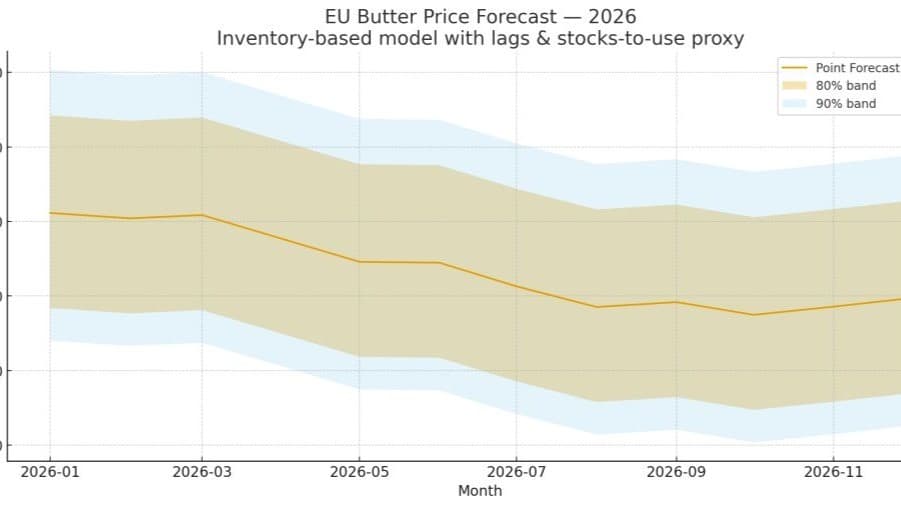
Summer Shopping or Summer Sale?
Last week was again a bit of a bearish week for the entire dairy industry. With cream prices under pressure and milk intake still strong, we keep seeing a market that has more supply than demand. Butter prices took another step lower, cheese prices cracked, and the powder market gave back a bit of its gains again.
The weekly report
Get it before it is anywhere else
Every market report, straight to your inbox the moment it is written. Butter, cheese, powder, liquids — pick what you actually trade.
Roughly weekly · Free · Unsubscribe any time