Milk, Fear & Fundamentals — A Market That Refuses to Make Sense

Calling this market anything but bullish is simply wrong. Prices across all commodities are pointing higher, futures are grinding up, the GDT Pulse showed a gain on Tuesday, and even cream is starting to find some life. Sure, there are still some bears out there warning that the tide is about to turn — but so far, they're on the wrong side of the trade. Over the last three days we brokered roughly 1,500mt of butter, with Q2 prices up around €200. Powder feels a bit capped, cheese feels well supported. And here's the funny thing about markets — bear markets tend to attract more buyers, and in bull markets like this one, more sellers start to show up.
The Bear Case: Why the top is near
We've been called too bearish more than once — and truth be told, we might be, and we still are. Call it stubbornness. One partner described us yesterday as a bear dressed in a bull costume, ready to rip off its clothes the moment prices start to slide. Well, consider this us stripping before prices drop — because we simply cannot get our heads around what's happening right now.
Our biggest problem with the current rally is milk, and mainly the insane volume the market simply cant seem to process. Raw milk prices are unbelievably weak. Spot prices for March are trading around 15ct/liter — not just a few spot loads, but structural. We've even heard prices below 10ct on spot. Dairies don't know where to put the milk, factories are running at maximum capacity, and it's still only the end of February. With daily milk volumes typically increasing through March, April and May, even bullish producers are quietly worried their additional milk might have to go for free at some point in the coming weeks.
The same logic applies to SMC. With SMC prices trading between €450-650/mt FCA France and Germany at the start of this week, anyone with free drying capacity is converting it into fresh SMP at below €1,600 cost price and selling it onto the market at €2,400-€2,450. Margins like that don't stay quiet for long — they attract volume.
And then there's cream. Yesterday's jump from the €3,800 level to €4,300-€4,400 caught many by surprise — but even at those levels, cream only justifies butter prices just below or just above €4,000. The disconnect between cream and butter valorisation normally lasts two weeks, around Christmas and at the peak of the flush. We have now seen cream trade below butter valorisation for more than 12 consecutive weeks. We genuinely cannot recall ever seeing that.
So let's be clear about what the fundamentals are telling us. If raw milk can't find an outlet through cheese producers at 20ct, EU cheese capacity is maxed out. If SMP prices can't find a sustainable floor above €1,500, free drying capacity is being fully utilised. And as long as cream trades well below butter sales equivalent, every butter cannon capable of running is running — non-stop.
If this milk problem persists well into Q2 — and we don't see how producers cut milk volumes when commodity prices are at current levels — then the EU is likely running at full production capacity from December through June. We cannot find a historical precedent for that.
So why are prices up? We think the answer differs by product — and it's worth unpacking each one.
The SMP rally looks largely technical to us. End users worldwide have spent the last two and a half years successfully covering short at the last minute, repeatedly avoiding the need to buy forward. That strategy has worked — until now. The result is a buyer base that is structurally short-covered, arguably more so than at any point in recent years. Those buyers are now scrambling to rebuild forward cover, effectively pulling two to three quarters of demand forward into the market simultaneously. Meanwhile, the EU is producing more SMP than ever, but a significant portion is flowing straight into warehouse as a hedge against forward sales rather than into consumption. Add the structural loss world wide of drying capacity to whey products — a trend that isn't reversing — and you have a market where motivated buyers can push prices a little further still. But make no mistake: in the short term we remain convinced supply is outpacing demand. Full warehouses and well-covered buyers will eventually cap the appetite, and we believe the SMP rally is closer to its ceiling than its floor.
The cheese market tells a different story. EU producers entered Q4 undersold and overproducing. Faced with mounting losses at low price levels, they cleared the oversupply the hard way — by cutting prices and pushing volume onto export markets. It worked. At the same time, forward export premiums for Q1 were attractive enough that many producers sold aggressively into that window, perhaps a touch more than was wise given the milk expectations. Strong export demand carried well into Q1 and kept the market clean. EU end users, having run a hand-to-mouth strategy for months, left very little slack between supply and demand. The balance is tight — with the exception of cheddar and emmental, where some excess stock remains visible.
Butter is a different beast entirely. We would still argue that the current rally is driven primarily by fear rather than fundamentals. The psychological asymmetry is stark: the fear of paying €8,000 for butter creates a far stronger incentive to buy today than the potential comfort of buying at €3,500 when stocks peak. On the sell side, producers sitting on record milk flows are still more afraid of overselling at the wrong price than they are of having to move a few extra tonnes at the bottom. And traders — most of whom played the short side for six months and got burned at the February short squeeze — have quietly covered their positions and are now sitting on their hands, waiting to position long. The result is a market with a structural shortage of sellers and an excess of buyers. We've seen this pattern before. It doesn't necessarily tell you where prices go over the long term — but it tells you everything about where sentiment is driving them in the short term. As we've said before: to trade butter, you don't need a degree in economics. You need one in psychology.
To the bulls: this is your moment to act.
Markets don't stay disconnected from fundamentals forever. You've had the rally. Q2 prices are up €200 this week and € 700 from its January lows. Sentiment is strong, and some buyers are fearful of missing out and still chasing the offers. But the milk keeps flowing, the dryers keep running, and the butter cannons don't have an off switch. The supply response is already happening — you just can't see it yet in the price. By the time you can, it will be too late. If you're sitting on profitable forward sales at current Q2 levels, the question isn't whether to sell. The question is why you haven't already.
The Bull Case — Why Prices Could Go Higher
The last sentence above may have oversold our bearish argument somewhat. If we were running a trading desk or heading up a large dairy cooperative, we'd be selling into this market. The next few weeks may well prove why we're brokers and not chief strategists. But in the interest of balance — and intellectual honesty — the same set of fundamentals can be used to build a (maybe less)compelling bull case. So let's give the bulls their moment.
The current weakness in spot liquids is real, but it reflects today's supply and demand — not tomorrow's. Forward curves can be read in multiple ways, and while we've made the bearish case above, there are signals in this market that deserve serious attention.
The single strongest bull argument — and the area where we'll openly admit our blind spot — is international demand. Four consecutive bullish GDT results are not a rounding error. The first increase can be dismissed as a correction. The second as follow-through. But four in a row, with butter up nearly 25%, AMF up 20%, SMP up almost 25% and WMP up over 15%? That's a demand signal. And critically, this happened while the world's major export regions were all producing more milk — New Zealand up roughly 2%, the US up more than 4%, the EU up more than 5% — and in a global environment where tariff uncertainty and geopolitical risk should, in theory, be suppressing economic appetite. The fact that buyers are this active, in this environment, points to something structural rather than opportunistic. We want to see demand hold for at least two more events before drawing firm conclusions — but so far, the world market is not blinking.
The same momentum is visible in the US. CME prices are building what looks like a stairway to heaven — and for good reason. Despite strong milk production data that led many to expect comfortable stock builds, exceptionally strong export sales have drawn inventories down far below where the market was pricing them. US butter stocks, if current trends continue, may hit their lowest seasonal peak in a decade. But to put that in perspective v.s. the EU: the US is expected to carry roughly 20,000mt less butter at peak than last year, and 40,000mt less than the record year of 2021. The EU, by contrast, is expected to carry 80,000mt more than last year and 120,000mt more than in 2024. But lets face it, the US tightness is real — and it's providing a price floor with global reach.
Then there's the post-seasonal argument, which may be the most powerful of all. If the EU is at max production capacity, is not putting commodity prices down, what happens when commodity production slips below YoY levels? The supply response on the way down can be fast and unforgiving. As one market contact put it to us this week: if maximum capacity production, record butter stocks and high import volumes in the EU can't push prices down, what happens when milk volumes drop, exports increase and imports and production falls with them? It's a fair point — and we don't have a comfortable answer to it. This is exactly whats driving buyers fears, and what keeps sellers from selling forward.
Beyond the seasonal cliff, there are further tailwinds the bulls can point to. After months of hand-to-mouth purchasing, any decision by retail or foodservice buyers to rebuild even modest forward inventory adds a meaningful demand pulse to a market that is already running lean on the forward book, like the cheese market. Uncertainty about European energy costs are quietly putting a structural floor under production costs across all commodities. And a weaker euro could make EU exports even more competitive globally — adding demand support at exactly the moment international buyers are showing up with real appetite.
Dear Bears — This Is Why You Keep Buying
We get it. The fundamentals are on your side. Milk is cheap, cream doesn't justify butter prices, and the supply math doesn't lie. But here's the uncomfortable truth: being right on fundamentals and being right on timing are two very different things — and in butter, sentiment has a momentum that analysis alone cannot stop.
Think about your actual risk. Staying short means betting that the market turns before your coverage gap becomes a problem. But look at what's in front of you: four consecutive bullish GDT results, a US market tightening faster than anyone expected, EU factories already at maximum capacity before the seasonal flush has even started, and a forward book that's thin because too many buyers spent two years convincing themselves they could always cover late. That strategy built the squeeze you're now sitting in.
The asymmetry is what should concern you most. If prices correct, you save €100-200 per tonne and feel vindicated. But if the seasonal production cliff arrives in June with stocks still uncomfortable and international demand still absorbing EU exports, the move higher doesn't slow — it accelerates. The cost of being wrong on the upside is not €200. It could be a multiple of that.
Cover your near-term exposure at current levels. Keep your bearish convictions as a trading position if you must — but not as a procurement strategy. The market may yet prove you right.
Being right and being uncovered are not the same thing. Only one of them keeps the factory running.
Final Thoughts — Pick Your Side, Own Your Risk
So here we are. The bears have the fundamentals. The bulls have the momentum. And the analysts — bless them — have the luxury of being right in hindsight from the comfort of a risk-free desk, ready to explain exactly what happened and why they saw it coming all along. Must be nice.
For everyone else, the people actually exposed to this market, the question was never really about who's right. It's about what business you're in.
In a typical market, comfort pays. Covering your position, sleeping well, avoiding the career-ending conversation with management — that's a legitimate strategy and it has served many procurement professionals a long and prosperous life. Being bearish in this market adds risk. Being bullish mitigates it. That's not an opinion, it's just arithmetic. The downside of buying too early is a number. The downside of being caught short when this market moves is a very different kind of conversation.
But — and here's where it gets interesting — not everyone reading this is in the risk mitigation business. Some of you are in the money-making business. You take risk deliberately, you size it carefully, and you back your analysis with real exposure. If that's you, the bearish case we've laid out is genuinely compelling. The fundamentals are broken, the disconnect is historic, and markets do eventually return to reality. Eventually.
The honest answer is that this market is a near-perfect storm of conflicting signals — and anyone with total conviction in either direction is either a genius or not looking hard enough. What we can say is this: the bull case protects many of you, the bear case could reward some of you, and the analyst case requires neither courage nor capital.
More from the desk
Our Long View Before Our Long Break 
Our Long View Before Our Long Break
Last week the market found a bit of stability. After lower trades on cheese, the cheese market traded slowly up, although a real rally remains absent. Butter prices did dip a bit further, although at the start of this week we see some strength on the back end of the curve. And on powder, our bullish feeling just doesn't go away — and now we can find some confirmation in the market as well.
Dairy Carry Has a Shelf Life 
Dairy Carry Has a Shelf Life
Last week was bearish across the board — every product we broker leaned the wrong way. Powders lost more momentum, cheese slipped well below €3,000 for some products, and butter continues to impress with just how much keeps showing up. Supply, supply, supply.
Summer Shopping or Summer Sale? 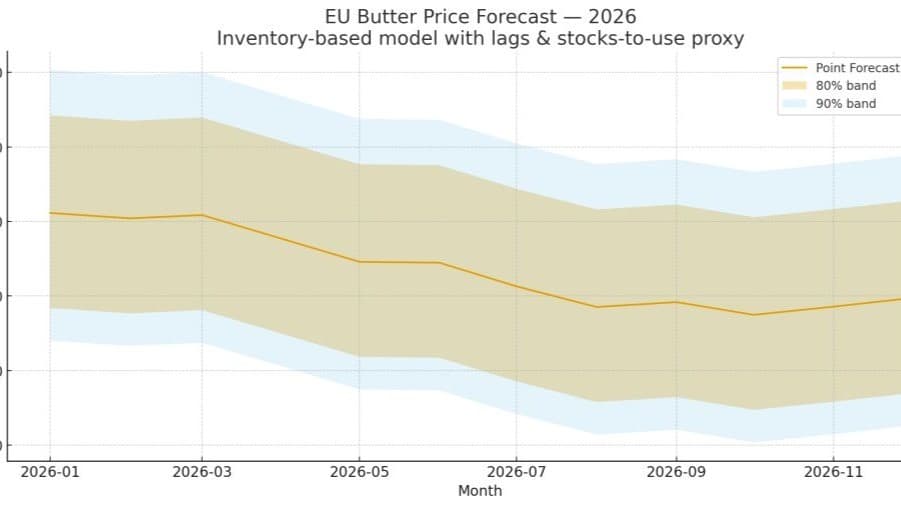
Summer Shopping or Summer Sale?
Last week was again a bit of a bearish week for the entire dairy industry. With cream prices under pressure and milk intake still strong, we keep seeing a market that has more supply than demand. Butter prices took another step lower, cheese prices cracked, and the powder market gave back a bit of its gains again.
The weekly report
Get it before it is anywhere else
Every market report, straight to your inbox the moment it is written. Butter, cheese, powder, liquids — pick what you actually trade.
Roughly weekly · Free · Unsubscribe any time