
Falling Fats & Frozen Quotations

The first three trading days of this week feel weak once again. Butter prices are slipping well below €7000 for Irish and Polish origins and are barely holding the €7000 mark for NL/DE/BE material. Lower cream values are weighing heavily on the market, and suddenly the tone has shifted. Offers are now appearing from sellers previously thought to be done for the year, while buyers are firmly pushing back on deliveries. A market that just weeks ago felt tight and oversubscribed is now showing cracks. But apparently, nobody told the quotation committees.
Yes, the Dutch corrected their quote slightly. The Germans? Forgot to act. And the French? Predictably pushed theirs up. Meanwhile, frustration about these quotes is building. Several of our partners — especially those hedged against index-linked contracts — are voicing frustration over the growing disconnect. The call for a new settlement mechanism is becoming louder.
We’re not in the business of battling the committees, but when discontent echoes across the trading floor — east to west — it deserves mention. Most agree: the spot market — via brokers, platforms, or direct deals between producers and end users — does not reflect the whole market. So when quotations held firm last week, even after a bearish GDT and clearly lower trade levels, we gave the system the benefit of the doubt. Maybe it needed a week to catch up. But now, even that grace period feels generous.
Since last Wednesday, we’ve seen offers firsthand and received consistent feedback from traders and buyers across our network: producers in Germany, France, Belgium, and the Netherlands are offering down. Yes, producer-to-user deals may differ from visible brokered levels, but the broader picture is clear. Direct offers from producers are consistently coming in between €7200 and €7300 — and this week, as low as €7100 in Belgium, France, and Germany. Against that backdrop, French (€7550) and German (€7490) quotations are doing the sector a disservice. These numbers shape long-term contracts — and in some cases, they’re putting partners in financially unsustainable positions. Even the Dutch — normally the most grounded — seem unusually disconnected. We would invite those involved in the quotation price settlements to give us a call, maybe we are missing something that explains this disconnect.
That said, this disconnect may give momentum to the new EEX initiative seeking a more accurate settlement mechanism. Until then, the Vesper Price Index (VPI) seems to be the fairest reflection of reality. With butter at €7100 for both Western and Eastern EU, it mirrors where we’ve seen spot deals average over the past week. And with that, we’ll end this rant and return to the market as we see it trading now.
Liquids: Weaker Fat Demand Weighs on Prices
The liquid market feels a touch softer again, but it’s clearly the cream segment that’s taking the real hit. Cream prices in Eastern EU are reported well below €8000 — with some outlier loadings even mentioned at €7800. In NL/DE/BE, prices hovered around €8300, though early-week trades were slightly firmer, while end-of-day levels yesterday were already softening again.
In France, cream remains relatively expensive at around €8600, although one of our French partners claimed to have secured cream just above €8000 DAP — suggesting the cracks are starting to appear there too.
On the other hand, SMC prices are holding up a bit better and seem to be clawing back some of the margin that cream is shedding. Trades have been reported up to €2300 FCA, with Southern EU countries continuing to pull prices upward. Still, it’s not enough to support raw milk values. After flirting with the 60ct/kg mark last week, raw milk prices have now retreated — back to the low-50s in NL/DE/BE and even below 50ct in France.
Butter: Bounce or Break?
The butter market has undergone a sharp correction in recent weeks, and the past three trading days have been no exception. We brokered significant volumes of NL/DE/BE butter between €7000 and €7150 for deliveries from July through December. Offers for next year are already surfacing just below €7000. Irish butter saw lower trades between €6900 and €7000, primarily by traders optimising their positions — buying cheaper Polish and selling Irish — while most Irish producers still aim for levels just below, but rather above €7000.
One thing is clear: offers are now coming from all directions. French producers, previously said to be sold out through December, have returned with frozen butter offers around €7100–€7150. German producers dropped their offers from € 7200- €7300 last Friday to as low as €7070 by yesterday’s close — only to be met with a firm “no” from the market. Sluggish retail and industrial offtake is causing end users to postpone deliveries, pushing more product to the front of the market while softening expectations for Q4.
Meanwhile, fresh production data confirms strong butter output in Q2, alongside higher imports and falling exports. The EU market balance has corrected faster than anticipated — and more thoroughly.
That said, we at Get Fair Dairy called for corrections in both February and April — and each time, the market bounced back up. Many producers now suggest we might be in for another rebound. And after being wrong twice, it would be arrogant to claim it’s impossible. But we can’t help being a little foolish here.
What makes this correction feel different is the mood: producers seem more concerned, traders aren’t stepping in to buy nearby, and end users are uneasy with the speed of the drop. Many now sit on covered Q3 and Q4 volumes — unable to benefit from current spot values. As we’ve asked before: who’s going to catch this falling market — and at what price?
We open the day with the following market levels:
- 6-9 trucks Irish butter for August at € 7025
- 6-9 trucks NL/DE/BE for Q4 at € 7175
- 4 loads Solarec butter for July at € 7100
- 4 loads Polish Sweet for August at € 6950
- 12 loads of NL/DE/BE for H1 2026 at € 7000
- 4 loads of Northern Irish butter for August at € 7000
Final Thought
At this stage, the butter market is clearly leading the charge — both in terms of traded volumes and volatility. It's where sentiment is shifting, prices are adjusting, and buyers and sellers are actively repositioning. In contrast, both the cheese and powder markets remain unusually quiet. Activity is thin, with few trades and most participants opting to wait and watch rather than engage.
Despite this subdued tone, prices in both cheese and powder appear to be holding steady, broadly in line with what we reported in our last update. No real shifts in fundamentals, and no major momentum in either direction — just a cautious calm. Whether this is the calm before another move, or simply a reflection of summer-season slump, remains to be seen.
For now, the real action — and uncertainty — sits squarely in the butter market.
More from the desk
Our Long View Before Our Long Break 
Our Long View Before Our Long Break
Last week the market found a bit of stability. After lower trades on cheese, the cheese market traded slowly up, although a real rally remains absent. Butter prices did dip a bit further, although at the start of this week we see some strength on the back end of the curve. And on powder, our bullish feeling just doesn't go away — and now we can find some confirmation in the market as well.
Dairy Carry Has a Shelf Life 
Dairy Carry Has a Shelf Life
Last week was bearish across the board — every product we broker leaned the wrong way. Powders lost more momentum, cheese slipped well below €3,000 for some products, and butter continues to impress with just how much keeps showing up. Supply, supply, supply.
Summer Shopping or Summer Sale? 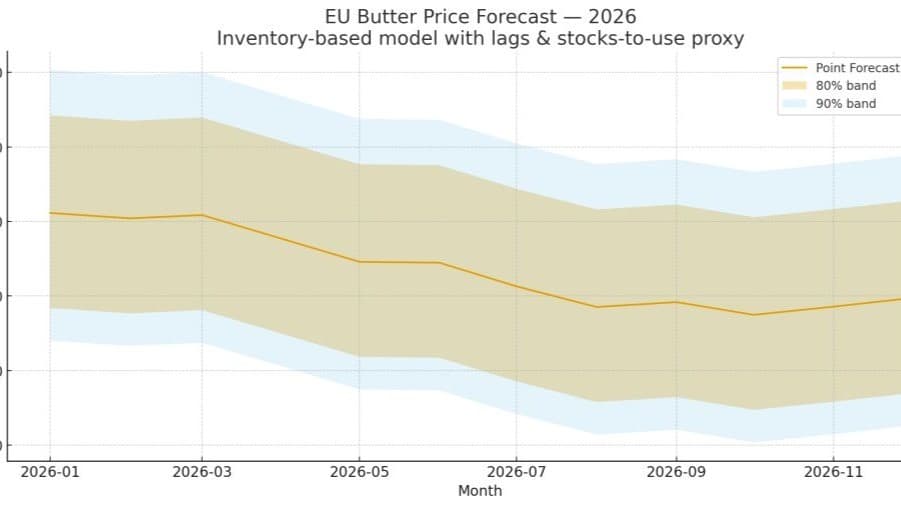
Summer Shopping or Summer Sale?
Last week was again a bit of a bearish week for the entire dairy industry. With cream prices under pressure and milk intake still strong, we keep seeing a market that has more supply than demand. Butter prices took another step lower, cheese prices cracked, and the powder market gave back a bit of its gains again.
The weekly report
Get it before it is anywhere else
Every market report, straight to your inbox the moment it is written. Butter, cheese, powder, liquids — pick what you actually trade.
Roughly weekly · Free · Unsubscribe any time