Tariffs Add 30% to Bearish Odds

The EU dairy market didn’t need another reason to feel bearish — but it got one anyway. With Trump proposing a 30% tariff increase on European Imports, the risk of a drawn-out bearmarket just moved from theory to near-certainty. While the dairy complex has been dragging its feet for weeks, this latest political jab could further restrict export flows, hit margins, and raise serious questions about demand recovery in key overseas markets. It remains to be seen if a panic response in physical trade will materialise, but sentiment has already shifted. Buyers are waiting things out, sellers are hesitant to commit, and futures are showing signs of unease. Combine that with softening demand and market-wide bearish indicators, and you have a dairy market walking on eggshells.
[gfd_milk_valorization currency="€" volume="10000"]
Over the weekend, our phones lit up. Reactions to the proposed 30% tariff increase ranged from dry humour to cautious optimism. One partner texted, “The dairy market just got 30% more bearish.” Another dismissed it with, “It’s TACO Trump — he won’t follow through.” A third stayed upbeat: “The US consumer will absorb it with ease.” The variety of takes says enough. But what stood out most? The fact that people felt compelled to text us on a Saturday — this isn’t just news, it’s nerves.
We’ve already highlighted the strategic importance of the US as a trading partner for EU dairy — no need to repeat the obvious. What matters now is this: if that 30% tariff actually sticks, we’re looking at a significant potential drop in EU dairy exports to the US. That’s not just a wild forecast — it’s baked into the latest export figures, which were already pointing down before this news even hit. A near-term recovery seems unlikely. And while the direct EU-to-US trade is the headline, the real impact could come from shifting international flows.
Mexico, like the EU, has been slapped with the same 30% tariff. That’s no footnote — Mexico is one of the largest buyers of US dairy and they promised to retaliate. If their flows slow, where will the US product go? And what happens when Canada — also hit — faces similar pressure? It’s naïve to say trade will “just stop.” Dairy moves. But the existing supply chains will need to twist, bend, or break to find new routes — and that’s never painless.
In the short term, we don’t expect chaos, just more silence. Many exporters had already frontloaded stock to the US or have products sitting ready to clear ports. So a few quiet weeks — or even months — won’t immediately see more dairy leaving the EU market. But the warning signs are clear. Sluggish domestic demand, weak signals from our other export partners, and now the risk of a hard stop with one of our biggest buyers? That combination smells like oversupply.
And so, we have to agree with our partner: "The odds of a bear market just got a lot bigger."
GDT: Dont expect fireworks
This week brings another GDT auction, but expectations are muted. After one of the more bearish events in recent months two weeks ago, we don’t foresee much of a rebound. Some voices suggest prices could slide further, but to us, a mild correction — if any — seems more likely. That said, a few key products are worth keeping an eye on.
On the fat side, the market still looks soft. More butter offered this round, so another correction wouldn’t surprise us. From an EU perspective, Irish butter in particular looks set for a price adjustment. After hitting above €7,210 last time, we expect it to settle closer to €6,950–€7,050. Solarec held around €7,250 last event, but should land between €7,100 and €7,150 this time. For AMF, a small plus seems likely.
On the cheese front, we see room for a modest correction. Mozzarella in particular could ease to €4,050–€4,100 — only slightly weaker than last time. Cheddar remains the wildcard. It surprises every time, but from what we see, the market looks well-supplied and demand is far from hot.
As for powders, we lean bullish. WMP already showed a hint of recovery during the Pulse auction, and the downward pace in SMP seems to be running out of steam. For EU product specifically, we expect a pretty flat outcome — somewhere between -1% and +1%.
Butter: Bearish Data Will Fuel Bearish Sentiment
The butter market has been steadily losing ground over the past two weeks, yet official quotations and published data have — so far — managed to keep the mood from turning outright gloomy. That’s about to change. This week, more bearish data will surface, and with it, a wider group of market participants will likely start to feel the weight. As mentioned earlier, we expect another soft GDT result. Quotations will need to correct meaningfully if they want to retain any credibility. Combine that with the 30% US tariff headlines, and it’s hard to see anything but bearish momentum dominating the sentiment.
But perhaps the more critical question is: how much cream will actually enter the market? In recent weeks, cream prices have collapsed, and it’s unclear what — if anything — will stop the slide. The European heatwave is over, and weather conditions have shifted in favour of production, not consumption. Meanwhile, spot demand for butter remains close to non-existent. If cream prices in Western Europe drop below €8,000/tonne, it’s only a matter of time before we see butter following suit — with prices falling below €7,000/tonne for Western EU product.
We’re already seeing producers become more aggressive. Last week brought a noticeable increase in offer volumes for July and August. In Poland, sellers are sitting on inventory they’d prefer not to hold into Q4. French producers are also reportedly trying to move stock due to delays on the buyer side. The problem? Those same end users are facing sluggish sales and can’t take additional volume. And the traders — normally the safety valve for oversupply? They’re long too. Many are struggling to move product even for nearby delivery.
So what would make them step back in? One thing: price. Offers for nearby butter that start with a six. With bids for Q4 hovering in the €7,150–€7,200 range, closeby offers starting with a seven are simply out of touch — unless carry into Q4 becomes too tempting to ignore.
Cheese: Strategies Shift as Balance Tips
We’ve seen it coming for weeks — the balance between buyers and sellers is shifting. The biggest change? Strategy. After months of sticking to a cautious, month-by-month approach, more producers are now broadening their sales horizon. Offers are increasingly being made for 3 to 6 months forward. With global sentiment turning bearish and prices showing signs of weakness, producers are looking to lock in value before it slips through their fingers.
Buyers, however, are adjusting just as fast. With more offers showing up — and international indicators flashing red — many are heading back to the strategy table. The expectation of softer prices is giving them reason to wait, reassess, and push back. They sense leverage returning to their side.
For the first time in months, the market balance appears to be tipping. Slower export data is starting to weigh on sentiment, and weaker valuations in both butter and SMP are contributing to that pressure. Meanwhile, cheese supply is slowly but steadily growing.
And now, as Europe rolls into summer holiday mode, the window for a short-term cheese price rebound is effectively closed. Whether we see firmer prices return in the second half of the year will depend heavily on two things: how the US trade situation unfolds — and whether butter can hold the line. If butter prices lose another €1,000/tonne, it’s hard to imagine cheese staying above €4,000 for long.
Powder: Still Quiet, but Flows Are Shifting
While the powder market remains largely dormant, the quiet might not last much longer. The recent 30% US tariff increase is not just a headline — it could stir up trade flows in a way that matters. US exporters might be facing a tougher road into Mexico, and will likely shift their focus more aggressively towards the Middle East and Asia. That opens the door for the EU to pick up business into Mexico — especially if EU-Mexico trade ties strengthen in the months ahead.
It's early days, but these geopolitical tremors often have delayed market consequences. If US product floods Asia and the Middle East, competition will tighten — but at the same time, it might pull some demand away from EU shores. If the EU can slide into Mexico with volume, that could partially rebalance things. Moreover, these trade tensions might impact the value of the USD/EURO fx rate and with that the export position of the US (And EU)
On the EU domestic front, though, not much has changed — and that’s not necessarily a good thing. The market is sluggish, with little urgency on either side. SMC is still trading at a premium (~€2,300/tonne), making it less attractive for drying and stocks to be running low. At the same time, demand from export partners is slow, and local buyers are only covering what they need. Spot interest is limited, and forward coverage is hesitant at best.
In the short term, we expect prices to remain subdued. No fireworks. No cliff either. But if you’re looking ahead to Q4 and Q1, there’s a chance for a surprise — a positive one. A handful of players (ourselves included) believe there’s room for a price recovery later this year. Reduced output, improved export dynamics could provide support. To be clear: this isn’t a widely shared view. Most partners are still firmly on the sidelines. But sometimes markets move when most people aren’t looking.
Finally, all eyes will turn to Tuesday’s GDT. It may not deliver a full verdict, but it could at least nudge the market into a direction. We’re watching SMP and WMP closely. A bounce would give the bulls a bit of air; another dip could reinforce the wait-and-see mode that has defined this summer so far.
Final Thought
With sentiment softening, stocks growing, and strategy shifting, the market tone has changed — and not for the better. The 30% tariff threat from the US didn’t just shake the export outlook; it cracked open deeper questions about global competitiveness, trade flows, and price floors. Across commodities, we're seeing signs of weight building, not lifting.
Still, markets rarely break cleanly in one direction. While the short-term feels heavy, Q4 could still bring surprises, especially if production slows and trade routes realign in Europe's favour. But for now, we’re trading in uncertainty, and in this market, that's favourable for the bears.
One thing is clear: if this market wants to turn bullish again, it will need more than a weak euro and wishful thinking.
More from the desk
Our Long View Before Our Long Break 
Our Long View Before Our Long Break
Last week the market found a bit of stability. After lower trades on cheese, the cheese market traded slowly up, although a real rally remains absent. Butter prices did dip a bit further, although at the start of this week we see some strength on the back end of the curve. And on powder, our bullish feeling just doesn't go away — and now we can find some confirmation in the market as well.
Dairy Carry Has a Shelf Life 
Dairy Carry Has a Shelf Life
Last week was bearish across the board — every product we broker leaned the wrong way. Powders lost more momentum, cheese slipped well below €3,000 for some products, and butter continues to impress with just how much keeps showing up. Supply, supply, supply.
Summer Shopping or Summer Sale? 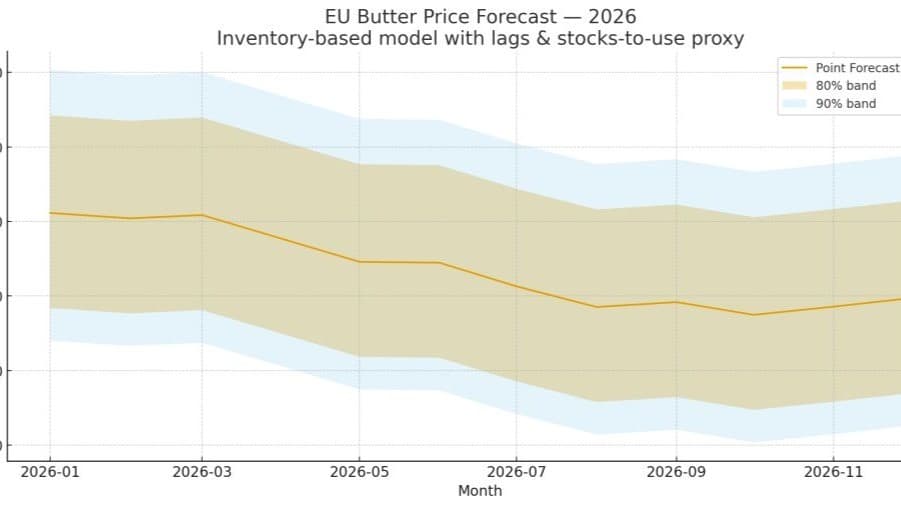
Summer Shopping or Summer Sale?
Last week was again a bit of a bearish week for the entire dairy industry. With cream prices under pressure and milk intake still strong, we keep seeing a market that has more supply than demand. Butter prices took another step lower, cheese prices cracked, and the powder market gave back a bit of its gains again.
The weekly report
Get it before it is anywhere else
Every market report, straight to your inbox the moment it is written. Butter, cheese, powder, liquids — pick what you actually trade.
Roughly weekly · Free · Unsubscribe any time