Tarriffic or Tarrifying: Trump’s Tariffs War, Round Two

As the dairy market tries to find its footing in a summer of weak prices and shaky sentiment, Trump’s latest hints at reintroducing tariffs — this time with more bite — are once again stirring up old ghosts in global trade. Despite multiple rounds of talks, few new trade deals have actually been signed. And now, the Trump camp is turning up the heat. This week, the administration is expected to send formal letters to trading partners deemed too slow or unwilling to strike fresh agreements, warning of tariffs that could run as high as 70%. The EU, notably, still hasn’t sealed a deal. Talks are reportedly set to continue this weekend, but time and patience are running thin.
How the ongoing trade negotiations between the EU and the US will ultimately affect the European dairy market remains difficult to pinpoint. What is clear, however, is that the stakes are high. The US is one of the EU’s largest dairy trade partners, and any move toward higher import tariffs would hit all categories — from powders to cheese and fats. But the ripple effects go beyond just transatlantic trade.
Should the US also escalate tensions with Asian partners, displaced buyers might pivot back toward Europe — potentially shifting demand in unexpected ways. Still, the current cocktail of uncertainty, currency volatility, and lack of clear policy direction is doing little to support confidence among EU exporters. Take the EUR/USD exchange rate: just six months ago, it hovered around 1.02. This week, it looks set to open near 1.18. One SMP exporter illustrated the pain clearly — a $2,700 CIF deal yielded €2,650 in January; today, it brings in under €2,300. And if the euro strengthens toward 1.25, as some predict, EU exporters could be priced out of even more global deals.
We attempted to assess how these factors — tariffs and currency — impacted trade flows in the first half of 2025. Unfortunately, EU data remains patchy and delayed, with most only up to March. Some countries report slightly more recent figures, but analysing export trends today feels like driving while looking in a very tiny rearview mirror.
From what we can see, Mozzarella and SMP exports still showed YoY growth in Q1. Butter and Gouda, on the other hand, were already slipping. Digging deeper, Irish butter exports to the US — Ireland’s main non-EU dairy partner — appeared strong in the first four months with a little over 10% increase YoY. That matches feedback from Irish producers, who claim their exports remain unaffected. However, US import data tells a different story: Irish butter imports fell 25% YoY through May, and 10% in April alone. This supports rumours of Irish volumes sitting in US ports, waiting for more favourable tariff conditions. Interestingly, demand for grass-fed butter in the US seems healthy, with imports from New Zealand up 34%.
Cheese exports from the EU have also taken a hit — especially in Japan. Dutch volumes dropped 45%, Germany 29%, Denmark 20%, and Ireland 35%. While South Korea has increased EU cheese imports slightly, it does little to offset the sharp decline in Japan, where NZ and Australian suppliers are clearly gaining ground.
Perhaps most worrying is the trend in the data itself: the older the numbers, the better they look. The closer we get to real time, the more negative the picture becomes. This aligns with what our export-focused partners have been telling us for weeks — business is slowing down. More complete data is expected post-summer, but early signs already confirm the mood: global dairy demand is under pressure.
And now, with sentiment weakening further, the prospect of new US tariffs and a declining dollar only adds fuel to the fire. For EU dairy producers, the road ahead looks increasingly uphill — and optimism is in short supply.
Butter: How Short Supplied Are We?
Talk about short supply — the butter market entered 2025 on the back of its tightest Q4 in years. EU stocks hit historical lows in late 2024, pushing prices to all-time highs. Driven by strong exports and domestic demand, Q4 supply was squeezed to a point rarely seen before. Fast-forward to April 2025, and data suggests that rebuilding has begun. Yet even with a solid pace of recovery, current stock levels remain the second lowest on record.
Butter bulls argue that the current situation is anything but relaxed — and they're not entirely wrong. Forecasts by StoneX suggest we could enter September with around 25,000 mt more in stock than last year. But context is everything: that would still be 40,000 mt below 2023 levels. So depending on your reference point, we’re either up 25,000 mt or down 40,000. Welcome to butter market relativity.
Looking back at late 2024 helps explain just how tight things got. The EU faced a major bluetongue outbreak, yet maintained a competitive edge on global markets well into Q2 and early Q3. This translated into strong export volumes in Q4 — especially for Irish butter, which surged 50% to the US. Cheese prices climbed past €5,000, and high-protein whey fetched a premium, incentivizing plants to pull fat out of butter and into cheese.
This year, the dynamic will shift. We expect butter exports to drop significantly YoY due to our overpriced markets, weak USD and sluggish global demand. Milk availability is projected to expand versus 2024, not contract. And cheese prices? They're not exactly flexing — dragged down by weak exports and sluggish food service demand. The fat battle of 2024 doesn’t look likely to repeat in 2025.
So where do we really stand? Last year’s squeeze hit hardest from September to mid-November — and even then, factories stayed running and buyers got their product. The real pressure came from tight cream and raw milk availability, not only butter scarcity per se. This year, butter buyers may face less competition from cheese markets, and with payout prices still strong, EU farmers remain highly motivated to milk hard.
That said, the market tone last week has softened. Last week, butter prices dropped about €150/mt. While Thursday and Friday felt more supported, buyers didn’t chase the dip. We suspect high quotations are skewing sentiment, creating a disconnect between published levels and tradable reality. Because if you know someone buying at €7,470/mt (the average of the three quotations), we’ll happily ship them more butter than they can handle.
If cream prices continue to decline and quotations fall back to realistic levels — somewhere in the €7,250–7,300/mt range — we expect futures to ease further, dragging spot prices down with them. The market feels more relaxed than it did a year ago, but we still see the biggest bears out keeping an eye out for a butter rally. The buyers' panic might have passed, but the question remains: is this market really stocked… or just less short?
Cheese: Sellers Going Forward
The story unfolding in the butter market might be foreshadowing what’s next for cheese. Last year, cheese prices surged post-summer, largely pulled higher by tightness in the fat complex. Buyers realised that if they didn’t pay up, milk would simply flow to butter instead. But if that fat premium doesn’t return in Q4 this year, it’s hard to see cheese repeating last year’s trajectory. Add to that a weakening demand picture. Export volumes are under pressure, food service is underwhelming, and increased Cheddar availability from both the UK and Ireland is dragging prices down across the continent. In short, the market feels heavy.
Cheese partners across the board are saying the same thing: it’s just... bleh. Even those who report year-on-year sales growth admit margins are razor-thin. Recent weeks have seen slower offtake, growing buyer hesitation, and producers pushing to move volumes while customers ask for delays. In the short term, prices are slipping. July Gouda has dropped to €4,150/mt — with reports of lower trades. Edam is now sub-€4,100, and Mozzarella deals have been done just above €4,000, with buyers claiming to have bought even lower.
Further down the curve, things look slightly firmer. Full-year contracts for Gouda and Edam are being locked in between €4,200 and €4,250 DAP customers through December. Mozzarella is offered in a similar range, with sellers targeting €4,200 but buyers leaning toward €4,000.
Still, the link between butter and cheese remains tighter than many acknowledge. Every upward move in cheese prices over the last months has coincided with a rally in butter. And now that butter is sliding, cheese is following. Should butter drop below the €7,000/mt mark, we wouldn’t be surprised to see Mozzarella lose €4,000 — with Gouda and Edam not far behind.
In a market already grappling with weak sentiment, tighter trade dynamics and shaky currency outlooks, the last thing dairy needs is another tariff tantrum out of Washington. If US duties rise and global sentiment continues to sour, the chances of a late-year fat-driven recovery in cheese start to melt away.
Powders: Bullish or Bearish, just look at the USD
For those who made it this far in our update, congrats. As you’ve seen, there’s plenty to say about butter and cheese. But when it comes to powders, there’s frankly... not much to add. The SMP market has been stuck in a narrow USD range all year, and in euros, it’s simply creeping lower as the dollar weakens.
Want to know where SMP prices are headed? Ask your FX desk. A weaker USD could push EU SMP below €2,200/mt, while a rebound might lift it toward €2,400. Outside that range, we see limited appetite — or logic — for trade.
In the EU, fundamentals remain heavy. Peak milk is behind us, and more milk is finding its way into butter/SMP production. German data shows a 1.8% decline in milk supply so far this year — yet butter output is up 2.5%, and SMP up 1.4%. So much for milk scarcity.
Spot trading reflects the reality. While some partners report buying Codex-grade SMP at €2,200–2,250/mt, official quotations are still printed at €2,400 — a level increasingly detached from actual deals. If butter quotations are clearly off, SMP isn’t far behind.
Over the past days, we’ve brokered volumes ranging from €2,300 DAP for Irish Codex to €2,430 for Q4 choco-spec product. There’s still non-standardized UK material floating around at €2,350 DAP NL — but with buyer interest fading, it’s not moving fast.
In a market where sentiment is sliding, trade flows are uncertain, and the FX rate is writing the script, the powder complex is not offering much of a plot twist. At best, it's background noise — at worst, it’s stuck on repeat.
Final Thought
With tariffs looming, the dollar drifting, and demand disappointing, the European dairy market finds itself balancing on an increasingly narrow ledge. Butter may be better stocked than last year, but not by enough to feel truly comfortable. Cheese is drifting alongside it, weighed down by export fatigue and margin pressure. And powders? They’re just following the FX ticker.
The real story isn’t just about prices — it’s about confidence. And right now, that’s in shorter supply than butter in Q4 last year.
The second half of 2025 will likely be shaped not just by milk flows, but by the mood of the market: if politics harden, currencies weaken further, and trade data keeps confirming the softness we’re already feeling, then we might look back at July as the calm before the real storm.
Brace for volatility — it’s the only thing still showing up reliably.
More from the desk
Our Long View Before Our Long Break 
Our Long View Before Our Long Break
Last week the market found a bit of stability. After lower trades on cheese, the cheese market traded slowly up, although a real rally remains absent. Butter prices did dip a bit further, although at the start of this week we see some strength on the back end of the curve. And on powder, our bullish feeling just doesn't go away — and now we can find some confirmation in the market as well.
Dairy Carry Has a Shelf Life 
Dairy Carry Has a Shelf Life
Last week was bearish across the board — every product we broker leaned the wrong way. Powders lost more momentum, cheese slipped well below €3,000 for some products, and butter continues to impress with just how much keeps showing up. Supply, supply, supply.
Summer Shopping or Summer Sale? 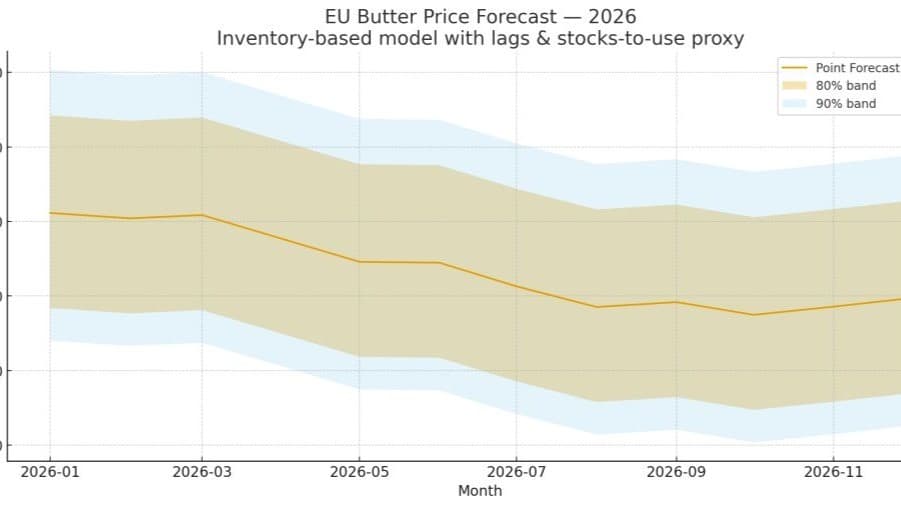
Summer Shopping or Summer Sale?
Last week was again a bit of a bearish week for the entire dairy industry. With cream prices under pressure and milk intake still strong, we keep seeing a market that has more supply than demand. Butter prices took another step lower, cheese prices cracked, and the powder market gave back a bit of its gains again.
The weekly report
Get it before it is anywhere else
Every market report, straight to your inbox the moment it is written. Butter, cheese, powder, liquids — pick what you actually trade.
Roughly weekly · Free · Unsubscribe any time