€ 3000/MT a Floor a Ceiling and a Bench?

Last week the dairy market lost more of the bullish momentum it had been building across all products throughout Q1. Cheese prices fell further, some claiming prices for gouda, edam and mozzarella below € 3500. Butter dipped well below €4,000 and SMP is struggling to hold above €2,600. And perhaps more telling than any of those numbers: the market no longer feels like it's listening to dairy fundamentals at all. Milk collection, grass conditions, milk price — the usual anchors — have been drowned out by something different. Oil and gas prices, other agro commodities, and almost hourly changing FX rates. International turbulence that has very little to do with what's happening on European farms, and very much to do with what's happening everywhere else.
Forecasting from here is, frankly, close to impossible. Too many external forces are in play. The 3–6 month view that many in this market prefer? We'd handle that with extreme caution right now. We've narrowed our own focus to the next 2–3 weeks — and even that timeline feels shaky. Nevertheless. We're going to try.
GDT Preview — Tuesday's Tender Sets the Tone
This shorter week, we expect bearish momentum to build. Tuesday's GDT will be the first real test, and we don't expect green numbers. All futures point to correction — the question is whether sentiment amplifies the move, or whether cautious buyers, still rattled by conditions well outside the dairy market, continue locking in more supply and paying higher prices than the fundamentals would justify.
Butter & AMF
Correction territory. Since the last GDT three weeks ago, NZX futures are down 5–10% depending on the period, EEX has shed roughly 7–8%, and CME is off 8–9%. We'd expect the GDT to follow the international trend — though we've been surprised before. A correction of 6–8% is our working forecast.
For EU Solarec prices, we'd put the range at €4,000–€4,100 average — down €500–€600 from the previous event. If EU butter ends below €4,000, the market is in for a heavy correction. That's the line to watch.
Powders
Futures are pointing down here too. The last GDT Pulse results were negative for both SMP and WMP, and EEX and CME SMP/NFDM have traded lower over the past week — though not as sharply as butter.
For SMP, the dynamic is more nuanced. This feels like a pullback or consolidation rather than a trend reversal — but we genuinely don't know if the bull run has reached its top or is simply on a plateau. Talking to traders in the powder market, the honest answer is: nobody is sure either.
The same structural arguments that have held all year still hold. Demand from Asia and MENA remains solid, even with disruptions tied to the Iran–US conflict. Internal EU demand is nothing to write home about, but the EU remains competitive on export markets. The US has little product to offer. New Zealand will likely be absent with large volumes from the market for several months. If export demand holds and supply stays short, prices can continue looking up. That case hasn't broken down — yet.
Cheese
Forecasting cheese on GDT remains difficult. On Cheddar, we'd lean lower — but it's more gut feel than conviction. On EU mozzarella, we're more confident: prices will correct. Three weeks ago the market held at €3,650. We'd expect this tender to clear somewhere between €3,400 and €3,500. Anything below that range should concern EU partners.
Overall
We expect the result to land somewhere between –3% and –5%. A negative tender, across the board.
EU Spot Market — Liquids
The next few weeks will answer a question the market has been asking since the flush began: is the EU dairy market heading into seriously deep trouble, or is a shift in the seasonal milk pattern going to keep volumes manageable?
Milk intake in western EU is running in some countries 5–7% above year-ago levels, and spot prices — even before the traditional peak of the flush — are already at unsustainably low levels. (raw milk below 10ct, cream below € 4000 and smc up until last week below € 1000) That's the baseline. What happens next depends entirely on which of two scenarios plays out.
The first: the week-on-week declines we saw in German and French milk numbers over last week are a genuine signal that the flush peaked 4–8 weeks earlier than usual. If true, that would be a welcome gift for processors. Even in this scenario, YoY volumes are likely to remain elevated through the end of Q2, and we would expect positive over the whole of 2026 — but at least they'd be more manageable. Processors can work around last week's levels as a top. They can't plan around record-breaking numbers over each of the next weeks.
The second scenario is less comfortable. The WoW decline is simply the effect of cows moving outside — a temporary dip — and milk volumes will continue rising over the next 4–8 weeks, setting new records for intake during the flush. If that's what's coming, expect free milk collection in April and May, and cream and skim prices trading well below commodity valuation.
We're already seeing early signs of what that pressure looks like in the UK. Speaking to partners in the UK, cream levels traded last week again lower, almost reaching € 3000,-. Raw milk prices some claim below 5ct. In the UK, at least one processor has begun paying just one penny per litre for all milk delivered above 102% of last year's intake. If EU intake doesn't roll over in the coming weeks, something similar could follow in western Europe.
Which brings us to cream — and a conversation we've been having with a number of partners. Last week we published our analysis suggesting cream prices typically fall after Easter. Several partners pushed back: cream actually traded slightly higher last week. We saw the same. It's a small data point, but an interesting one. If 2026 breaks with eight years of post-Easter cream weakness, it would be a meaningful signal — not just a quirk. It would suggest we're in scenario one: the flush has already peaked, the milk pattern is shifting, and the market is beginning to price that in.
We're watching cream prices closely this week. They may tell us more than the GDT does.
Here's the rewritten Q1 review and Q2 outlook section:
Q1 2026 in Review — And What Q2 Looks Like From Here
We took a look back at our first quarter, and the numbers surprised even us. Q1 2026 was our strongest quarter on record. Over 38,000 MT of product changed hands via our books — more than 25,000 MT of butter and over 12,500 MT of powders brokered through GFD. We're proud of that. But we'll be honest: those volumes don't just reflect hard work. They reflect a market that gave everyone something to do.
Cast your mind back to Q1 last year. Volumes were significantly lower — not because the market was quiet in a pleasant way, but because there was simply nothing to trade around. Butter sat stubbornly above €7,000 for almost the entire quarter. Powders didn't move. In a market with no price discovery, there's no opportunity — for our partners or for us.
This year was the opposite. Butter moved from €3,800 to €5,000 and back to €3,800. Powders ran from €1,900 to €2,800. That kind of range doesn't just create headlines — it creates opportunity. And opportunity creates volume.
Q2 — Slower, But Not Silent
We expect Q2 to be a different story. Markets that fall don't always trade heavily on the way down. On butter, we expect prices to drift lower — but the activity around it to slow. Speculative interest will be minimal. What we'll see instead is pressured selling from producers, and that tends to trickle rather than flood. Forced selling — the kind that really moves volume — typically arrives at the peak of the stock build. By our reckoning, that's still roughly three months away. Until then, producers will follow the market down slowly, as they always do. Buyers who are already well covered won't chase prices up. The ball is in the court of the producers. Our Q2 price forecast for butter points to a low in the €3,000–€4,000 range — but don't expect the market to get there quickly or dramatically.
Powders are a different picture. We expect activity through our books to remain strong. The EU will be the seller of choice for international markets, and despite the skepticism we hear from many partners about upside potential, we still believe EU SMP prices will cross €3,000. The path won't be straight — with relatively low stocks, price moves tend to come in shocks rather than trends. But the direction, we think, remains up.
Cheese — let's put it simply. €3,000 is the number that connects all three markets right now. Butter will test it as a floor. Powders will test it as a ceiling. Cheese will use it as a bench. With more cheese production coming online in Q2, and fat losing value relative to protein, expect more milk to flow toward cheese rather than butter. Unless international demand pulls the market clean again, we expect EU cheese prices to test December's lows. A move well below €3,000 seems unlikely — but the market will get close enough to make people uncomfortable.
A Final (Personal) Note
Markets like this one have a habit of humbling the confident and rewarding the patient. Q1 2026 was a quarter that moved fast and punished those who stood still — in either direction. Butter lost nearly half its value from peak to trough within a two quarters. Powders ran 50% higher from their lows. Cheese quietly ran higher and higher. And through all of it, the usual rulebook — fundamentals, seasonality, supply and demand — felt less reliable than it has in years.
What replaced it? Sentiment. Macro noise. Futures markets pricing in fears that have nothing to do with a cow in a field in Friesland or a processing tank in Germany. The dairy market has always been influenced by forces beyond its own borders. But rarely has the ratio felt this skewed.
That's not complaining or giving excuses why our market forecast was something (very) of. It's an observation. And it comes with a practical consequence: the tools we've historically used to forecast this market are less precise than they used to be. Not broken — but blunter. A 3–6 month view right now deserves a very wide confidence interval. Even a 2–3 week view requires humility. These are not easy markets to navigate, not for traders, not for producers, not for end user, and not for brokers.
And yet — 38,000 MT. We keep coming back to that number.
Not because it makes us look good, though we won't pretend we're not proud of it. But because of what it represents. A quarter like Q1 2026 doesn't happen without trust. Without partners who pick up the phone, share their position, and move when we bring them something worth moving on. Every tonne that passed through our books did so because someone on the other side believed we were bringing them a fair deal. That's not something we take lightly.
We started GFD with a simple idea: that brokerage should feel less like a transaction and more like a partnership. Markets like this one test that idea thoroughly. We came out the other side with our strongest quarter ever — not in spite of the chaos, but partly because of it. Because in uncertain markets, people want to work with someone they trust.
Q2 will be quieter. Probably harder. The easy volume slows down, and what's left will require more patience, more precision, and more honest conversations.
What we do know is this: milk is coming. Stocks are building. The flush is either already peaking or about to accelerate — and the next few weeks will tell us which. The GDT on Tuesday will set a tone. Cream prices will tell a story. And somewhere in between, the market will give us its next signal.
We'll be watching. And we'll be ready to pick up the phone when you give us a call.
GFD — Get Fair Dairy Good trading. 🤝
More from the desk
Our Long View Before Our Long Break 
Our Long View Before Our Long Break
Last week the market found a bit of stability. After lower trades on cheese, the cheese market traded slowly up, although a real rally remains absent. Butter prices did dip a bit further, although at the start of this week we see some strength on the back end of the curve. And on powder, our bullish feeling just doesn't go away — and now we can find some confirmation in the market as well.
Dairy Carry Has a Shelf Life 
Dairy Carry Has a Shelf Life
Last week was bearish across the board — every product we broker leaned the wrong way. Powders lost more momentum, cheese slipped well below €3,000 for some products, and butter continues to impress with just how much keeps showing up. Supply, supply, supply.
Summer Shopping or Summer Sale? 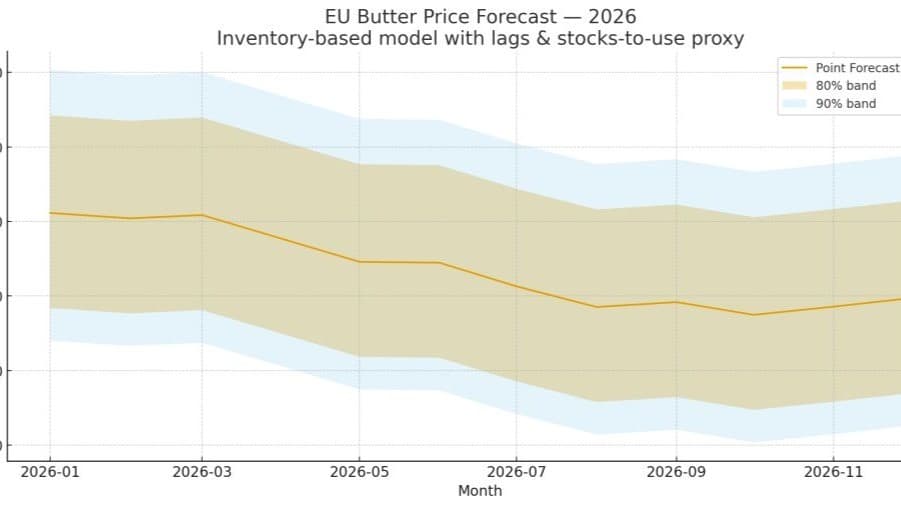
Summer Shopping or Summer Sale?
Last week was again a bit of a bearish week for the entire dairy industry. With cream prices under pressure and milk intake still strong, we keep seeing a market that has more supply than demand. Butter prices took another step lower, cheese prices cracked, and the powder market gave back a bit of its gains again.
The weekly report
Get it before it is anywhere else
Every market report, straight to your inbox the moment it is written. Butter, cheese, powder, liquids — pick what you actually trade.
Roughly weekly · Free · Unsubscribe any time