
Don’t Flex Your Muscles. Flex Your Book.

This week, the market's activity came quietly. With yesterdays GDT looming, most partners preferred to wait — and who could blame them. The market held its breath. The tender delivered. Down across most products, and largely in line with what we forecasted. Solarec's butter held slightly better than expected — a minor comfort. Its mozzarella, however, underperformed. So it balances out.
Meanwhile, confirmation is emerging that France has already seen its seasonal milk peak. After two weeks of week on week declining milk volumes, the upward trend is clearly broken. That's not a small detail. It opens up a genuine conversation about where milk flow goes from here — and whether the worst of the flush pressure is already behind us.
Bring it all together and the picture is this: the market is far from bullish. But the bulls haven't been slaughtered yet. There's still a thread of hope running through the trading floor. We've always believed hope belongs in church — not in a commodity market. But it seems not everyone has received that memo. And in a market this uncertain, perhaps that's not entirely a bad thing.
GDT Results — In Line with Expectations , But Not Reassuring
AMF down 7.1%. Butter down 8.1%. The tender followed the international trend set by EEX and CME on fat — no surprises there. But we'll say it plainly: we still believe NZ butter is significantly overvalued relative to where European and US butter is trading. With neither region showing meaningful upward potential, the –8.1% feels less like a correction and more like the opening move of a longer slide.
On Solarec's butter specifically — we had forecast levels around €4,100. The tender cleared between €4,140 and €4,170, so slightly better than we expected. Kerry's butter also appeared on the tender, but with a starting price above where Solarec finished, it received no bids. In our view, Irish lactic butter is worth around €3,850 at best right now. The market agreed — by saying nothing at all.
Cheese
Cheddar dropped just over 3%. Mozzarella came down more than 6%. With the collection period well into Q3, that's a strong signal: the market sees little upward momentum for mozzarella over the coming months. Should Gouda and Edam producers be concerned? We think so. The GDT tender is typically a reliable benchmark for broader EU cheese sentiment, and this week's message was not a comfortable one. Buyers who were already hesitant will find confidence in waiting. The question is whether sellers will find equal confidence — perhaps taking comfort in the early French milk peak — to hold their ground as well.
Powders
The correction could have been sharper. SMP down just 1.6%, WMP down 0.7% — we were braced for something more severe. But those watching EU product will find a more bearish story underneath. Solarec's SMP prices cleared just above €2,700, and Arla didn't break that level. We've seen trades closer to €2,800 — and above — in recent weeks. Why powders are losing momentum is, frankly, something of a riddle to us. The EU should still be the cheapest source on the world market. We wouldn't bet against the current trend, but shorting EU powder prices feels dangerous. Once international shipments begin pulling on EU supply again, prices could recover quickly. Patience here is not the same as bearishness.
Overall: –3.7%
That lands squarely within our forecast of –3% to –5%. A clean result, in that sense. But the signal it sends is not clean at all. The world market is cooling. For butter, that's a bearish signal — the EU genuinely needs exports to balance its books, and a tender with zero interest in Irish lactic butter is not the kind of demand signal the market needed. For cheese producers, the message is equally direct. And for those still hoping the powder bull run has legs — the jury is still out, but the courtroom is getting quieter.
Peaking Early in France — Signal or Noise?
This morning several partners sent us the latest French milk collection data. The trend is clear: down over the last two weeks WoW. As we mentioned yesterday, an early seasonal peak would take meaningful pressure off producers — and off the market more broadly.
But let's be precise about what this data does and doesn't tell us.
It's France. One country. And even within that comfort, the numbers deserve a closer look. Week 13 milk volumes are still running 3% above last year. Still above the strongest collection week recorded in previous years. To call this bullish would require a very generous interpretation of the word. The bears in the market — and there are plenty — have been quick to point that out, with some amusement at producers trying to spin the data in their favour.
What the French data does tell us is something more fundamental: relying on historical milk trends to forecast the current season makes little sense. The peak may come earlier. But the shoulders could be broader. A earlier top doesn't necessarily mean a shorter flush — it may simply mean the pressure is distributed differently across the calendar.
And then there's the question nobody has a clean answer to: the second milk peak. Last year Q3 brought a second wave that had a meaningful impact on commodity prices. How confident are we that 2026 will follow the same pattern? And if it does — will it carry the same weight?
We're watching Germany closely. How its milk curve develops over the coming weeks, and how it diverges from prior years, will tell us more than any single data point from France. One thing is certain: forecasting prices is hard enough for brokers and traders. Forecasting production is next to impossible — even for the cooperatives living it in real time. A 2–3% swing in milk volumes makes a world of difference to commodity markets, and right now nobody has that number pinned down.
Spot liquid traders will be kept busy over the coming weeks. They thought last year's flush taught them everything they needed to know. We suspect 2026 has a few new lessons lined up.
A Final Note — Build for Whatever Comes Next
Nobody knows what this market is going to do. We've said it this week, we've said it last week, and we'll probably say it again next Sunday. The variables are too many, the external forces too unpredictable, and the historical playbook too unreliable to lean on with any real conviction.
So what do you do with that?
You stop trying to be right. And you start trying to be ready.
The traders who will navigate this market best over the coming weeks and months are not the ones with the sharpest price forecast. They're the ones with the most flexible book. Covered on multiple periods. Spread across origins. Not overexposed to a single scenario playing out — because right now, any scenario can play out.
Think in threes. What happens to your position if butter drops to €3,000? What happens if it holds at €4,000 longer than expected? What happens if the French milk peak turns out to be a genuine turning point — and what happens if Germany tells a completely different story next week? A book that can absorb all three of those outcomes without forcing a panic decision is worth more right now than any single well-timed trade.
Spreading risk is not the same as giving up upside. It's buying yourself the ability to stay in the game long enough to be right — eventually. In a market this volatile, the players who survive the next three months intact will be the ones with options. Options to buy when others are forced to sell. Options to wait when others are forced to act.
This is exactly where we hope to come in. Not to tell you what the market will do — we've been honest enough about the limits of that. But to think with you. To stress-test your book. To find the trades that give you flexibility rather than lock you in. To keep you agile when the market is doing everything it can to make you rigid.
Difficult? Absolutely. Impossible? Not even close.
Flex your book. We'll flex our brains alongside you.
GFD — Get Fair Dairy Good trading. 🤝
More from the desk
Our Long View Before Our Long Break 
Our Long View Before Our Long Break
Last week the market found a bit of stability. After lower trades on cheese, the cheese market traded slowly up, although a real rally remains absent. Butter prices did dip a bit further, although at the start of this week we see some strength on the back end of the curve. And on powder, our bullish feeling just doesn't go away — and now we can find some confirmation in the market as well.
Dairy Carry Has a Shelf Life 
Dairy Carry Has a Shelf Life
Last week was bearish across the board — every product we broker leaned the wrong way. Powders lost more momentum, cheese slipped well below €3,000 for some products, and butter continues to impress with just how much keeps showing up. Supply, supply, supply.
Summer Shopping or Summer Sale? 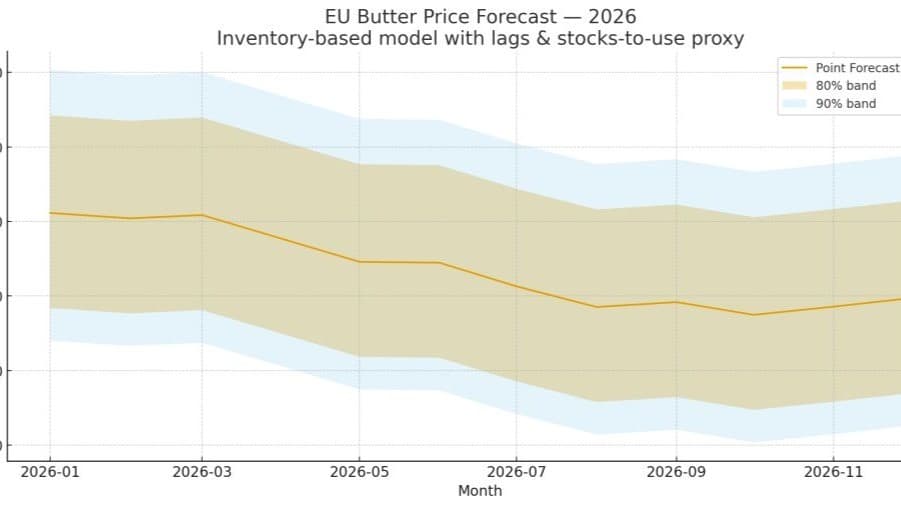
Summer Shopping or Summer Sale?
Last week was again a bit of a bearish week for the entire dairy industry. With cream prices under pressure and milk intake still strong, we keep seeing a market that has more supply than demand. Butter prices took another step lower, cheese prices cracked, and the powder market gave back a bit of its gains again.
The weekly report
Get it before it is anywhere else
Every market report, straight to your inbox the moment it is written. Butter, cheese, powder, liquids — pick what you actually trade.
Roughly weekly · Free · Unsubscribe any time