
Hedged and Stuck — Futures Without a Future

Last week was one of the quietest of the year. With just 1,230 MT changing hands via our books, activity dropped off significantly compared to the first 14 weeks of 2026. Both on powder and on butter, our partners seem to be lacking confidence and conviction — and with that, the urgency to trade. The market is throwing around uncertainty. Export markets volatile, exchange rates fluctuating, and talk of structural demand shifts from fat to protein — without a single hard number to back up the potential impact. To manage that uncertainty and keep trading, futures markets exist precisely to manage risk. Although lately, the divergence between physical market prices and futures prices has turned that risk management tool into a risk of its own. Today, we look at how futures are throwing sand in the eyes of our partners — and how that is driving volatility rather than dampening it.
As many of you know, we used to be traders ourselves. Admittedly not the best in the business, but we understood the basics of trading, hedging and managing risk. I still remember the first courses I took in Cork with the StoneX team — and that one quote (combined with an iconic drawing of four squares) that started my whole dairy risk management journey: "You buy futures, you sell your physical." The fundamentals of hedging margin were relatively straightforward at that point. We were taught the principles of basis risk and how certain origins of butter trade at a premium or discount versus the EEX averages. It's that basis that has changed in the 10 years since I took that course. For powders, that disconnect remains relatively contained. That is why today's update focuses exclusively on the divergence between physical butter prices and futures prices — what it means for market liquidity, price visibility, and what needs to change.
Growing Disconnect
Hedging butter has never been an exact science. Even when we started trading a decade ago, we remember the frustration of EU quotations — used to settle futures contracts — not always responding to market moves as fast as the physical market did. But within a healthy timeframe, quotations would fall back in line, offering a reasonably fair reflection of where physical prices actually were.
Now, we are aware that we could simply have lost our feel for the physical market. But the data we have generated over the years tells a different story — and we think it tells a credible one. We put together a chart comparing our own brokered prices — filtered on contracts with a 60-day forward collection date on NL, DE and BE origins — against the average official quotations of the Netherlands, Germany and France, which together form the EEX average. You can access the full dataset via the link below.

The first thing that stands out is that every time the market moves sharply, there is a meaningful lag in quotation response — creating a large gaps up to € 600,- between physical and futures. That is not unusual in itself. Physical markets trade multiple times per week, producing multiple data points, while official quotations move only once. In a rising market, that lag is manageable and quotations tend to catch up relatively quickly.
What is more revealing is what happens once price moves cool down a bit. Even at peak prices between September 2024 and June 2025, settlement prices were consistently coming in at a premium versus our physical trades; that's not a lag, that's a disconnect. And once the market began to turn, that disconnect accelerated again. In several months, our brokered physical prices came in more than €600/MT below settlement levels. That is not a basis risk the market can work with. That is a structural divergence.
The most recent example cuts the other way. During the short squeeze in February 2026, physical butter moved sharply higher well before quotations followed — confirming that the gap works in both directions, and that futures are increasingly a lagging indicator rather than a leading one. If historians will look back at Feruary 2026 butter prices they might think there was no real short squeeze, while our week-to-week data shows a € 1000,- rally.
Via this link you can study the dataset yourself.
Hedged and Stuck
The data above illustrates the disconnect between physical spot trades and EEX settlement prices — and we can already hear the critics: who lets their hedges settle in the delivery month itself? You trade out before settlement. Every financial broker will agree with you as they are happy to trade you in and out of your hedge. But not every buyer of futures is a trader.
End users locking in index-linked contracts will, in many cases, simply let their futures run to settlement. And while we believe a meaningful share of end users do trade in and out of their positions, a significant group does not — and that distinction matters more than it used to. Because where traders use to be the liquidity on both the buy and sell side, now the buy side has grown a lot bigger with end users, while the sales side hasn't grown as fast.
In our view, this is creating a structural imbalance between buyers and sellers on the financial market. The most active participants are traders, who are typically on the sell side of futures when an end user wants to lock in a hedge — usually backed by a physical purchase they will eventually need to trade out of, adding liquidity to the buy side in the financial market, and liquidity on the sales side in the physical market. But that end user who bought futures rarely becomes a financial seller. The natural counterpart — a producer willing to lock in a forward milk price for its farmers — is increasingly present, and cooperatives are clearly beginning to use futures more actively. But the liquidity that side provides drops off sharply once milk prices fall below €0.50/kg. The forward curve is therefore dominated by buyers: end users locking in index-linked or outright contracts, and traders looking to exit earlier hedges.
In recent months, traders were selling futures forward at premiums of €200 to sometimes €250 above their physical purchase price. That basis has now compressed to a point where trading out no longer makes economic sense. Looking at the current forward market, Q3 futures are trading at €4,525 while physical butter is being offered €300 lower — without finding a buyer.
Sellers of physical butter who need to buy back futures have two options: sit it out, only moving their physical product as the settlement month approaches and hoping quotations realign with physical reality — or accept the loss and trade out now. Neither is comfortable. And for April, there is little light to find either way. The average quotation still sits around €4,225, with limited expectation for a meaningful move lower. Meanwhile, physical butter is trading somewhere between €3,800 and €3,900 — widening the gap to as much as €400 and leaving sellers caught between a futures market that won't move and a physical market that already has.
Price Discovery or Trend Discovery?
For us, the futures market has always been a way of gauging where prices could move over the coming months. Never a crystal ball — but for us, and for many others, a reliable enough compass to indicate where physical product should roughly trade toward. For SMP, we still believe that holds true. And with the cheese index launched by EEX, cheese futures are beginning to offer something similar. Liquidity remains too thin to use with real confidence, but the midpoint between bid and ask is broadly consistent with where the physical market trades. That is a start.
The fact that EEX butter futures are trading so far from physical market reality is telling — and in our view, the market needs to move to a new settlement mechanism as soon as possible. But even with a new settlement in place, the overall market structure needs to mature considerably before dairy has a genuinely robust financial instrument for risk management.
Both EEX and Vesper have launched initiatives worth watching, and they will compete to become the dominant pricing reference in the dairy market. We hope one of them gets there quickly — because the current butter quotation structure offers very little in the way of real price discovery for producers, end users and traders alike.
What it does offer, at best, is trend discovery. A signal of shifting sentiment rather than a reliable anchor for price. And navigating the current structure as a risk management tool requires a level of expertise that most market participants — understandably — do not have.
Where Do We Go From Here?
Forecasting this market remains as difficult as ever — and anyone who tells you otherwise is selling something.
Butter is clearly on a downward path. The direction is not the debate; the depth is. Many of our partners remain uncertain about how far prices can fall, and we understand the hesitation. But when you look at the volume of butter being offered across the next four months against what is actually being bid, the supply picture tells a clear story. It is one we have been telling for months now. The path towards €3,000 remains very much open — and nothing we see in the physical market today is closing it.
We spent much of today's update explaining why futures are making that journey harder to navigate than it needs to be. Sellers/producers of physical butter are caught between a futures market priced €300–400 above where physical trades, and a quotation mechanism that refuses to catch down fast enough. That is not basis risk. That is a structural problem — and until settlement methodology changes, or until one of the competing initiatives from EEX or Vesper establishes itself as the market's true pricing reference, butter sellers will continue navigating with one eye blind.
SMP is a different animal entirely — and if we are honest, it tears us apart every week. EU fundamentals scream oversupply by every metric we look at. And yet the NFDM rally on CME continues to push towards levels that feel entirely disconnected from physical reality. It has to end. Right? Right?
The thing is, we are increasingly convinced that the structural shift from fat to protein is real. And unless Kim Kardashian starts rubbing butter on her behind at considerable speed, that trend is not reversing. With the EU sitting as the cheapest source of SMP globally — despite being heavily supplied domestically — there should be only one direction for powder prices to move. And that direction leads towards the same magical €3,000 marker, reached by a very different road than butter, but arriving at the same destination.
Cheese we will admit freely — we remain largely clueless. But if butter softens further and SMP firms on the back of global protein demand, all we can hope for is that dairy sentiment keeps cheese steady. Flat and quiet around €3,400–3,500 across all known types would be a perfectly acceptable outcome for a market that has had quite enough excitement already.
Bring it all together, and the picture is one of a market still looking for a floor it has not found yet. The disconnect between futures and physical is not helping anyone find it. As we wrote today — price discovery has quietly become trend discovery, and trend discovery in a falling market is a lonely business. Sellers are hedged and stuck. Buyers are cautious and patient. And the quotations are, as ever, running fashionably late.
We keep trading. We keep watching. And as always — the truth will be in the physical.
GFD, Good Trading 🤝
More from the desk
Our Long View Before Our Long Break 
Our Long View Before Our Long Break
Last week the market found a bit of stability. After lower trades on cheese, the cheese market traded slowly up, although a real rally remains absent. Butter prices did dip a bit further, although at the start of this week we see some strength on the back end of the curve. And on powder, our bullish feeling just doesn't go away — and now we can find some confirmation in the market as well.
Dairy Carry Has a Shelf Life 
Dairy Carry Has a Shelf Life
Last week was bearish across the board — every product we broker leaned the wrong way. Powders lost more momentum, cheese slipped well below €3,000 for some products, and butter continues to impress with just how much keeps showing up. Supply, supply, supply.
Summer Shopping or Summer Sale? 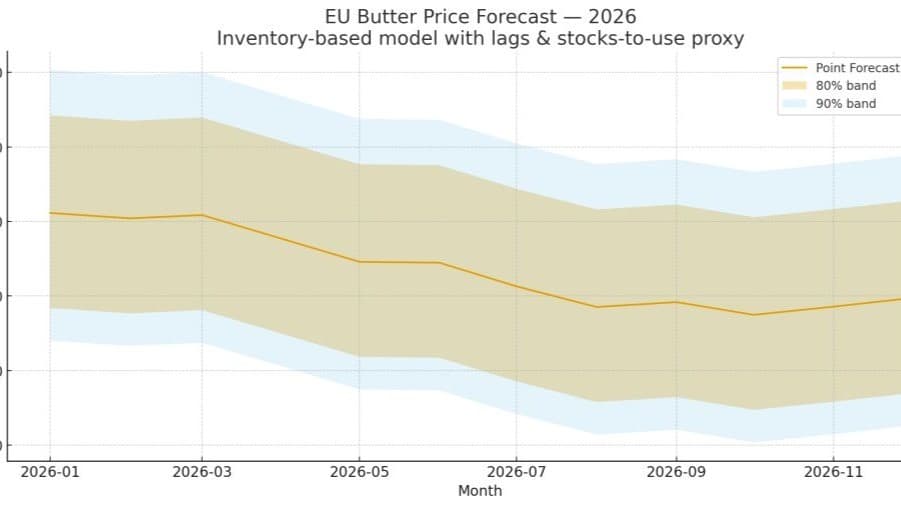
Summer Shopping or Summer Sale?
Last week was again a bit of a bearish week for the entire dairy industry. With cream prices under pressure and milk intake still strong, we keep seeing a market that has more supply than demand. Butter prices took another step lower, cheese prices cracked, and the powder market gave back a bit of its gains again.
The weekly report
Get it before it is anywhere else
Every market report, straight to your inbox the moment it is written. Butter, cheese, powder, liquids — pick what you actually trade.
Roughly weekly · Free · Unsubscribe any time