
Dairy Complex Heavy as Q4 Optimism Fades

Yesterday was an active day in the dairy market. Butter prices continue to slide lower, while the GDT result came in largely in line with our forecast. Cheese sellers seem to be stepping back into the market, with more offers on Gouda, Edam, and Mozzarella appearing. Overall, the market feels heavy across almost all products, and hopes for a Q4 bounce are becoming slimmer.
First of all, apologies for yesterday’s update — it contained incomplete information. We thank our partners for reaching out. The export data we used for butter appeared to be incomplete, and we regret the error. Although data remains somewhat contradictory, it now seems that butter export data for June is stronger than we reported. We usually rely on two main sources: one indicating a 7% increase in butter export volumes, and another reporting a 7% decrease. Cross-checking alternative sources did not provide a clear resolution.
That said, even the most optimistic figures for EU fat exports show a 4.9% decrease YTD for butter and a 17.4% decrease for AMF, bringing the total export loss for butterfat from the EU28 countries to 7,000 mt. Adding to this, butterfat imports YTD increased by 22,000 mt (AMF +9,000 mt and butter +13,000 mt compared to 2024). In total, this brings us to an approximate 30,000 mt YTD increase of butterfat into the EU. Most of the imported butter and AMF originate from New Zealand and Ukraine, with US volumes still relatively small. However, based on the volumes we have brokered for some partners, we expect US numbers to rise in the second half of the year.
GDT: Small Decline
As expected, the GDT remained largely stable on AMF pricing and posted a minor decline in butter. A 1% decrease in butter is not headline material. In the EU, Solarec’s bidding prices traded just above and slightly below the €6,850 level we anticipated. Mozzarella also moved down, though the scale of the drop was sharper than expected. With prices now averaging just over €3,800 (with Arla even lower), the message is clear: cheese is not going to sustain fat prices. Cheddar also recorded a modest decline.
More surprising was the negative result on SMP. Particularly New Zealand SMP, now in line with EU pricing, looks cheap, and we had expected stronger results. WMP prices were stable, as anticipated. In summary, the small overall decline was expected, with no major surprises. If milk collections continue to rise year-on-year in New Zealand, the next event could deliver more fireworks — but likely for the bears.
Butter: Deeper Corrections Emerging
Butter remains under pressure. Q4 futures traded at €6,800, while Q1 futures fell to €6,675. Physical markets mirrored this trend: NL/DE/BE traded at €6,775 for September, while Q1 parcels slipped to €6,650 after earlier trading at €6,700. Polish Sweet Cream Butter held relatively firm at €6,825–€6,850, supported by expensive Eastern EU cream and tight fresh production.
We do not believe that slightly lower Polish butter output will lift the market. Polish production is up 3.5% YTD, and a temporary slowdown in September–November will not change the broader picture. We expect production to remain higher year-on-year, given that last year Polish cream economics only justified butter production above €8,000 - € 9000, keeping volumes exceptionally low. This year we dont expect cream to trade at these premiums vs. butter.
Meanwhile, more offers are emerging from German producers, with Danish and even Irish suppliers now lowering offers below €6,900 after holding them higher in recent months. Even they cannot ignore the bearish signals from global futures and the GDT.
The biggest downward pressure continues to come from buyers. Yesterday again saw end users delaying and postponing August and September collections into Q4. The volumes we hear are not insignificant and vary from a few loads to a couple of hundred mt. This is creating short-term pressure and pushing open Q4 demand further toward the back end of the year.
Butter Offers and Bids
Offers:
- 6 loads Irish butter, Aug/Sept, FCA Ireland, €6,750
- 6 loads Polish Sweet Cream, Sept, €6,850
- 6 loads NL/DE/BE, Sept, €6,800
- 6 loads NL/DE/BE, Q4, €6,800
- 6 loads NL/DE/BE, Q1, €6,700
- 6 loads Irish butter, Dec/Jan, €6,700
- 6 loads Polish Sweet Cream, Q1, €6,700
Bids:
- 6 loads Irish butter, Sept, FCA Ireland, €6,650
- 6 loads Polish Sweet Cream, Sept, €6,775
- 6 loads NL/DE/BE, Sept, €6,700
- 6 loads NL/DE/BE, Q4, €6,700
- 6 loads NL/DE/BE, Q1, €6,600
- 6 loads Irish butter, Dec/Jan, €6,600
- 6 loads Polish Sweet Cream, Q1, €6,400
Cheese: Buyers Seeking Discounts
The cheese market is not yet as crowded as butter, with several regular counterparts still on holiday. Sellers active in the market are looking for buyers willing to pay a premium, but buyers are making it clear they will only engage if prices drop significantly.
Bid/Ask today:
- 2 trucks Mozzarella (NL/BE/DE), DAP NL at €3,700 (vs. €3,950 offer)
- 3 trucks Gouda (NL/BE), DAP NL at €3,800 (vs. €3,950 offer)
Powders: Partners Paralysed
We joked with one partner that in SMP you only need to work within a very narrow spread: forget prices below €2,250 and do not expect prices above €2,500. As long as you calculate within this €250 band, you are safe. Yesterday’s GDT confirmed global alignment, with weak demand keeping prices sluggish. Perhaps our hope for more activity made us more bullish than we should have been, but fundamentally, this market warranted stronger support.
Partners remain paralysed: selling below current market levels has not paid off in recent months, while going long at these prices also seems unnecessary. Paying a premium for further-out positions is off the table for most, flattening the curve as milk collection prospects improve.
Offer today:
-
A few loads of FCMP, Belgium origin, €4,180
Final Thought
The market is entering a phase where sentiment appears increasingly decisive, with participants cautious to commit while structural pressures build. The coming weeks may well test whether current values are a floor or merely a pause in a deeper correction.
More from the desk
Our Long View Before Our Long Break 
Our Long View Before Our Long Break
Last week the market found a bit of stability. After lower trades on cheese, the cheese market traded slowly up, although a real rally remains absent. Butter prices did dip a bit further, although at the start of this week we see some strength on the back end of the curve. And on powder, our bullish feeling just doesn't go away — and now we can find some confirmation in the market as well.
Dairy Carry Has a Shelf Life 
Dairy Carry Has a Shelf Life
Last week was bearish across the board — every product we broker leaned the wrong way. Powders lost more momentum, cheese slipped well below €3,000 for some products, and butter continues to impress with just how much keeps showing up. Supply, supply, supply.
Summer Shopping or Summer Sale? 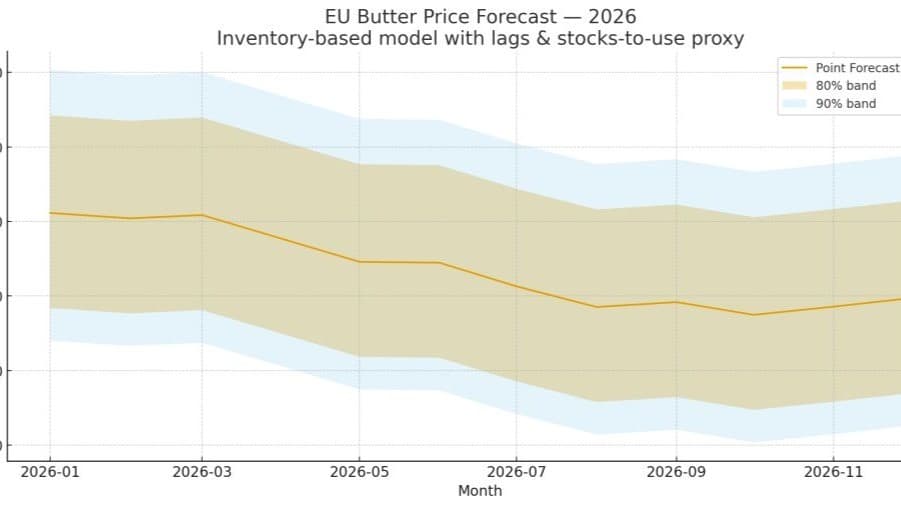
Summer Shopping or Summer Sale?
Last week was again a bit of a bearish week for the entire dairy industry. With cream prices under pressure and milk intake still strong, we keep seeing a market that has more supply than demand. Butter prices took another step lower, cheese prices cracked, and the powder market gave back a bit of its gains again.
The weekly report
Get it before it is anywhere else
Every market report, straight to your inbox the moment it is written. Butter, cheese, powder, liquids — pick what you actually trade.
Roughly weekly · Free · Unsubscribe any time