

Back with Bearish Data

After a four-week break we are back in the market. And while entertaining an 18-month-old girl and a six-year-old boy is a lot of fun, we are happy to return to discussing the markets with our partners. As expected, the market didn’t turn bullish during the summer. In fact, most of the new data increases the likelihood of a more bearish scenario. Milk collections in France and Germany have improved, cheeses are ageing and losing the €4,000 floor, and butter production data even outperforms our most optimistic forecasts. Even on the powder side, where we had expected more positive momentum, the market cannot shake the bears: the ONIL tender ended with disappointing results for many EU partners. Meanwhile, the US, NZ and South America are also showing strong milk production while demand remains sluggish. So, after our bearish summer greeting from four weeks ago, we welcome you back with a bearish outlook once again.
Although yesterday was more about catching up with regular partners, it was also important to reassess market sentiment. During our holiday we followed the market by looking at the data, but it is good to place those numbers in a physical trading context. After a rather quiet few weeks, the market seemed to wake up last week. With the ONIL tender in place, powders showed some upward momentum, but once results came in, most people were disappointed. SMP traded its 30,000mt for November–February deliveries between $2,900 and $3,000, while most EU partners had hoped to see at least part of the volume filled above $3,000 CFR. On the WMP side, the majority of the 40,000mt quantities came from NZ, with reported prices between $4,000 and $4,100 CFR.
Stronger Milk Production and Stable Milk Prices
Looking at liquids, those bullish in the market can at least point to some upward momentum there. Cream prices are still trading below €8,000, but signs of improvement are visible. The same can be said for SMC, although prices are still just below €2,000. Raw milk prices remain available well below 50ct, but also show a solid floor. Only in France—where production seems to be growing—are prices reported just a little over 40ct.
Milk production is clearly increasing almost everywhere. The latest YoY production number for France came in at its highest level in the last five years. Although exact numbers were debated, feedback ranged from +3.5% to +5.4%. In any case, production is clearly well above last year. Germany also shows stronger output: with a 2.2% YoY increase, intake is not only above 2024 levels but also higher than 2023. If this trend continues, we could be looking at record German production this year.
With two of the biggest producers showing strong growth, Europe’s milk expansion forecast is being revised upwards. The UK is reporting 5–6% more milk, while Ireland, Italy and Poland are also positive compared to 2024
GDT: Correction Expected
Looking at today’s GDT tender, we expect a negative close. The NZ milk season seems to be heading for a strong start, and international futures suggest weaker demand. We expect stability on AMF, but a bearish result on butter. EU butter prices still traded above €7,000 two weeks ago, but should close between €6,850 and €6,900 this event. NZ butter prices are likely to feel pressure from US product, and an uptick would be a surprise.
Mozzarella is also expected to trade down, although modestly. On powders, the outlook is less clear since we haven’t caught up with all partners yet. WMP could correct slightly, while SMP may hold firmer. Overall, we expect the tender to reflect a correction.
Butter: Bearish Outlook Strengthens
We are known for our bearish butter outlook, and coming back to the market we find our forecast reinforced. Q4 prices have dropped to €6,800, and for next year we already see a further decline, with bids between €6,600 and €6,650 and offers just above €6,700. Today, we traded 264mt of butter (August and Q4, NL/DE/BE and Irish origin) at €6,800 FCA NL.
From our partner discussions:
- Converting cream into butter remains profitable, and those with contracts at larger dairies are maximizing butter production.
- End users, particularly in repack and industrial bakeries, are delaying collections due to slower sales.
- Producers remain relaxed, expecting buyers to return after next week.
Producers are still confident that tightness will reappear compared to last year, and all seem well positioned to deliver. If demand returns, they could benefit. But if demand is—as most traders describe—focused on next year, we may see a long line of sellers with fewer buyers to absorb the product.
Latest butter production data for June (we previously reported up to May) suggests plenty of supply: Ireland +8%, France +7.6%, Germany +7.4%, Poland +14.4%, Italy +17.4%. Only Belgium declined (-7.1%). Outside Europe, the US also reported a 10% increase vs last year.
These strong numbers are being compared against weak comparables, which previously justified €8,000+ butter prices. Now, with strong production, prices could potentially return closer to €6,000 (still a historically high average).
Exports Slow Further, Imports Rise
Export data through June confirms further slowdown. While May looked in line with April, June shows a sharp decline in exports (mainly to the US) and a rise in imports. In May, the import/export balance added 22,000mt to EU butter stocks; June added another 50% on top of that.
As said, our forecast for butter is bearish, though one can debate how bearish €6,000 butter really is. Our bid/ask book shows more sellers at last week’s prices, while buyers only engage if prices move lower.
Cheese: Aging and Losing Value
As expected, cheese weakness persisted over the summer. Gouda, Mozzarella and Cheddar are aging, and buyers are delaying purchases. Demand is weaker, while production is increasing, putting pressure on prices.
Gouda last week lost its €4,000 floor, while Mozzarella had already been trading below €4,000 in previous weeks. Our partners do not expect a strong rebound, unlike some butter producers. If cheese continues to lose value, less milk may be directed to cheese and more back into butter—the opposite of last year, when strong cheese demand pulled fat away from an already tight butter market.
We do see some buying interest: Mozzarella bids for September at €3,800 DAP NL, and Gouda at €3,900 DAP NL for Q4.
Powders: Still Bearish
On powders, we keep it short today. We haven’t spoken to most partners yet, but those we did speak with confirm our view: the market is relatively clean, without huge stocks, but with strong global milk supply and slowing demand, even a clean market cannot shake the bears.
In our second update this week, we aim to give more detail on powders. Partners who usually speak with Linda, feel free to reach out directly to discuss the market and its potential.
Final Thought
The market has returned from the summer with a distinctly bearish tone, but also with a sense of clarity: supply is strong, demand is hesitant, and the balance of power lies with the buyers. The coming weeks will test whether this cautious sentiment hardens into a prolonged downturn or if fresh demand can provide a lifeline before year-end.
More from the desk
Our Long View Before Our Long Break 
Our Long View Before Our Long Break
Last week the market found a bit of stability. After lower trades on cheese, the cheese market traded slowly up, although a real rally remains absent. Butter prices did dip a bit further, although at the start of this week we see some strength on the back end of the curve. And on powder, our bullish feeling just doesn't go away — and now we can find some confirmation in the market as well.
Dairy Carry Has a Shelf Life 
Dairy Carry Has a Shelf Life
Last week was bearish across the board — every product we broker leaned the wrong way. Powders lost more momentum, cheese slipped well below €3,000 for some products, and butter continues to impress with just how much keeps showing up. Supply, supply, supply.
Summer Shopping or Summer Sale? 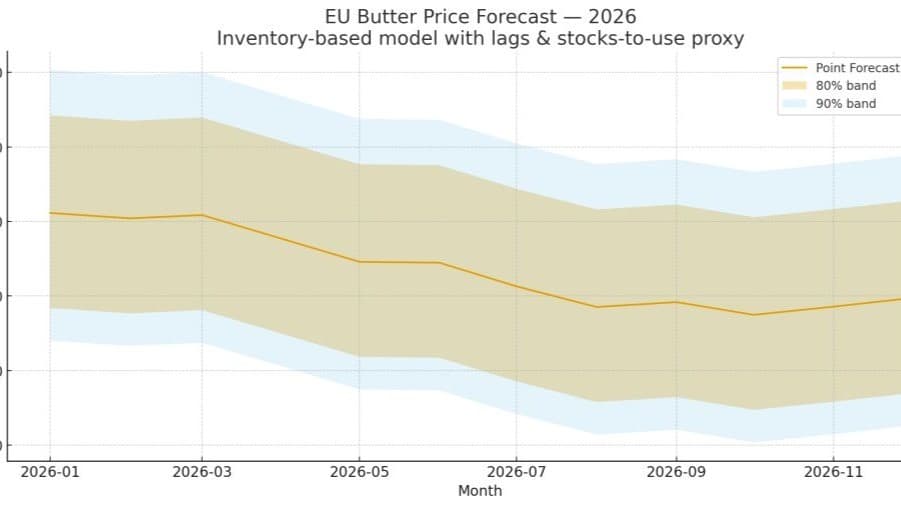
Summer Shopping or Summer Sale?
Last week was again a bit of a bearish week for the entire dairy industry. With cream prices under pressure and milk intake still strong, we keep seeing a market that has more supply than demand. Butter prices took another step lower, cheese prices cracked, and the powder market gave back a bit of its gains again.
The weekly report
Get it before it is anywhere else
Every market report, straight to your inbox the moment it is written. Butter, cheese, powder, liquids — pick what you actually trade.
Roughly weekly · Free · Unsubscribe any time