Break or Bounce?

The previous week proved challenging for even the most seasoned market analysts, with mixed signals and conflicting trends dominating the dairy sector. The butter market, after a period of relative stability, experienced a sharp downturn by Friday. In contrast, cheddar prices strengthened while other cheese varieties failed to gain significant momentum. Simultaneously, SMP (Skim Milk Powder) values plummeted to their lowest levels in September, even as the liquid components—SMC (Skimmed Milk Concentrate), cream, and raw milk—remained tight, trading at consistently elevated levels.
Despite fundamentally bullish underpinnings, the overall sentiment across most commodities we broker has shifted decisively toward a bearish outlook. This divergence between fundamentals and market behavior has led us to confront the reality that, even with our bullish stance, prevailing price trends force us to reassess. It’s a moment of reflection: are we too rigid in holding to our bullish forecast, or is the current market sentiment prematurely discounting the genuine supply constraints?
GDT's Role and the Chinese Influence: Upcoming Market Insights
The upcoming GDT (Global Dairy Trade) event on Tuesday could introduce new variables into this already complex picture. China’s dairy market dynamics continue to warrant close observation, paralleling our analysis of EU market trends. Recent reports suggest that the Chinese government is rolling out more stimulus packages for its dairy sector, driving up stock prices for major Chinese dairy corporations. While the rising consumption trend persists, there are indications of an overcorrection in domestic milk production, according to insights from some of our partners.
Their bullish outlook on Chinese dairy imports contrasts with the more conservative projections from our EU-based counterparts, hinting at potential opportunities or risks. Preliminary GDT expectations appear to indicate a tempered outcome, with SMP and WMP (Whole Milk Powder) futures suggesting a deceleration, while butter futures are pointing toward a softer market. Conversations with EU partners indicate an overall expected dip of 1-2% at the GDT, though our interactions with Asian traders suggest a more nuanced -1% to +1% outcome. It seems likely that Tuesday's results will either validate or challenge this mixed sentiment.
Liquids: Tight Markets Amid Volatility
The liquid dairy segment has exhibited heightened volatility, reflecting regional supply imbalances. In parts of Germany, sourcing raw milk has become increasingly difficult, driving prices beyond 60 cents. However, late-week reports revealed some sellers still holding unplaced volumes, a potential signal of softening demand. The cream market experienced similar fluctuations: while mid-week trading was tight with prices between €9,800 and €10,200, Friday’s excess availability forced last-minute price adjustments to the €9,500-€9,600 range. SMC remained more stable at around €2,450. These fluctuations suggest a potential peak in liquid prices, although average figures do not yet fully capture this underlying volatility.
Butter: A Surprising Reversal
The butter market’s trajectory last week defied conventional expectations. Early in the week, prices appeared softer, only to rebound midweek on the back of robust industrial demand. However, Friday saw a sudden influx of sellers, exposing the market's thinness, with prices plummeting by €250 in a single day as buyer interest evaporated.
This downward shift was unexpected, given that stable cream prices, strong retail demand, and high quotations across NL/DE/FR (Netherlands, Germany, and France) averaging €8,260 should, in theory, support a more resilient butter market. Moreover, considering Ireland's focus on cheddar production and reduced milk flows in Germany, Denmark, and the Netherlands, overproduction appears unlikely. Current cream prices above €9,600 imply that butter production in Poland should not sustainably drop below €8,000. Despite recent bearish signals, we maintain that butter prices should trend above €8,000 this year. Whether this stance is based on sound fundamentals or sheer obstinacy remains to be seen.
Current Butter Market Overview:
NL/DE/BE
| Period | Bid | Size | Offer | Size |
|---|---|---|---|---|
| October | €7,650.00 | 44 | €7,750.00 | 88 |
| Q4 | €7,500.00 | 132 | €7,800.00 | 132 |
| Q1 | €7,100.00 | 132 | €7,300.00 | 66 |
| Q2 | €6,700.00 | 132 | €7,000.00 | 66 |
Irish Butter
| Period | Bid | Size | Offer | Size |
|---|---|---|---|---|
| October | €7,600,0- | 44 | €7,700.00 | 88 |
| Q1 | €7,050.00 | 132 | €7,500.00 | Indicative |
Additionally, two trucks of Portuguese sweet cream are offered at €7,875 FCA NL.
Cheese: A Divergent Outlook
Cheese markets remain firm overall, though demand has notably shifted from Gouda, Edam, and Mozzarella toward Emmental, Maasdam, and Cheddar. Supply tightness for products like cheddar curd and mild Emmental has resulted in marked price increases. Given the long ripening periods, market participants face challenges in meeting this uptick in demand.
Conversely, the Gouda, Edam, and Mozzarella segments have seen quieter activity. Despite futures indicating significant backwardation into 2025, producers show little inclination to align with these projections, questioning the logic behind such pricing. One German producer emphasized that cheese prices don't exhibit the typical Q1 downturn observed in butter. Hence, if cheese prices stabilize above €5,000, milk and cream prices cannot soften, casting doubt on whether butter prices might see a substantial correction.
Cheese Market Overview:
Gouda
| Period | Bid | Size | Offer | Size |
|---|---|---|---|---|
| October | €4,700.00 | 44 | €4,950.00 | 44 |
| Q4 | €4,750.00 | 132 | €5,000.00 | 132 |
Mozzarella
| Period | Bid | Size | Offer | Size |
|---|---|---|---|---|
| October | €4,600.00 | 44 | €5,000.00 | 44 |
| Q4 | €4,650.00 | 132 | €4,875.00 | Indicative |
An offer for Irish White Mild cheese is available at €5,400 FCA NL.
Powders: A Bearish Sentiment Prevails
The powder market remains distinctly bearish, with ample stocks surfacing. WMP prices are under pressure, and demand from the feed sector has waned, leading to a €100/mt decline within the week. While the GDT results could potentially inject optimism, current signals from futures and the CME point to further downside risks.
| Product | Origin | Volume | Period | Price | Incoterm |
|---|---|---|---|---|---|
| FCMP | IRL/BE | 132 | Oct | 4350 | FCA NL |
| SWP | Spanish | 150 | Q4 | 950 | FCA SP |
| D40 | Spanish | 200 | December-March | 1100 | FCA SP |
| SWP | Polish | 100 | Oct | 1100 | FCA PL |
| SMP Codex | Belgium | 100 | Oct | 2425 | FCA NL |
| SMP Codex BB | French | 100 | Oct | 2450 | FCA NL |
We would have the following bids
| Product | Origin | Volume | Period | Price | Incoterm |
|---|---|---|---|---|---|
| FCMP | IRL/BE | 132 | Oct | 4100 | FCA NL |
| SMP Nonstand | EU15 | 100 | Oct | 2400 | DAP PL |
| SMP Codex | Belgium | 100 | Oct | 2300 | FCA NL |
| SMP Codex BB | French | 100 | Oct | 2300 | FCA NL |
Overall, the market feels heavier than it did a few weeks ago, when all signals were pointing to a more bullish Q4. In general, we agree with the bears that the top for most commodities is closer than the bottom. But perhaps it’s just our stubborn nature, or it's because we prefer to adopt a contrarian view of the market. But, with many partners turning bearish without any clear weaker underlying fundamentals, this sentiment feels risky. Low stocks, low milk production, short-covered end users, and traders already positioned for a weaker market are dangerous ingredients, especially given that Q4 still needs to start (on Tuesday). It feels too early for a break, but will October show us a bounce? Let's find out over the next 31 days.
More from the desk
Our Long View Before Our Long Break 
Our Long View Before Our Long Break
Last week the market found a bit of stability. After lower trades on cheese, the cheese market traded slowly up, although a real rally remains absent. Butter prices did dip a bit further, although at the start of this week we see some strength on the back end of the curve. And on powder, our bullish feeling just doesn't go away — and now we can find some confirmation in the market as well.
Dairy Carry Has a Shelf Life 
Dairy Carry Has a Shelf Life
Last week was bearish across the board — every product we broker leaned the wrong way. Powders lost more momentum, cheese slipped well below €3,000 for some products, and butter continues to impress with just how much keeps showing up. Supply, supply, supply.
Summer Shopping or Summer Sale? 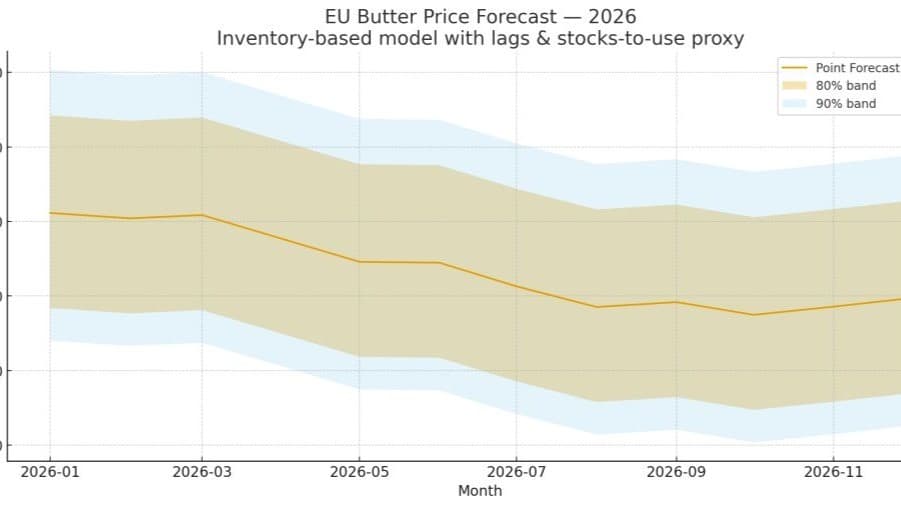
Summer Shopping or Summer Sale?
Last week was again a bit of a bearish week for the entire dairy industry. With cream prices under pressure and milk intake still strong, we keep seeing a market that has more supply than demand. Butter prices took another step lower, cheese prices cracked, and the powder market gave back a bit of its gains again.
The weekly report
Get it before it is anywhere else
Every market report, straight to your inbox the moment it is written. Butter, cheese, powder, liquids — pick what you actually trade.
Roughly weekly · Free · Unsubscribe any time