Be Aware of the Bear

The first two trading days of this week have been decisively bearish across the dairy market. The butter market alone has witnessed a sharp decline, with October prices falling over €500 and December futures tumbling more than €700. Q1 futures plummeted to €6,650, while Q2 futures experienced an even more pronounced drop. This abrupt downturn in butter has exerted downward pressure on cheese markets, with Q4 mozzarella futures now being offered as low as €4,400, down from nearly €5,000 just days earlier.
Frankly, these bearish moves have caught us off guard, and we are actively analyzing the potential driving forces behind this shift. In the short term, we still observe tightness in the liquids market, but for November and December, prices are loosening. It appears the market is contending with more milk supply than anticipated and weaker demand than hoped for. The question now is: how deep can this correction go? As of now, buyers are hesitant to step in and provide a price floor.
Unanticipated Market Dynamics: What’s Fueling the Sell-Off?
The scale and speed of this market correction suggest that few participants anticipated the move, leaving them unprepared and unable to adjust their positions swiftly. It seems producers may have overestimated the impact of factors like bluetongue disease and underestimated the effects of elevated prices. Although it's unclear whether actual consumption has declined, what’s evident is that orders from buyers have decreased. This could be driven either by a genuine drop in end-consumer demand or by retailers anticipating softer demand and thus maintaining lean inventories.
Faced with weaker near-term sales prospects, sellers are focusing on moving product in Q1. However, with end users also uncertain, they are encountering a wall of indecision. Most products we handle are displaying significant backwardation, leading to rapid devaluation of stocks. Holding onto inventory in hopes of better prices is becoming an increasingly costly strategy. Consequently, sellers are highly incentivized to offload nearby positions as prices for forward months trend downward. Conversely, buyers are motivated to stretch their existing stocks as much as possible, finding it more advantageous to delay purchases.
Navigating Volatile Markets: Caution Amid a Bearish Trend
In this volatile environment, traders need to be acutely aware of the risk of attempting to catch the market bottom too soon. However, it's worth remembering that the fundamental market conditions from three weeks ago have not entirely disappeared. Despite the roughly €1,000 drop in butter prices from their recent peak, this equates to about a 4-cent decline in the milk price. Expectations of milk prices exceeding 60 cents are unlikely to materialize, and it's questionable how much EU milk production will respond to the recent declines. Low butter stocks will take months to replenish, and with falling butter prices, the incentive to build inventory diminishes—traders might even be tempted to short-sell in such an environment. A similar rapid reversal is occurring in the cheese market, raising doubts about whether the strong demand we witnessed for months can be sustained if incentives continue to fade.
Our own bullish perspective may be causing us to focus on a potential market reversal. Admittedly, we find it difficult to accept being wrong, but wrong we have been. Our target prices for butter are approximately €1,000 higher than current market levels, and for cheese, we're off by around €600 from our forecasts. However, in our defense, we continue to observe relatively strong demand for spot milk, cream, and SMC. Conversations with producers seem to exist in a parallel universe—they report solid demand, no need to adjust their prices downward, and view the current market turbulence as purely a trader-driven phenomenon.
GDT Provides a Glimmer of Hope: Stronger than Expected
Amid the market's bearish undertones, the GDT auction offered a more positive outcome, ending with a 1.2% increase compared to the previous event, just 0.2% outside our forecast range. WMP demand remains robust, and cheddar demand, both in the EU and globally, continues to show strength. SMP prices traded slightly lower, but the effect was negligible. BMP prices showed resilience, while butter and AMF prices displayed some weakness; however, they ended stronger than anticipated, especially given recent EU market weakness. Considering the volume offered and New Zealand’s strong milk intake, international demand remains firm. Additionally, the weaker euro against the dollar could lend some support to EU SMP in light of this GDT event.
Butter Market: Dramatic Downturn Continues
As mentioned, the butter market has taken an exceptionally steep dive. With demand cooling and sellers accelerating their efforts, the market has been reaching new lows almost hourly. While we've witnessed numerous dramatic shifts over the years, this could be one of the most extreme yet. Sellers are fighting for the remaining bids, dragging the market down more aggressively than necessary. Given the underlying stock data, this could exacerbate supply challenges in 2025.
We aren't suggesting that the market shouldn't correct further. As long as buyers remain absent, the downward trend is likely to persist. However, the core issue of underproduction versus overconsumption in the EU butter market will only intensify if European buyers aren't prepared to pay a premium to build butter stocks.
In a recent discussion, one of our partners questioned whether the current market movements accurately reflect the broader EU fat market. We reiterated that the volumes we broker represent only a small segment of the market. He also highlighted that certain segments—those requiring specialized products like AMF for the chocolate industry, fresh butter, or fresh cream—are still facing high prices. Anyone capable of offering French cream DAP Western EU for Tuesday is encouraged to send us an offer.
Our butter markets have become extremely wide with sellers not dropping their prices as fast as the buyers drop their bids. Even with futures trading lower we are not able to offer much volumes close to EEX future levels.
Current Butter Market Overview:
NL/DE/BE
| Period | Bid | Size | Offer | Size |
|---|---|---|---|---|
| October | €6950 | 44 | €7350 | 88 |
| Q4 | €6850 | 132 | €7400 | 132 |
| Q1 | €6650 | 132 | €7000 | 66 |
| Q2 | €6300 | 132 | €7000 | 66 |
Irish Butter
| Period | Bid | Size | Offer | Size |
|---|---|---|---|---|
| October | €7000 | 44 | €7500 | 88 |
| Q1 | €6350 | 132 | €7250 | Indicative |
Additionally, two trucks of Portuguese sweet cream are offered at €7,875 FCA NL.
Cheese: Mirroring the Butter Market’s Decline
The cheese market continues to follow in the footsteps of the butter market. Where butter previously lifted cheese prices, the rapid decline in butter is now exerting downward pressure on cheese. The sudden selling pressure is surprising, especially given that stocks appeared tight just days ago. Again, we find it difficult to see how lower butter prices in Q1 will contribute to increased cheese availability in Q4. Nevertheless, more offers are surfacing on EEX futures, prompting some of our partners to search for bids in the physical market.
Futures prices are now being offered nearly 10% below levels from a week ago without finding buyers, suggesting further price pressure ahead. Although we may be mistaken, short-selling in such a tight cheese market seems even riskier than in butter. We anticipate a thin market in the coming days. The below offers and bids are only indications as both our buyers and sellers are uncertain in their quest for a market deal.
Cheese Market Overview:
Gouda
| Period | Bid | Size | Offer | Size |
|---|---|---|---|---|
| October | €4200 | 44 | €4650 | 44 |
| Q4 | €4150 | 132 | €4650 | 132 |
Mozzarella
| Period | Bid | Size | Offer | Size |
|---|---|---|---|---|
| October | €4100 | 44 | €4650 | 44 |
| Nov-Dec | €4200 | 132 | €4600 | Indicative |
Powders: Can GDT Establish a Floor?
The powder market feels decidedly heavy, and although other commodities are declining more rapidly, powders seem to be fundamentally the weakest. The absence of demand isn’t a recent phenomenon; it has been evident over the past 18 months. While we anticipate buyers returning to butter and cheese soon, the same cannot be said for SMP. However, the GDT results and a weaker euro might provide some much-needed support and potentially form a price floor.
WMP prices on the GDT found some support, but EU WMP remains significantly more expensive. There’s noticeable pressure on WMP and FCMP, but sellers are less aggressive than their counterparts in butter and cheese.
We expect to have a similar market as to the days before
| Product | Origin | Volume | Period | Price | Incoterm |
|---|---|---|---|---|---|
| FCMP | IRL/BE | 132 | Oct | 4200 | FCA NL |
| SWP | Spanish | 150 | Q4 | 935 | FCA SP |
| D40 | Spanish | 200 | December-March | 1050 | FCA SP |
| SWP | Polish | 100 | Oct | 1100 | FCA PL |
| SMP Codex | Belgium | 100 | Oct | 2425 | FCA NL |
| SMP Codex BB | French | 100 | Oct | 2450 | FCA NL |
We would have the following bids
| Product | Origin | Volume | Period | Price | Incoterm |
|---|---|---|---|---|---|
| FCMP | IRL/BE | 132 | Oct | 4000 | FCA NL |
| SMP Nonstand | EU15 | 100 | Oct | 2400 | DAP PL |
| SMP Codex | Belgium | 100 | Oct | 2300 | FCA NL |
| SMP Codex BB | French | 100 | Oct | 2350 | FCA NL |
The dairy market is currently facing an unprecedented level of volatility, with recent dramatic declines in butter and cheese prices defying the bullish expectations we held just weeks ago. While the bearish sentiment has taken hold across most commodities, the fundamentals haven't shifted as drastically as the market suggests. It’s clear that demand uncertainties, speculative trading behaviors, and shifting supply dynamics are playing significant roles in driving the current trends.
For those of us navigating these turbulent waters, the coming weeks will be pivotal in determining whether this correction is a short-term overreaction or a deeper recalibration of market fundamentals. The recent GDT results offer a glimmer of hope, but it remains to be seen if this positivity can translate into a more stable market environment. As always, those in the dairy sector must remain vigilant, adaptable, and ready to act when market conditions inevitably shift once again.
More from the desk
Our Long View Before Our Long Break 
Our Long View Before Our Long Break
Last week the market found a bit of stability. After lower trades on cheese, the cheese market traded slowly up, although a real rally remains absent. Butter prices did dip a bit further, although at the start of this week we see some strength on the back end of the curve. And on powder, our bullish feeling just doesn't go away — and now we can find some confirmation in the market as well.
Dairy Carry Has a Shelf Life 
Dairy Carry Has a Shelf Life
Last week was bearish across the board — every product we broker leaned the wrong way. Powders lost more momentum, cheese slipped well below €3,000 for some products, and butter continues to impress with just how much keeps showing up. Supply, supply, supply.
Summer Shopping or Summer Sale? 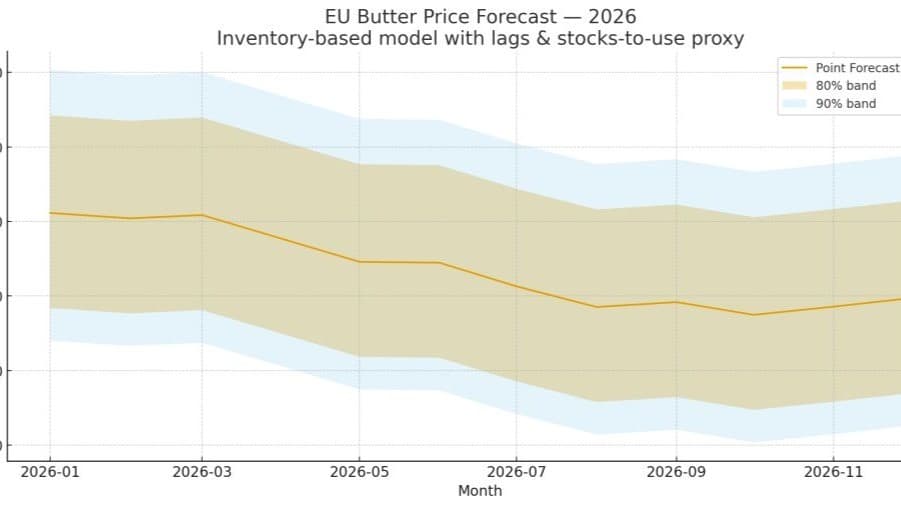
Summer Shopping or Summer Sale?
Last week was again a bit of a bearish week for the entire dairy industry. With cream prices under pressure and milk intake still strong, we keep seeing a market that has more supply than demand. Butter prices took another step lower, cheese prices cracked, and the powder market gave back a bit of its gains again.
The weekly report
Get it before it is anywhere else
Every market report, straight to your inbox the moment it is written. Butter, cheese, powder, liquids — pick what you actually trade.
Roughly weekly · Free · Unsubscribe any time