Be Ready for a Boring Break

We are currently facing challenges in updating the dairy commodity markets due to indecisive partners and uncertain price directions. The likelihood of prices rising in the second half of this year for most seems just as significant as the likelihood of them falling. Partners are postponing their decisions without incurring costs, as prices have been stable. Buyers are pleased to avoid paying premiums for future products, while sellers continue to receive steady prices for nearby deliveries. As long as this strategy remains effective for most partners, the market will likely continue to trend sideways. Traders are hoping for more volatility, but with the summer break approaching, it is doubtful this will change. The sideways trend is expected to last until mid-August, with market fundamentals dictating prices in Q4.
Key fundamentals to watch for Q4 commodity prices include:
Milk Production: Higher vs. Last Year, but Compare to the 5-Year Average!
Most partners are monitoring milk production growth in the EU. After a small decline last year, most countries are expected to show year-over-year gains. However, it's advisable to compare milk intake against the 5-year average, not just last year. For example, France had an exceptionally poor year in 2023. While there's a good recovery compared to 2023, French milk collections are still below the 5-year average. If the EU can increase milk output relative to the long-term average, there might be more milk available for commodities like butter, SMP, and cheese.
Exports: Is the EU the Cheapest?
Another aspect to watch is the EU export business. Currently, the EU has a price advantage over New Zealand for butter and SMP. The EU is also reclaiming some market share for Mozzarella from the US. The second half of the year is usually strong for EU butter exports. With low unsold stock levels and a tense market, the question is whether EU partners can meet foreign demand. If the EU secures significant export sales in the next 8-10 weeks, stock levels for most products will be very low before the high-demand season in the EU.
Valorization: Cheese vs. Butter and SMP
Worldwide cheese demand and production capacity are growing. While demand for fats remains strong, weak protein demand has tipped valorization in favor of cheese production in most countries. We see this back in the production numbers, cheese output has been growing world wide, while butter production has been slowing down. Producers prefer to maximize cheese plant utilization. In the US, the trend some say is slightly different, but in the EU, cheese remains more profitable than butter and SMP. If this balance continues through summer, we expect weak SMP and butter production numbers to persist. The question is whether increased milk production will compensate for the production deficit, especially for butter.
GFD Outlooks: Butter
Regular readers know we are not shy about sharing our commodity market opinions. However, at this stage, predicting market direction is more guesswork than well-founded argument. Our best guess is that butter prices will reach new highs due to a significant production deficit. The current backwardation in Q4 versus Q3 does not incentivize stockpiling, so we expect less product in storage by summer's end. The market will need fresh butter, and high cream prices will likely push butter prices even higher. Additionally, many partners are hedging with futures instead of physical products, meaning they will need to convert paper positions to physical in Q4 adding to the postponed physical purchases.
Cheese Market Outlook
The cheese market appears balanced, with supply and demand in line. Only a significant rise in butter prices might divert milk from cheese production, exerting upward price pressure. If this doesn't happen, seasonal demand will likely push prices up in September and Q4. There are bullish signals for cheese, as current market prices make Gouda and Mozzarella exports attractive to Southeast Asia. We expect these buyers to purchase during the quiet summer months in the EU, potentially tightening the Q4 market.
Powder Market Outlook
The powder market remains volatile, with bullish supply signals but weak demand from China. Despite low stocks and production, weak Chinese demand dampens the outlook. We expect a scenario similar to last year, with a slight build-up to Q4 as EU producers avoid selling forward too much. However, with strong competition from New Zealand and the US in Q4, EU prices will likely hover between €2350 and €2500.
More from the desk
Our Long View Before Our Long Break 
Our Long View Before Our Long Break
Last week the market found a bit of stability. After lower trades on cheese, the cheese market traded slowly up, although a real rally remains absent. Butter prices did dip a bit further, although at the start of this week we see some strength on the back end of the curve. And on powder, our bullish feeling just doesn't go away — and now we can find some confirmation in the market as well.
Dairy Carry Has a Shelf Life 
Dairy Carry Has a Shelf Life
Last week was bearish across the board — every product we broker leaned the wrong way. Powders lost more momentum, cheese slipped well below €3,000 for some products, and butter continues to impress with just how much keeps showing up. Supply, supply, supply.
Summer Shopping or Summer Sale? 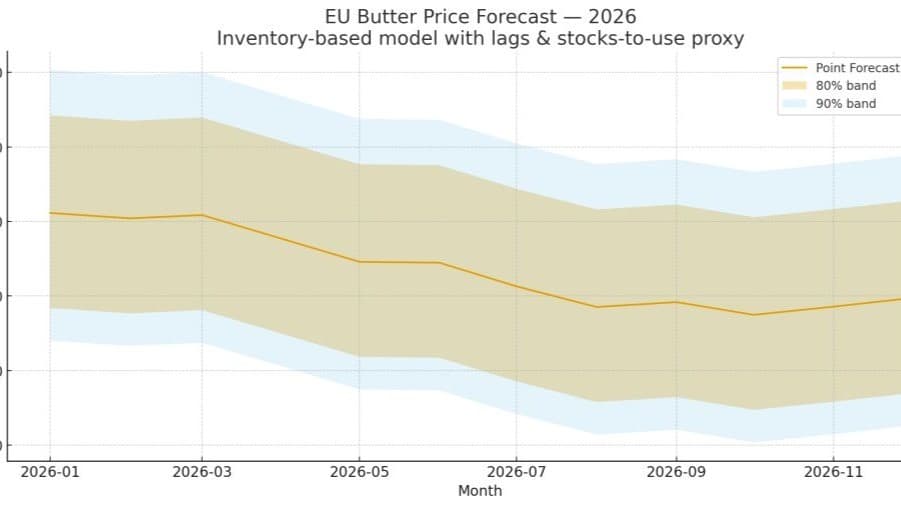
Summer Shopping or Summer Sale?
Last week was again a bit of a bearish week for the entire dairy industry. With cream prices under pressure and milk intake still strong, we keep seeing a market that has more supply than demand. Butter prices took another step lower, cheese prices cracked, and the powder market gave back a bit of its gains again.
The weekly report
Get it before it is anywhere else
Every market report, straight to your inbox the moment it is written. Butter, cheese, powder, liquids — pick what you actually trade.
Roughly weekly · Free · Unsubscribe any time