Mirrored Markets: The Five Stages of a Seller’s Grief

The first two trading days of this week have been very active—or should we say, yesterday was active. With over 1,000 MT of butter brokered, selling pressure remains evident. We are also seeing increased pressure on skimmed milk powder and cheese, as all commodities face higher production while demand remains elusive. For those accusing us of only writing bearish updates, let’s take a short trip down memory lane. Exactly one year ago, on August 27th, we published an article titled “The Five Phases of a Buyer’s Grief.” Feel free to revisit it.
A year ago, we had just returned from the summer break and found ourselves in fierce debates with buyers, who accused us of being too bullish on the market. The trader market had just broken the €8,000 per MT level, cream prices traded well over € 10.000,-, and end users across the EU were under significant financial stress. Buying spot loads well above budget meant that some companies required board approval for every purchase, as each truckload cost more than €50,000.
Yesterday, the market dropped below €6,500 for the first time in over 16 months, with sellers and producers now experiencing the same stages of market stress that buyers went through last year. Because markets don’t move in straight lines, and neither do emotions. If anything, trading dairy feels like running the Kübler-Ross grief cycle on loop — every time prices shift, the industry marches through the same emotional script. Let’s walk through it.
Denial: “Buyers haven’t covered yet, they’ll come back.”
A market turning officially bearish always starts the same. The confidence that the lull is temporary, that milk collections might dip once the summer flush passes, that the weather isn’t perfect, that surely Christmas demand will swoop in like a white knight, we all know the excuses. In denial, there’s always another reason why prices should hold.
But denial has a short shelf life. Reality keeps showing up in the numbers, and eventually, the “buyers will return” story runs out of oxygen. Coming from butter prices in Q4 well above € 7250,- some say the denial period lasted quite long. Producers who refused to sell well over € 7250 lost almost € 750,- per mt of value. That's a hard reality to face. We feel the market has lived through this phase during the summer months.
And when patience collapses, denial hardens into discontent and resentment — welcome to Anger.
Anger: “It’s the traders’ fault.”
This is the current phase the market is in. Now the fingers come out. It's not the seller's misreading of the market; it's traders who are pushing the market down. Other producers are panicking and falling for the trap set by the buyers. And the finger is also back to us, because we at Get Fair Dairy are being far too bearish in our updates. Exports? They’re bound to pick up in the second half of the year. Production? Overestimated. Stocks? Non-existent. And with every argument we get, the volume on the phone turns louder....
A quick side step; We could not find our son when we were on our holiday this year. He was hiding, and only when we started screaming he came running out of his hiding place. But shouting doesn’t make demand appear and never attracts buyers. And after the outrage burns through its fuel, anger doesn’t resolve anything.
And when yelling stops echoing, the tone shifts to bargaining.
Bargaining: “Maybe we can work something out…”
Some of the sellers are coming to this phase as we speak. This is the stage of hopeful haggling. “If we can get a sharp price on Q1, you’ll pay up in Q4, right?” “Can we just have the bid from last week back?” “What if we tie it to an index? What if we trade on goodwill — we helped you last year, now it’s your turn.”
It’s the language of compromise, of deals dangled just to stop the slide. But bargaining rarely bends the fundamentals. And when even compromise doesn’t work…
hope gives way to heaviness. Depression arrives.
Depression: “There’s no fun in this market.”
The mood turns dark. If demand doesn’t return, farmers will pay. Milk prices will sink. Supply will shrink. Sellers mutter, “We’ll sell below €5,000 if it breaks — but we won’t front-run this market.” Conversations lose their spark. The energy is gone. We remember these conversations from last year with our buyers. It's the phase we dislike most, as we can feel the real frustration and honest disbelief.
It’s the stage where the jokes stop, where every call sounds the same.
And yet, out of the gloom comes the quietest stage of all: Acceptance.
Acceptance: “It is what it is.”
Finally, reality lands. The market is the market. And let's face it, a market the size of the European dairy complex is not steered by a group of participants, it gets it direction from the balance between supply and demand. We don’t make it, we follow it. If cheese prices drops to €3500, then fine — we’ll sell at market value. If prices bounce, all the better. But the fight is gone. The market is no longer something to resist; it’s just something to work with.
Acceptance isn’t joy. It’s clarity. And once clarity sets in, positions are adjusted, risk is managed, and — most importantly — everyone is ready for the next cycle of grief to begin.
Closing Note
The dairy market doesn’t hand out happy endings, but it does hand out lessons. And the stages of grief? They’re less about psychology and more about survival. Because in this business, denial, anger, bargaining, depression, and acceptance aren’t abstract concepts — they’re daily practice.
Let's just focus on the current bids and offers
Butter: Tight spreads
Q4: NL/DE/BE bid/ask spread is € 6500 - € 6600 both for 2 trucks per month on the buy side, and 6 a month on the sell side.
Q4: Irish Lactic bid at € 6400,- fca Ireland and offered at € 6575 fca Ireland
We currently hold a sizable bid from one of our regular partners for 900 MT of German butter at €6,250/MT for Q4, should one of the larger sellers wish to place a bigger parcel in a single transaction.
Q1: NL/DE/BE bids ask spread is € 6375 - € 6400 for both 2 trucks per month
Q1: Polish lactic bid - ask spread is € 6300 - € 6400 for both 2 trucks per month
Q2: NL/DE/BE bid for 2 trucks per month € 6375
Cheese: Looking for Bids
In the cheese market, we are seeing for the first time that producers are proactively looking to secure volumes for Q4 and Q1. Buyers, however, remain comfortable sourcing on a monthly basis and see little reason to change that strategy. With current increases in milk intake, they see no justification for committing at today’s prices six months ahead. Only if the market offers a firm discount do we expect buyers to engage.
September: Mozzarella NL/DE/BE bid € 3700 DAP NL and offered € 3850
Q4: Gouda Slicing NL/DE origin offered € 3900 and bid at € 3700
Q4: Edam Slicing NL/DE origin offered at € 3850
Q1: Gouda Slicing NL/DE origin offered at € 3850
More from the desk
Our Long View Before Our Long Break 
Our Long View Before Our Long Break
Last week the market found a bit of stability. After lower trades on cheese, the cheese market traded slowly up, although a real rally remains absent. Butter prices did dip a bit further, although at the start of this week we see some strength on the back end of the curve. And on powder, our bullish feeling just doesn't go away — and now we can find some confirmation in the market as well.
Dairy Carry Has a Shelf Life 
Dairy Carry Has a Shelf Life
Last week was bearish across the board — every product we broker leaned the wrong way. Powders lost more momentum, cheese slipped well below €3,000 for some products, and butter continues to impress with just how much keeps showing up. Supply, supply, supply.
Summer Shopping or Summer Sale? 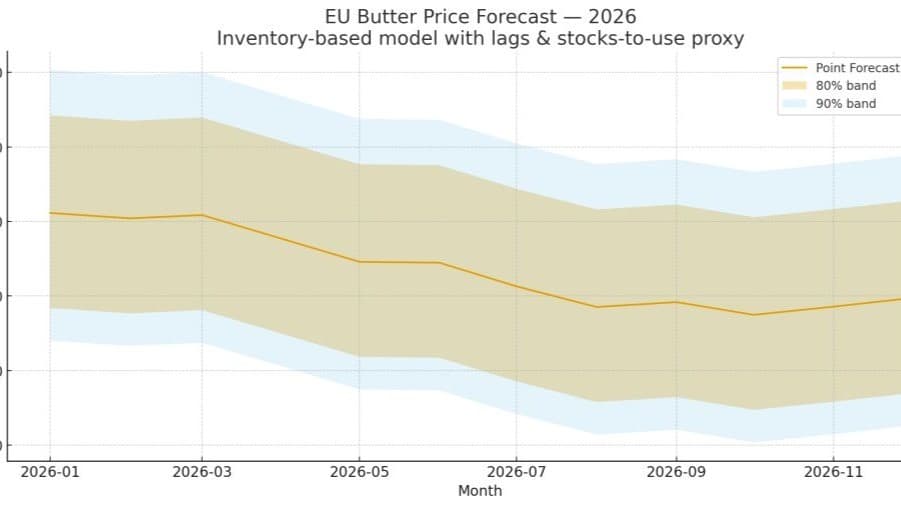
Summer Shopping or Summer Sale?
Last week was again a bit of a bearish week for the entire dairy industry. With cream prices under pressure and milk intake still strong, we keep seeing a market that has more supply than demand. Butter prices took another step lower, cheese prices cracked, and the powder market gave back a bit of its gains again.
The weekly report
Get it before it is anywhere else
Every market report, straight to your inbox the moment it is written. Butter, cheese, powder, liquids — pick what you actually trade.
Roughly weekly · Free · Unsubscribe any time