How High Prices can create Higher Prices

Yesterday was a very active day in the market. While prices did not change significantly, a substantial amount of product changed hands, with nearly 1,900mt brokered in just one day. This makes it one of the most active Augusts in recent history. The powder market was particularly dynamic, with steadily rising prices for SMP and WMP. In contrast, the butter and cheese markets saw more discussions than actual trades. At these high prices, the risk of making a wrong move is significant, and many of our partners are understandably cautious. While we wouldn't advise anyone to take undue risks, the current lack of risk-taking due to these elevated prices may actually push prices even higher in the coming weeks.
This may sound counterintuitive since we all know that "high prices are the best cure for high prices." However, as we venture into uncharted territory, the fear of these high levels is driving everyone to act similarly, and this collective hesitation appears to be sustaining — or even elevating — prices.
Producers Keep Inventories Low
For years, holding stock was relatively inexpensive, but with rising interest rates, the financial incentive to keep inventory is diminishing. Capital that could be used for revenue-generating activities is tied up in stocks, making it less attractive for end users, traders, and producers alike. This dynamic varies by product. For example, when butter was priced at €5,000, holding stock was already unattractive. We observed that producers kept their warehouses mostly empty over the summer as butter prices rose to €6,000, and now we are hitting €7,000 and even €8,000 levels. The fear of a price correction is prompting producers to sell every kilo they have rather than risk holding inventory.
With cheese prices climbing rapidly, we might have expected producers to hold some stocks for later in the year, but they seem to be managing cheese inventories much like butter. Stocks are extremely low, partly due to limited concerns over milk supply. The spot demand and availability for some products clearly show this, with producers uniformly reporting, "We don't have any stocks!"
Only in SMP does the inventory situation appear somewhat healthier. However, producers are not adding to their stocks at this moment. High SMC prices and a relatively flat forward curve for SMP on the EEX do not justify production plus storage costs. Interestingly, in the SMP market, the fear of high prices has not yet taken hold.
Buyers: Buying Hand-to-Mouth
Buyers, having faced high butter prices for some time, are employing a strict hand-to-mouth buying strategy. One purchasing manager, whom we advised to purchase some Q4 stock at €6,500, remarked, "Wouter, we can always buy expensive." This same sentiment was echoed today (with permission to share the quote). The fear of buying at the peak of the market is keeping buyers from purchasing anything beyond their immediate needs. However, this strategy means the butter market continues to find a spot buyer (or a lot of them) each week. Demand remains steady, and with declining production due to seasonally lower milk volumes, the market is tightening week by week.
In the cheese market, buyers have maintained a month-to-month purchasing strategy for some time. While supply and demand seemed balanced for the first eight months of the year, that balance now feels disrupted. Producers are revising their milk intake forecasts, and there is evident fear of higher prices. End users are concerned that cheese buyers will strongly resist these price increases; a 20-25% jump in just one week is not being accepted easily. At the same time, some partners, particularly traders, are de-risking their positions due to concerns that prices could return to 2022 levels. With no offers available from producers, futures markets are becoming the primary source of trades. The high volume of trades on futures, without corresponding activity in the physical market, is driving prices higher. As we see and hear no counter trades on the physical market, it feels like some demand risk is taken out by buying a financial product, but the physical product still needs to be purchased, so the demand side of this market is just as big, only now at a much higher level.
SMP buyers, however, have a different perspective. The supply and demand balance for powders still seems healthy, and most buyers believe they can secure nearby products if needed. It seems they all test their strategy once or twice month, after they go dormant again. We do see a group of buyers concerned that rising prices for cheese and butter may push more buyers into the powder market derisk their exposure to uncovered demand, especially as SMC prices trend higher. While many of our partners remain cautious about powders, the fear of rising prices in other commodities could spill over into the powder market as well.
Traders: Fear of Missing the Top
Traders, often known as a fearless and talented group adept at navigating uncertain markets, also seem to be losing some confidence. The market has been challenging to read in recent months, and our conversations indicate that some have made small missteps throughout the year.
In the butter market, most traders are carrying almost no stock. As mentioned, financing is tight and expensive, and there have been significant challenges in securing volumes for future periods. Irish producers have been very cautious in their forecasts, making offered prices for Q4 unattractive. Producers in the Netherlands, Germany, and Belgium have also kept sales low, while those in Poland tend to sell on a week-to-week basis. Additionally, they struggled to find end users willing to pay prices well above €6,500, so most traders avoided taking on large volumes. The fear of prices dropping from their highs kept them from building substantial long positions. As a result, we see a market with nearly no unsold long positions — the shortest we have ever observed.
For cheese, traders have had little chance to secure volumes further out. Producers have maintained a month-to-month selling approach, and end users have been unwilling to pay a risk premium. Traders who took long positions earlier in the year have often been forced to sell at a loss, as markets failed to break out of their narrow trading range for several months. Last week, most traders tried to secure as much volume as they could, but with the current high prices for cheese, the fear of buying at the top of the market pops up again. With no sales outlet at these elevated levels, most traders hold only small long positions that could quickly vanish.
On the powder market, however, traders seem to be carrying a bit more stock. They do not fear high prices; they anticipate them. Many powder traders have held long positions for months, believing that the supply and demand balance in the EU favors higher prices. This anticipation encourages them to maintain stocks. The fear of missing the lowest prices is causing almost everyone to push their safety stocks forward, awaiting the market's eventual rally.
In Summary:
Producers fear the higher cost of holding stock and the possibility of declining demand, leading them to keep minimal inventories. It appears that producers are carrying the lowest stock levels we've seen in years. At the same time, end users have adopted a hand-to-mouth strategy in butter and a month-to-month approach in cheese, which is now beginning to create some strain. End users seem to be the shortest covered we've ever seen, particularly in butter and cheese. Traders have also faced difficulties securing volumes for Q4 due to a lack of offers or the high risk associated with those available. As a result, most traders are maintaining very balanced positions, with only a few long positions. Usually, we would expect them to carry more stocks for Q4. The fear of prices falling back from their highs is causing all market participants to maintain very tight or short positions. This might be advantageous if prices begin to decline, but until then, it is likely to exert upward pressure on prices.
Currently, we see the butter and cheese markets as the tightest they've been in recent years. Only the SMP market appears to have some stock and long positions, but even those are not significant. We suspect that the current lack of fear about higher prices in the powder market may cause it to rally further, and we wouldn't be surprised to see a 10% increase in powder prices in the next few weeks.
More from the desk
Our Long View Before Our Long Break 
Our Long View Before Our Long Break
Last week the market found a bit of stability. After lower trades on cheese, the cheese market traded slowly up, although a real rally remains absent. Butter prices did dip a bit further, although at the start of this week we see some strength on the back end of the curve. And on powder, our bullish feeling just doesn't go away — and now we can find some confirmation in the market as well.
Dairy Carry Has a Shelf Life 
Dairy Carry Has a Shelf Life
Last week was bearish across the board — every product we broker leaned the wrong way. Powders lost more momentum, cheese slipped well below €3,000 for some products, and butter continues to impress with just how much keeps showing up. Supply, supply, supply.
Summer Shopping or Summer Sale? 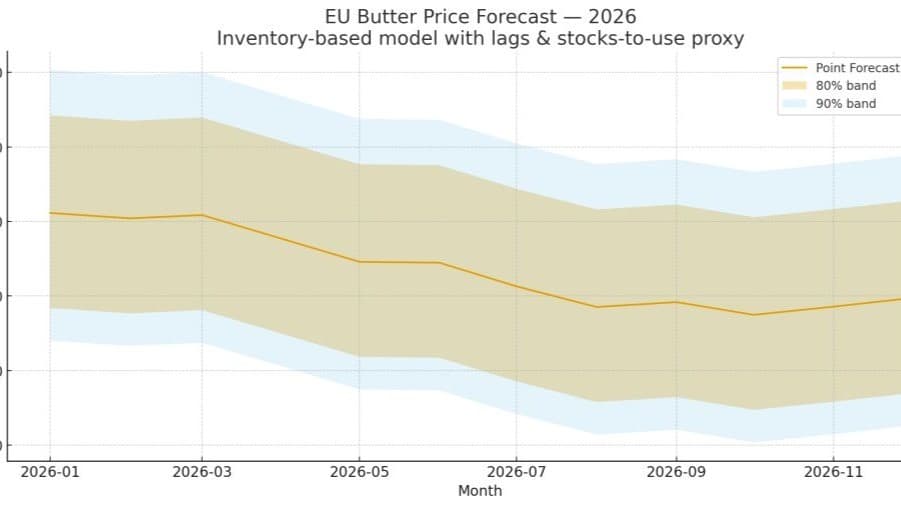
Summer Shopping or Summer Sale?
Last week was again a bit of a bearish week for the entire dairy industry. With cream prices under pressure and milk intake still strong, we keep seeing a market that has more supply than demand. Butter prices took another step lower, cheese prices cracked, and the powder market gave back a bit of its gains again.
The weekly report
Get it before it is anywhere else
Every market report, straight to your inbox the moment it is written. Butter, cheese, powder, liquids — pick what you actually trade.
Roughly weekly · Free · Unsubscribe any time